
48th annual American Indian Council Powwow celebrates unity
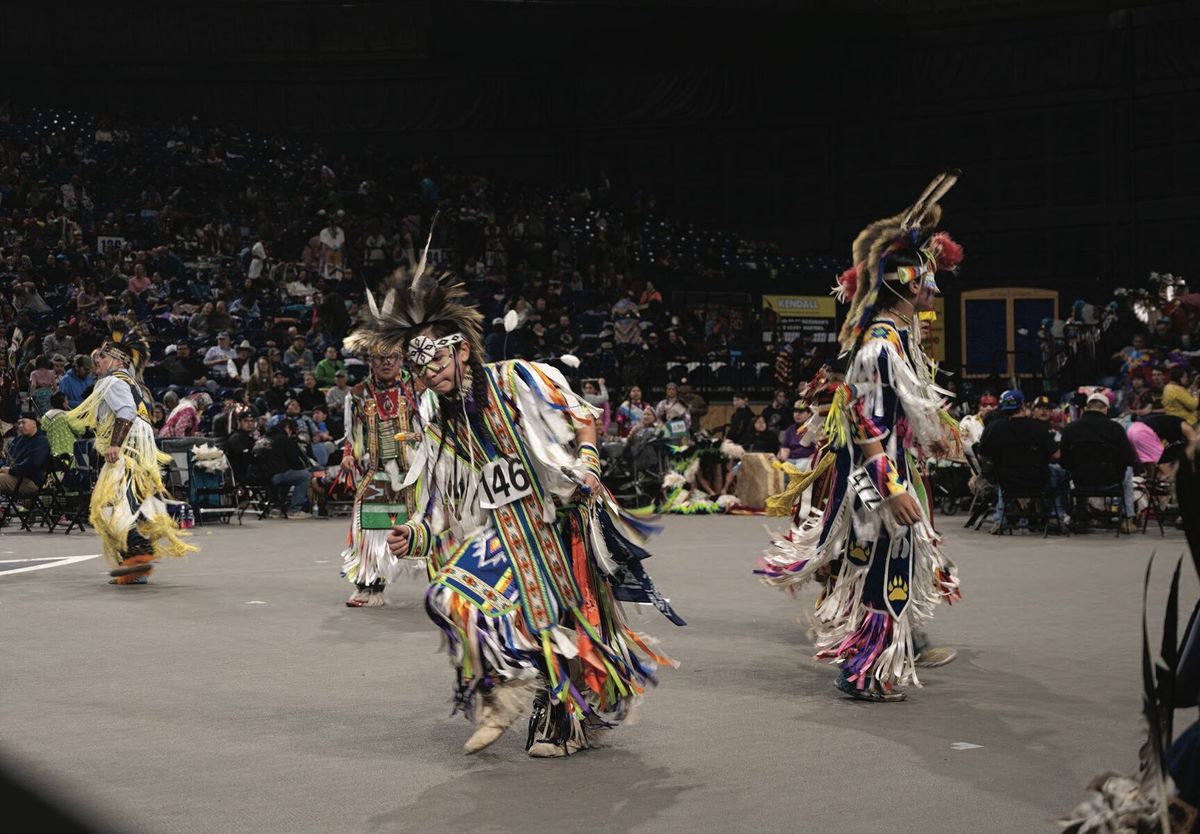
In the blue bleachers of the Brick Breeden Fieldhouse, women lovingly braided their daughters' hair. Some used otter skin hair ties to secure the braids, while others sewed finishing touches on beaded dresses with needle and thread. Men fastened headdresses, some comprised of intricate beading, while others were adorned with deer or otter fur and most featured eagle feathers attached to the top of the headpiece. Through this simple yet meaningful ritual of communal dressing, a profound bond with the community was evident.
The 48th annual American Indian Council (AIC) Powwow kicked off on Friday, Mar. 29 at 6 p.m. and went through Saturday. Powwows are a celebration of Indigenous culture, where community members from various tribes and nations gather to dance, sing and honor traditions. The celebrations often feature dance and drum circle competitions, royalty pageants and a variety of cultural cuisine.
The event was put on by students and faculty in the AIC, who worked diligently to coordinate dancers, singers, vendors and community members. Treasurer for the council, freshman Tracee Burland, explained what the Powwow means to her.
“I am the treasurer for the [AIC],” Burland said. “It's been an amazing journey. I am Salish and Kootenai. My father is adopted, so I never really grew up with my heritage until I moved here. I am still learning and I am loving every experience. Getting to do this with my best friends is [the highlight].”
On Friday, the first session began after dancer and drum competition registration. At 6 p.m., the grand entry commenced with a blessing of the arena and an opening prayer read by an elder in the community. Following the prayer, all dancers prepared for the “Victory Song” and “Flag Song.” An elder in the community entered the dance circle first, carrying an Eagle Staff. Honored veterans followed, holding the American and Canadian flags. AIC students carried various state and tribal flags as title holders from tribal pageants danced alongside the beginning of the procession. Then, all registered dancers joined in order of their dance categories. After the grand entry was completed, the competitions began.
Zenaida Arroyo and Daniel Scholfield heard about the Powwow held in Bozeman from word of mouth and Facebook. The duo traveled from California to compete in dance and connect with members of their community.
“My dance is called the Jingle Dress dance,” Arroyo said. “The dance is a healing dance. The cones on my dress provide healing for those who need it. It comes from [the] Ojibwa people, around the Great Lakes area. I am from the Ojibwa people, and I have been dancing it since I could walk. My family all dances this dance.”
The Jingle Dress dance is identified by the rolled metal cones sewed onto the skirt, often created from chewing tobacco lids. The dance features light footwork and a gentle, graceful sway to the beat of the drum groups. The women often hold and raise a feather fan in salute to the drum.
Similarly, Scholfield said he grew up dancing in his specific style of traditional dance and resonates with the history behind the category.
“Men's fancy dance originated from Oklahoma, from the Punca people,” Scholfield said. “It began in the Wild West shows. The dance is based on a horse galloping, which is why we wear the angora furs on the bottoms. It was originally in Buffalo Bill shows. My family dances in this category, I grew up with it. I love it, and you have to be really athletic to do it.”
In the stands, Osamuskwasis Roan, who is from Alberta, secured the final touches to her dress while waiting for the women’s Jingle Dress competition to begin. The top of her teal dress featured various floral patterns, with the jingles sewn in horizontal rows on the bottom. She wore beaded pinkish-red strawberry earrings.
“I designed my dress last year,” Roan said. “Last year, I was going through health problems, so I wanted to make the dress to heal myself as I dance. It is a representation of myself and my family. All the designs on my dress are Cree florals. [Cree women] wear strawberries to represent womanhood.”
On the arena floor, MSU junior Ryan Old Crow watched dancers with fellow drum circle teammates as they waited for their turn to play.
“A drum circle is a very sacred space for men,” Old Crow said. “We sing our songs for dancers. I grew up around [powwows], my brother sings and he is the one who introduced [me to] it.”
According to Old Crow, the MSU Bobcat Singers group took a brief hiatus but has been revived this year by the new council members.
“We weren't good at all when we first started,” Old Crow said. “We have been practicing consistently over the last year. [The most challenging part] is not losing your voice. When you sing with your throat, you lose your voice. You have to learn to sing with your stomach and your diaphragm.”
To the west of the dance area, various vendors set up stands to sell handmade artwork. MSU senior Kayla Kujaczynski is an artist and enrolled member in the Chippewa-Cree tribe. She drew the artwork for the 2024 Powwow poster and set up a pop-up shop to sell her art with her mom, Stefanie.
“I primarily do ledger art,” Kujaczynski said. “I do my best to capture Indigenous beauty and try to honor my people through my work. Art is what I feel connects me best to my people. It helps me express myself and my Indigenous identity to people who may not be familiar with Indigenous people.”
Kujaczynski and her mom run a shop through Etsy called Twisted Feathers Shop, where they sell stickers, clothing and Kujaczynski’s ledger art.
Alongside booths showcasing Indigenous artists, numerous organizations who collaborate with Native communities establish informational stalls throughout the arena. Some included MT 988, Western Native Voices — an organization that advocates for Native peoples to register to vote — and the Helena Indian Alliance — a community health center based out of Helena.
Next to the announcer stage, Indigenous Peoples’ Day Montana sold t-shirts, hats and artwork. The Montana-based initiative focuses on changing Columbus Day to better honor Native peoples. Additionally, the booth offered a sign-up sheet for a developing Women’s Self Defense Workshop, put together by the Fierce Women Warrior’s Society.
The Fierce Women Warrior’s Society is a non-profit established in 2019 by a multi-generational group of Native women, who aimed to combat rising statistics of missing and murdered Indigenous women in Montana.
“It’s about raising awareness for domestic violence,” member Marsha Small said. “It encourages us to heal and move forward.”
The group's current projects focus on the prevention of violence against Native women, offering resources and support to those who seek it. To donate or to find information about the self-defense workshops, visit www.thefiercewomenwarriorsociety.com.
“Know your culture,” Small said. “But learn from others as well.”
Comments ()