
A lesson in human connection with the Intermountain Opera Bozeman
The smell of burning white sage filled the Community Room of American Indian Hall on Monday, March 4. Soprano Sage DiPalma performed a smudging ritual to cleanse the space before the preview performance of the Wheels of Harmony school tour, run by Intermountain Opera Bozeman.
The Wheels of Harmony tour runs through March, traveling to K-12 schools around the state. DiPalma’s heritage — part Cherokee and Italian — sets her up perfectly to sing classic Choctaw, Lakota and Cherokee songs as well as teach Lakota phrases alongside pianist and composer J. Cruise Berry, a member of the Chickasaw nation. Later in the tour they will be joined by baritone Mark Billy, who is Choctaw.
During the preview performance on March 4, DiPalma and Berry went through the program for their school tour, doing a call-and-response performance with the audience. Attendees consisted of older community members, and MSU staff members, who were asked to define various musical terms and what emotions they thought could be evoked in operatic performances.
DiPalma began what she called the “four directions song” where she added two directions, down to the earth and up to the sky. The singing began when she faced west while hitting a drum to the rhythm of her words. The audience turned with her around the cardinal points and knelt on the ground while raising their hands to the sky.
After giving the audience a quick introduction to opera DiPalma sang a song from French composer Charles Gounod’s “Roméo et Juliette.” She discussed the meaning of Juliette’s body language and the meaning of the song title, “Je Veux Vivre,” which translates to “I Want to Live.”
Continuing on, DiPalma led the group in a thankfulness song, beginning with the Lakota word “pilamaye,” meaning “thank you.” Small egg shakers were handed out to the crowd. A steady rhythm echoed throughout the space as DiPalma sang and motioned for the audience to join her.
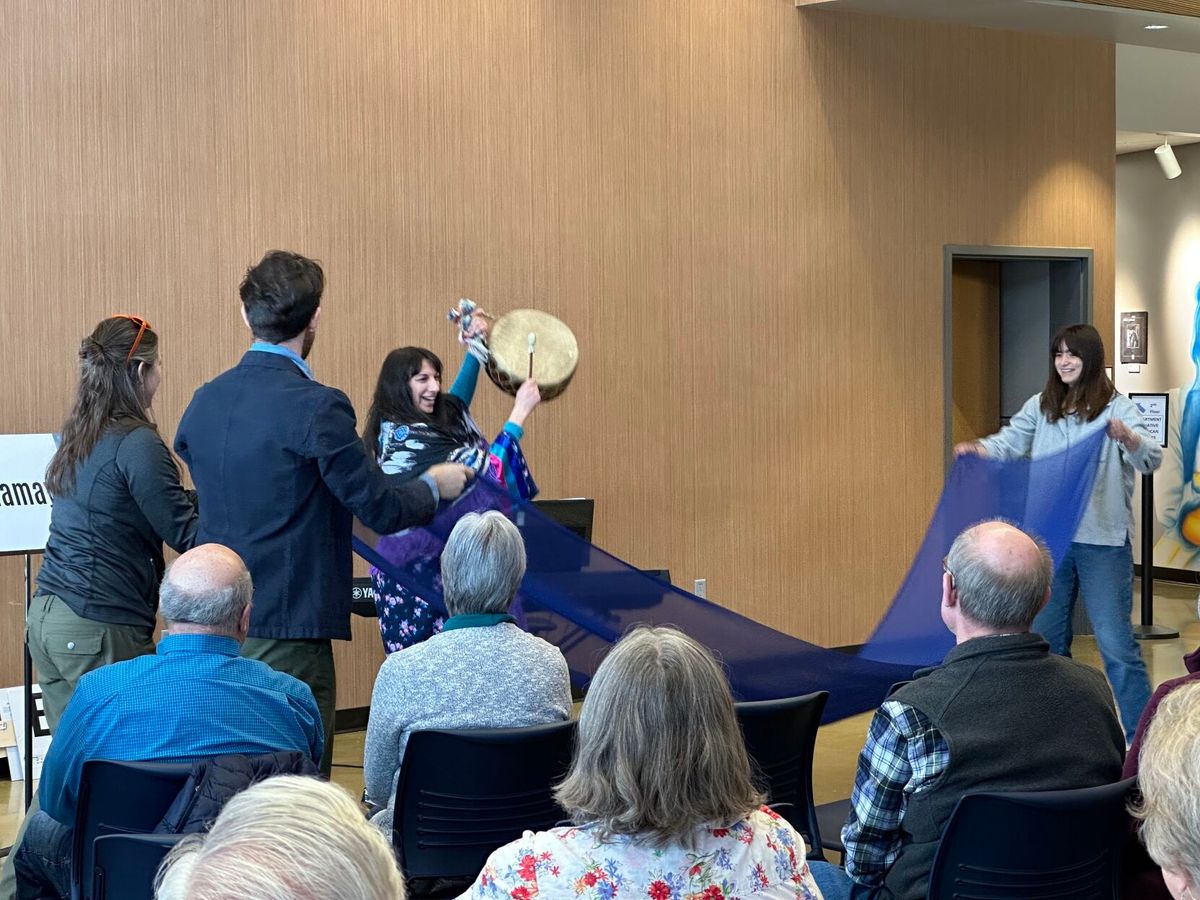
To bring the performance to a close, DiPalma led the audience through a song about water. Berry as well as two audience volunteers held up a sheer blue piece of fabric, lifting it up and down, its movement imitating the shape of water rising and falling.
“We’re mostly focused on becoming water,” DiPalma said as she talked about the Cherokee water song and the audience joined her in singing.
Berry spoke about his work as a composer and asked the audience to close their eyes and listen to a piece he had composed for a loved one.
“When I think of that person, that is what happiness sounds like. As I play, I would love to invite all of you to become composers with me,” he said. He played a bright, contemplative piece on the piano that ebbed and flowed similarly to the bright blue fabric that accompanied DiPalma’s singing moments before.
Ideas of being grateful, feeling present and experiencing moments with other people filled the room as audience members smiled and applauded.
During a question-and-answer period after the performance, an audience member asked Berry what success on this tour would look like to him. He said that foremost, it is to show Native Montanan students that “We will always be here. We can be creatives, classical musicians and composers. That to be a native person living today can mean lots of things.”
“Sharing what we’re most passionate about and communicating that with a lot of sincerity [would be a success],” he said.
Comments ()