
Amateur Radio club tunes in to chess tournament
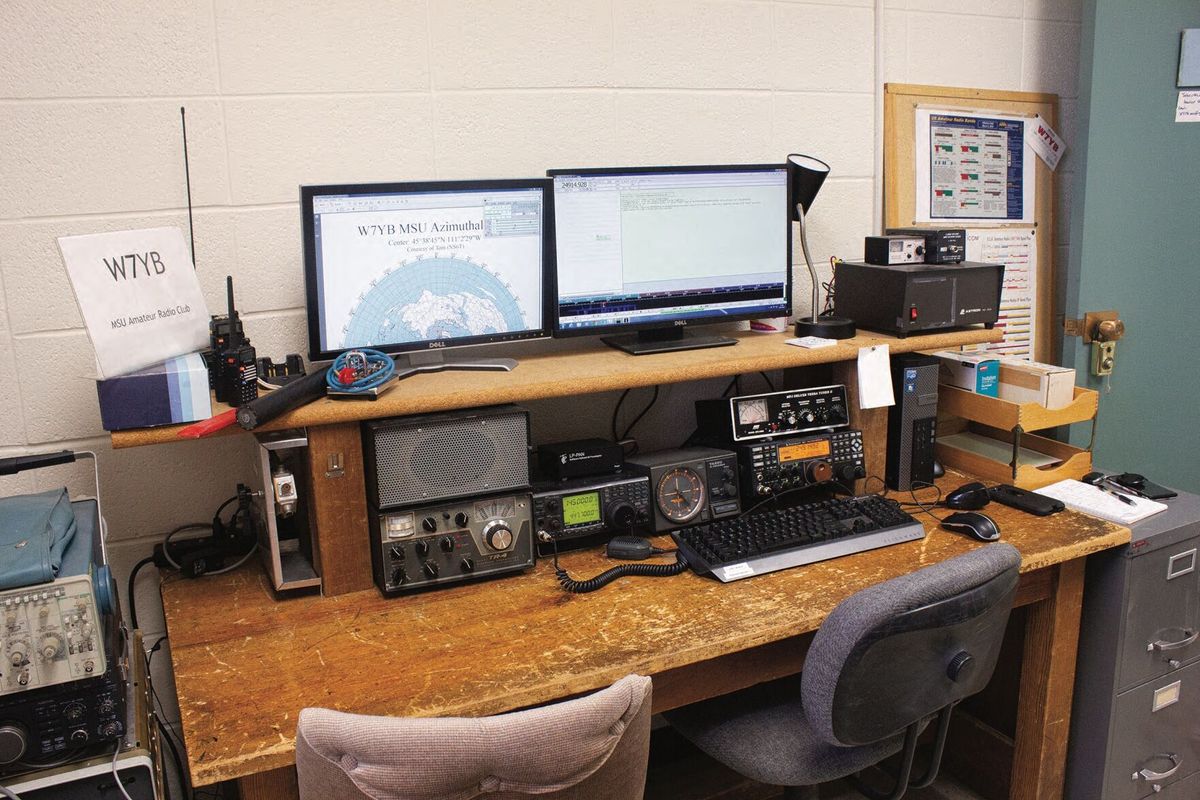
In our increasingly digital age, the thought of radio-based communication might sound a little strange or dated to the average student. The W7YB Amateur Radio club would like to change this perspective and promote student interest in Amateur Radio services. As part of this effort, they’ve been competing in the Inaugural Intercollegiate Radio Chess Tournament (IIRCT).
“We’d like for it to not be niche,” club vice president Caroline Conolly, a junior at MSU said.
According to Conolly, Amateur Radio, popularly known as ham radio, is a license-based radio service focused on person-to-person communication. This communication can take the form of voice, digital or Morse code. The service differs from AM or FM radios in that it is not broadcast focused and the radio communication can only take place between licensed operators.
The club was essentially rebooted by Conolly and club president, Bo Lamb, in the fall of 2021 during their freshman year at MSU. The two, both of whom are licensed operators, inquired with the University the prior summer about the inactive club ham radio station. For several years the space was really only being used for storage and the radio equipment was just collecting dust. After each of them reached out separately, they were put in touch with one another and given permission to revitalize the club.
A handful of different college Amateur Radio clubs across the U.S. are currently participating in the Inaugural Intercollegiate Radio Chess Tournament, where they’ll be competing against each other in chess matches via ham radio service.
The radio chess tournament is being organized with support from the American Radio Relay League’s Collegiate Amateur Radio Program (CARP). Adam Goodman, president of Case Western Reserve University’s Amateur Radio Club, and affiliate with CARP, is the chief organizer for the chess tournament, according to Conolly.
The competition is fairly straightforward — or as straightforward as chess can be on the air waves. Competing clubs connect over ham radio and engage each other in a game of chess.
According to Conolly, moves are conveyed and recognized through voice and then kept track of using both club’s respective physical chessboards, as well as logging techniques such as written lists or online programs — otherwise known as taking notation.
The MSU club is one of nine collegiate Amateur Radio clubs competing in the tournament. They participated in their first match on Sunday, Sept. 24, against St. Louis University in Missouri. Conolly, who played on behalf of the club, was checkmated in 14 moves within 20 minutes.
Conolly stressed that the Amateur Radio club hopes to receive assistance from the MSU Chess club for their upcoming match against Youngstown State University of Ohio this week, as well as during their final match on Wednesday, Oct. 11, against the Ohio-based University of Cincinnati.
Whichever club wins the tournament will receive a delicious box of buckeye candy – peanut butter fudge partially dipped in chocolate.
All are encouraged to come and observe these radio chess matches in person at the MSU ham radio station on campus in Cobleigh Hall, room 633.
According to Conolly, the club hosts weekly meetings conducted on the air on Mondays at 8:30 p.m. and Thursdays at 8 p.m. The MSU ham radio station is also open during these times, so anyone interested but not yet certified can check in to the meeting using the club’s callsign under the supervision of a licensed ham radio operator.
According to Conolly, between the exciting radio chess tournament and a myriad of other applications and services provided by Amateur Radio, students can feel encouraged to get involved.
“If you like radio, if you like friends, if you like talking or texting with people, this is a great medium to do that,” she said. “It's a great medium to reach out around the world, to prepare for emergencies, to just hang out and meet new people that maybe are completely different than you would have expected.”


Comments ()