
Author Margo Lee Shetterly speaks about diversity in STEM
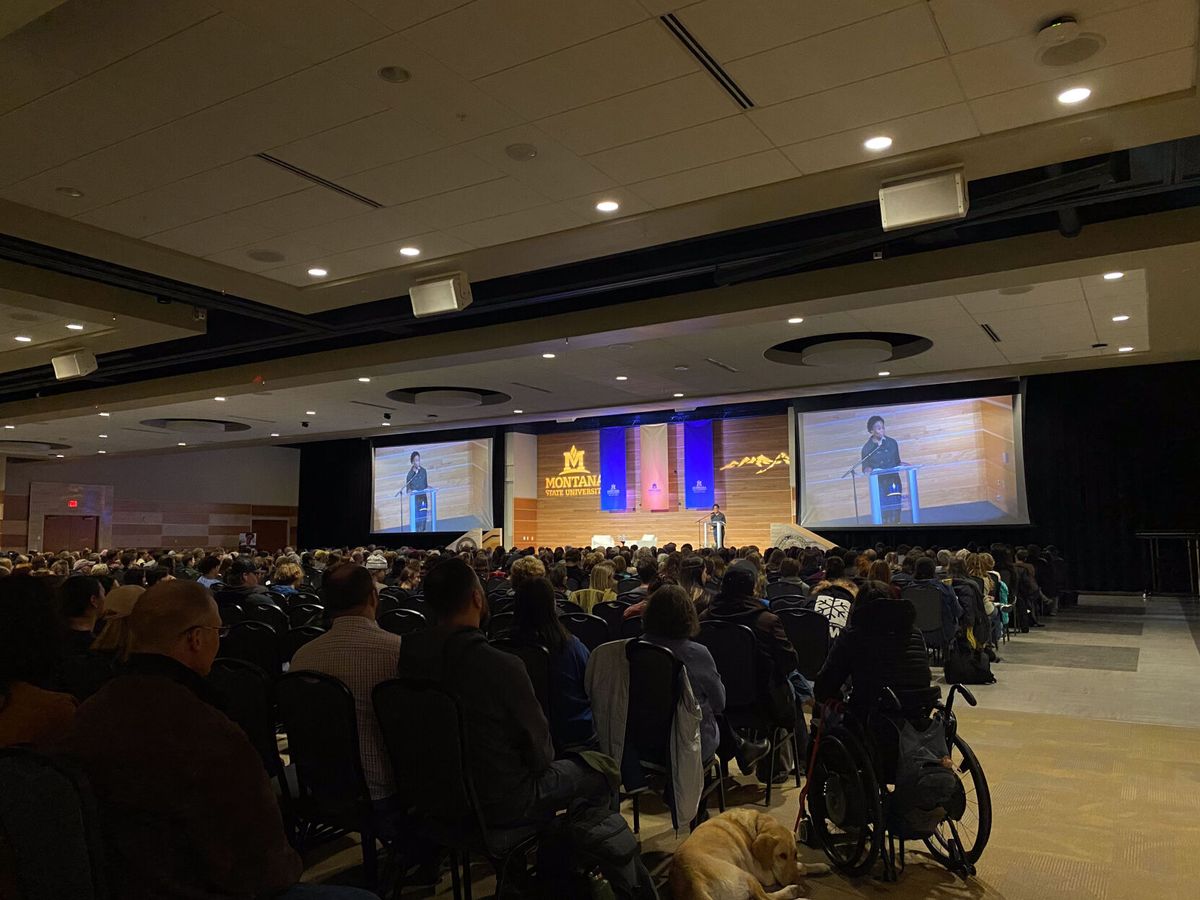
In front of SUB Ballroom A last Wednesday, stacks of books — all provided by the MSU Bookstore — dwindled as the line to purchase them grew. The nonfiction work,“Hidden Figures: The American Dream and the Untold Story of the Black Women Mathematicians Who Helped Win the Space Race” by Margot Lee Shetterly was sold as a part of the second annual “President Crossing Boundaries Speakers Series” (PCBSS). By the time the introductory speakers appeared on stage, only one book remained.
On Oct. 30, the university hosted Margot Lee Shetterly, author of “Hidden Figures.” Shetterly was hosted as the third and final speaker this semester for the PCBSS.
This series, started last year by President Waded Cruzado, intends to “give [MSU] an opportunity to see the world from where another person stands,” according to the MSU website. Following Shetterly’s speech, there was a Q&A and a book signing.
Shetterly is currently a scholar in residence at the University of Virginia. Her book “Hidden Figures,” was a top book of 2016 for Time magazine and Publisher’s Weekly as well as a No. 1 New York Times bestseller in 2016. The subsequent film adaptation, produced by Donna Gigliotti and directed by Theodore Melfi, was released in 2016 and went on to be nominated for three Academy Awards in 2017, according to Shetterly.
The story surrounds three African American women — Katherine Coleman Goble Johnson, Dorothy Vaughan and Mary Jackson whose work as human computers — individuals who did arithmetic calculations for aircraft and space missions — helped the National Aeronautics and Space Administration (NASA) succeed in the space race against the Soviet Union.
Despite being up against racial and gender discrimination that was standard for that time, they are now credited by NASA for their groundbreaking contributions in advancing both space exploration and social equality.
In her opening speech, Shetterly described these women as “agents of social change” who used their innovative mathematical skills to “look beyond the math as well as the gendered expectation of their time.” She grew up in Hampton, Virginia — where NASA’s Langley Research Center is located — and spoke about her history with these women, as many of them were her neighbors and community members.
Shetterly told the audience that her inspiration for the book sprouted from her husband meeting some of these women at a local church and asked Shetterly, “why haven’t I heard this story? You should write this as a book.”
Shetterly touched on the humanity of the women she wrote about, explaining that they were ordinary people capable of extraordinary things. “People like you and me,” she said. The process of learning about these women was the best part of her research, and she encouraged others to speak to older community members in their own communities.
“Once you start asking people about their lives things just come out,” she said. “History really does happen around us.”
She went on to describe her work as the founder of The Human Computer Project — which is a virtual museum dedicated to recovering and showcasing the identities and accomplishments of other human computers from the 1930s to the 1980s.
In the Q&A portion of the event, Shetterly was asked to give advice to struggling students. “Life is not a straight line,” she said, emphasizing that hard things are sometimes the most important things to do.
Audience member Allechar Serrano López, assistant professor in the math department, explained that it is important for her to attend events that not only feature her areas of knowledge, but also all of the people who have been marginalized in mathematics. “The part that resonated with me the most was [the question] why haven't we heard about this before? And I think that that's a question that we should ask a lot, because a lot of things in mathematics are named after people,” Serrano López said.
Serrano López said she values the PCBSS and hopes that the series continues, even after Cruzado retires in June 2025. “They're important for the faculty and the students as we continue to have more diverse people attending the University,” she said.

Comments ()