
Behind the harvest: Research into Latinx farmworkers, injustice and the fight for change
In an age of convenient services like DoorDash and open-late fast food, many people may overlook the origins of their food. According to the Journal of Agricultural Education, agriculture literacy refers to one’s understanding of food sourcing. Researchers have since identified a lack of agricultural literacy as one avenue that allows for discrimination and human rights abuses among those who grow and cultivate food.
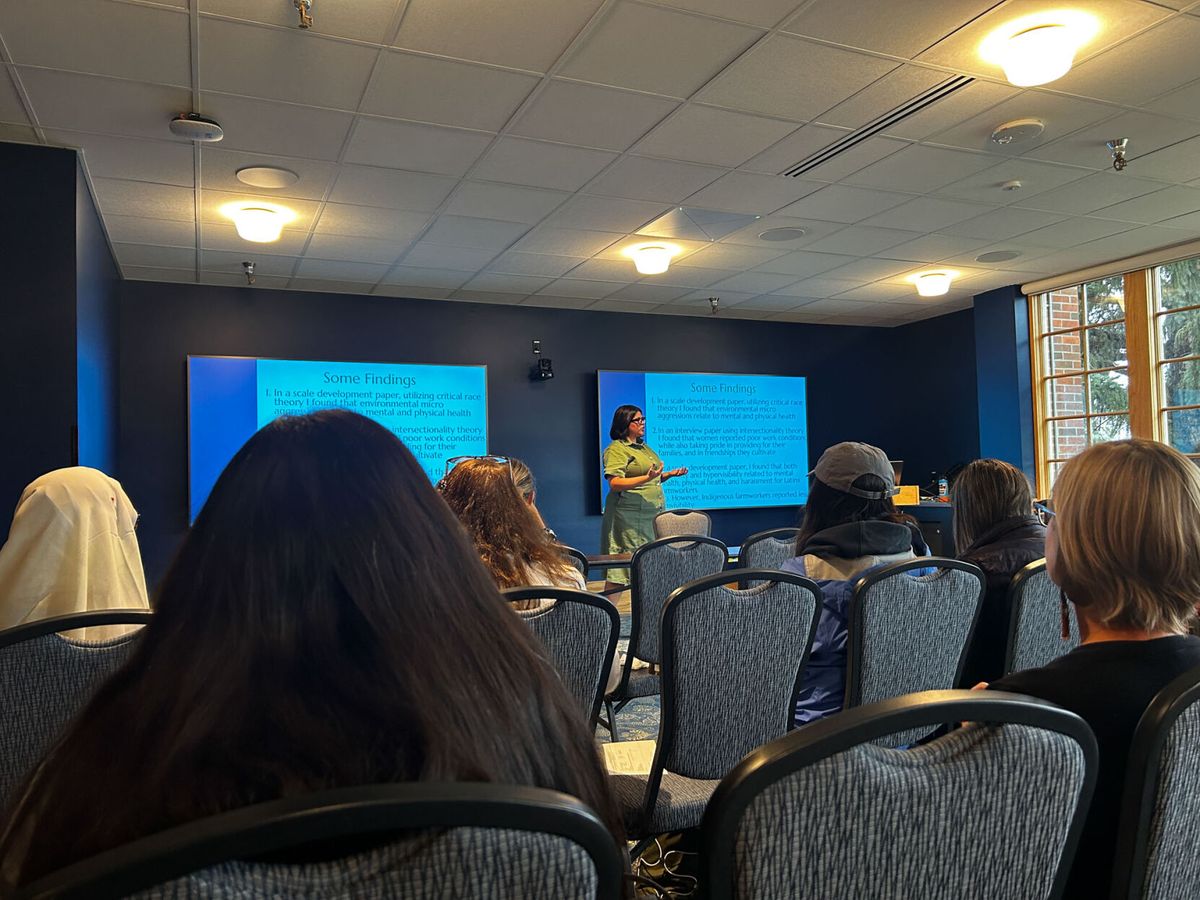
After growing up as a child of farmworkers in the Central Valley of California, Assistant Professor of Psychology and Gender Studies Mayra del Carmen has dedicated her professional life to conducting research among farmworker and Latinx populations. On Sept. 18, the Women’s Center hosted the recurring Sack Lunch Seminar to both start the celebration of Hispanic Heritage Month and present Carmen’s research that revealed the hidden cost of industrialized food production.
“I am from the Central Valley of California,” Carmen said during her presentation. “We are told from a very early age that [the Valley is] the fruit basket of the world. As a child I tried to imagine how big that fruit basket would be — now I understand it’s because we harvest and produce a lot of that fruit and vegetables in our area.”
The Central Valley is home to 18 counties in California. The production of crops in the Valley encompasses more than 20 percent of total U.S. production, according to a 2017 report on the Central Valley. Wage theft, inadequate pay, threat of deportation and sexual assault are just a few of many injustices that Latinx farmworkers have reported throughout history.
“I'm committed to the farmworker justice movement because of what I've seen growing up in a farmworker area,” Carmen said. “I witnessed people experience wage theft, experience fear of retaliation after being injured on the job and then not wanting to report anything. I’ve experienced people reporting things, and then not being invited back to work.”
Carmen further explained that anti-immigration rhetoric and the historical treatment of Latinx communities has a lasting impact on the way these communities are treated.
“People have nuanced identities, and that impacts how they are treated legally,” Carmen said. “I think that is very applicable to farmworkers, who [may] be dealing with a lot of legal issues in terms of documentation but also wage theft. When we say this person lost their wages, we're not gonna say, oh, it’s because they do not have documentation or papers. We can consider other aspects like they do not speak the native language or the history — if we then go into critical race theory — and consider a historical perspective on how these racial ethnic groups have been treated, how we have treated forced labor or labor.”
In the audience, sophomore and accounting major Crystal Ayala took notes during Carmen's speech. Ayala is closely involved with reinstating the student-led Fuerza Latinx club, which has been inactive since COVID-19.
“[Fuerza focuses] on education, family and community,” Ayala said. “The [previous] ASMSU Vice President, Melissa Ramirez, reached out to me and said she wanted to start this club again and so, we collaborated to try and get people to sign up and [get] leadership going. After she graduated, I took over. There are not many communities in Bozeman for us. So, let's try and make a community that will withstand multiple years and semesters and future Latinx students coming in have a prominent place to be and feel safe. Having a group of people and people that can relate to you kind of feels nice.”
During her presentation, Carmen explained both the origins of her research and where she hopes to take it. She offered the audience various guidelines for working on research with Latinx people. She emphasized the importance of being transparent, coming prepared with resources for the community and being inquisitive but respectful of boundaries.
“I believe that all the inequities we experience across the world are very much intertwined,” Carmen said. “I really do believe that your liberation is tied in with mine. And so without you being free, I am also not free. And so I think it's like something you try to work on embodying every day.”
Carmen is currently working on cultivating her research lab at MSU and building connections in the community. She currently serves on the board for Bienvenidos, a nonprofit organization in the Gallatin Valley that works to help Spanish speaking individuals navigate resources and language barriers. The organization is largely volunteer driven and looking for volunteers to help serve their mission. To find out more, email bienvenidosabzn@gmail.comor visit https://bienvenidosgv.org/our-team.
As for Fuerza Latinx, more information about the club can be found here https://montanastate.campuslabs.com/engage/organization/fuerza_latinx.
To further celebrate Hispanic Heritage Month, ASMSU and the Office of Diversity & Inclusion are hosting two movie screenings in the Procrastinator Theatre on Friday, Sept. 27. At 5:00 p.m, “A Million Miles Away” and “Encanto” at 7:30 p.m. Tickets are $2 for students and $5 for community members. More information can be found here https://www.montana.edu/asmsu/programs/films.html.
Comments ()