
Chef Sherman advocates for Indigenous food systems at MSU's 34th annual Bug Buffet
"You are on Native Land." These words were projected on the wall of the Procrastinator Theater for Sean Sherman, the Keynote speaker for MSU’s annual Bug Buffet. Sherman, the founder of The Sioux Chef company and Owamni Restaurant, spoke in Norm Asbjornson Hall on Monday, Feb. 28, capping off the opening day of the 34th annual buffet.
“People shouldn't be afraid of animals if it doesn't happen to be a cow or a pig or a chicken. They’re not even from these landscapes,” Sherman said. “At our restaurant, we have crickets on the menu, and we go through about 15 pounds of crickets a week, and crickets don’t weigh that much so that's a lot of crickets.”
Sean Sherman, Oglala Lakota, was born on the Pine Ridge Reservation in South Dakota, and has been cooking in kitchens for over 30 years. “A few years into my chef career I realized that I knew very little about my own heritage,” Sherman said. “I made the decision to start to try and understand what my Lakota ancestors were eating.”
His journey learning about Indigenous food systems started in 2014. Sherman’s focus on the revitalization and evolution of Indigenous food systems throughout North America led him to create an Indigenous food education business and caterer, The Sioux Chef. He has also published an Indigenous cookbook and is the founder of the nonprofit North American Traditional Indigenous Food Systems. In July 2021, Sherman opened Owamni, the first full service Indigenous restaurant in Minneapolis. The impact of Sherman’s work was apparent in an emotional introduction speech from Danielle Antelope, a student in the sustainable food and bioenergy program from Browning, MT.
While Sherman works with Indigenous food systems, his presentation largely focused on the impact colonization has had on Indigenous education. “The United States has never come to terms with its own history of how it became a world power by stealing Indigenous lands,” Sherman said. “We have to remember how young the United States actually is. If you look at a map of the year 1800…the Western Frontier is Ohio.”
Sherman spoke about one of George Washington’s first acts as president in 1779 that involved completely destroying huge and complicated Indigenous farming systems. “We have to remember how damaging that one century is for Indigenous peoples,” Sherman said. “Because of the immense amount of land loss that happened, the relocations that happened, enslavement, genocide and it just goes on and on.”
“We see not only a huge loss of Indigenous food access, but our whole world changed because of how the colonial machine comes in, putting settlers everywhere, stripping this land of all sorts of natural resources to make a very few people very rich,” Sherman said. “It changed the entire world. Just all of the cattle ranching and the barbed wire fences, which inhibits the natural flow of animals and divides land space up, and there's so much environmental damage that happens in a very short period of time.”
Sherman works to connect food back to the land and to move away from colonial borders that obscure regional diversity. “To understand Indigenous foods is to understand diversity,” Sherman said. “You have to just think about all these wonderful regions and all the different plants and animals that live here.”
Sherman views his work as Indigenous evolution and revolution. There is much creativity involved in Indigenous food, like “making food taste like where you are: white cedar and wild rice and rabbit and cranberries,” Sherman said. “I can stand in that spot in Minnesota and see all these ingredients just right around me. That's how we should be thinking about food and flavor.”
As the presentation was pushed for time, the microphone was urgently passed around the crowd for a Q&A session. One gentleman asked how people of colonial descendantscan become an ally for Indigenous food. “A lot of it is purely supporting and realizing that there's so much work to do,” Sherman responded. “We should be very choosy as to who we're supporting and who we're purchasing from.”
The woman next to me sat on the edge of her seat as she was handed the microphone and asked how people can work with Montana ranchers to bring back Indigenous food. “The land access is a huge issue. If you look at the statistics, 98% of all land ownership is still in the hands of white Europeans,” Sherman said. “If you look at the history of how the land changed through really intense logging, mining and cattle ranching, it really was an environmental disaster across the board. There's definitely healthier ways to run cattle but we should also just be thinking about allowing some of these lands to really grow to reach the full potential of what they can be.”
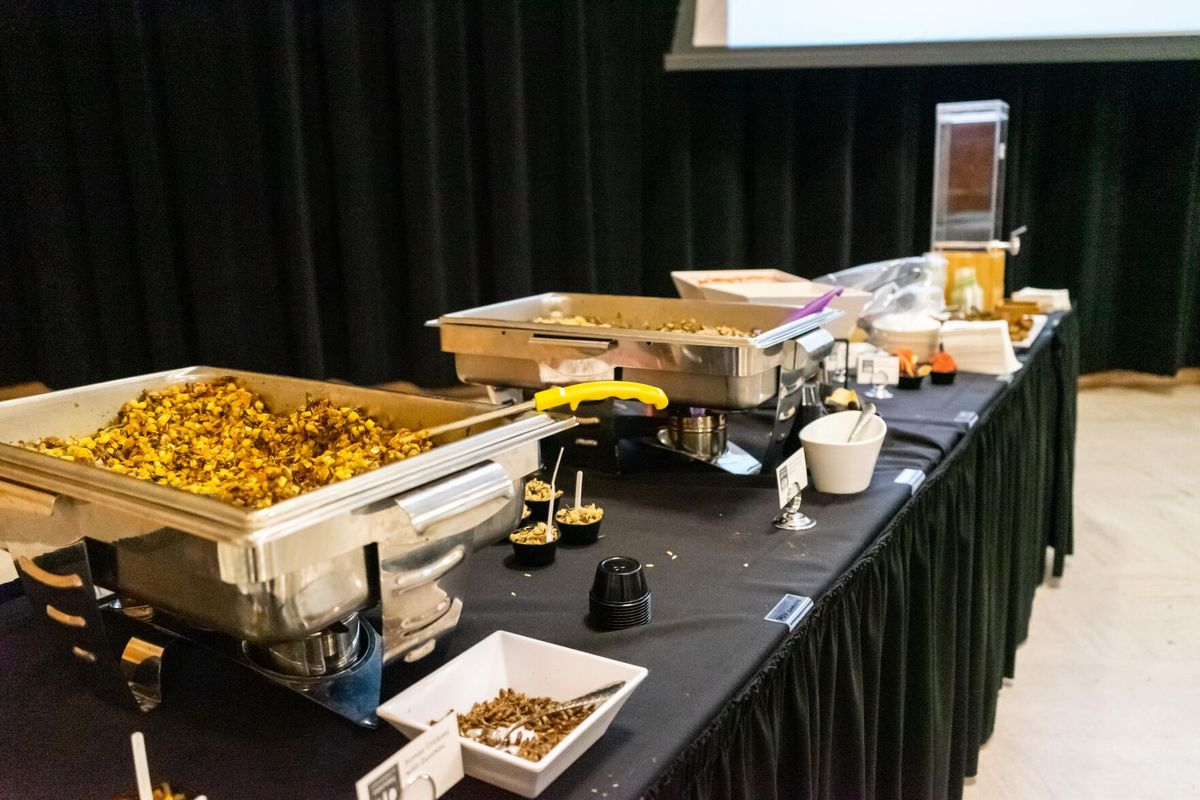
The 34th annual Bug Buffet includes a week of events and activities that explore the history of edible insects across western North America and their relation to Indigenous cuisine. The Bug Buffet kicked off at noon on Monday, Feb. 28, in the SUB. University Catering Services provided the opportunity for community members to experience bug cuisine through a multi-course buffet. This year's menu highlighted the history of Montana by featuring edible insects that have been used in the Great Basin by Native Americans. The menu included a range of items: pumpkin bread with cricket powder or mealworm powder, salsa with scorpions, salsa with chapulines, tamales with black ants, wild rice with juniper berry sauce and cedar-braised chapulines, pemmican with sunflower seeds and chapulines, Native American cookie with cricket powder and grasshoppers fried in a marinade.
The room was full of tables for people to sit and enjoy the food. Posters and flyers surrounded the tables explaining the benefits of eating insects. While eating insects can be off-putting, there are many reasons to add them to your diet. Insects are rich in protein and good fats as well as high in calcium, iron and zinc. Eating insects also has many environmental benefits, compared to livestock, from emitting less greenhouse gasses to using less land and water.
“I like the little bugs,” Clare Menzel, a history graduate student, said. “I specifically would choose something with more visible bugs.”
“Seeing the bugs, I think, makes it worse,” Isaac Winemiller, a music technology student, said. “But if you told me it was something else, I honestly wouldn't be able to tell that it's bugs.”
“I'd have to say the ant tamales have been my favorite because tamales remind me of my original home of Dallas, Texas,” Noah Johnson, a music technology student, said. “I grew up eating so many tamales, and the ants are tasteless so I could probably eat that all day.”
The first MSU Bug Buffet was held in 1989 and consisted of a pound of butter, a frying pan and grasshoppers. In August 2020, MSU became the first university in the U.S. Land Grant system to put bugs on the daily catering menu as part of its goal to use ingredients with a minimal carbon footprint.
The events on Monday, March 1, and Tuesday, March 2, included a plant sciences and plant pathology seminar and a screening of the film “Edible Insects.” For those wishing to take part in the Bug Buffet at 1:00 p.m. on Thursday, March 3, in the American Indian Hall there will be presentations and workshops with anthropologist Professor Mark Sutton from University of San Diego; Brian Yazzie, a chef at Owami; Jill Flores, MSU executive chef for Culinary Services; Jeff Tomberlin, a professor who helps lead the Center for Environmental Sustainability Through Insect Farming at Texas A&M University; and chef Kay Ann Miller. On Friday, March 4, participants in the Student Insect Cuisine Cookoff will be meeting in the Hannon Hall Commercial Teaching Kitchen/Cafeteria at 5 p.m. At noon on Saturday, March 5, the public is invited to the cookoff in the same location.
Comments ()