
Climbing impact goes beyond the wall
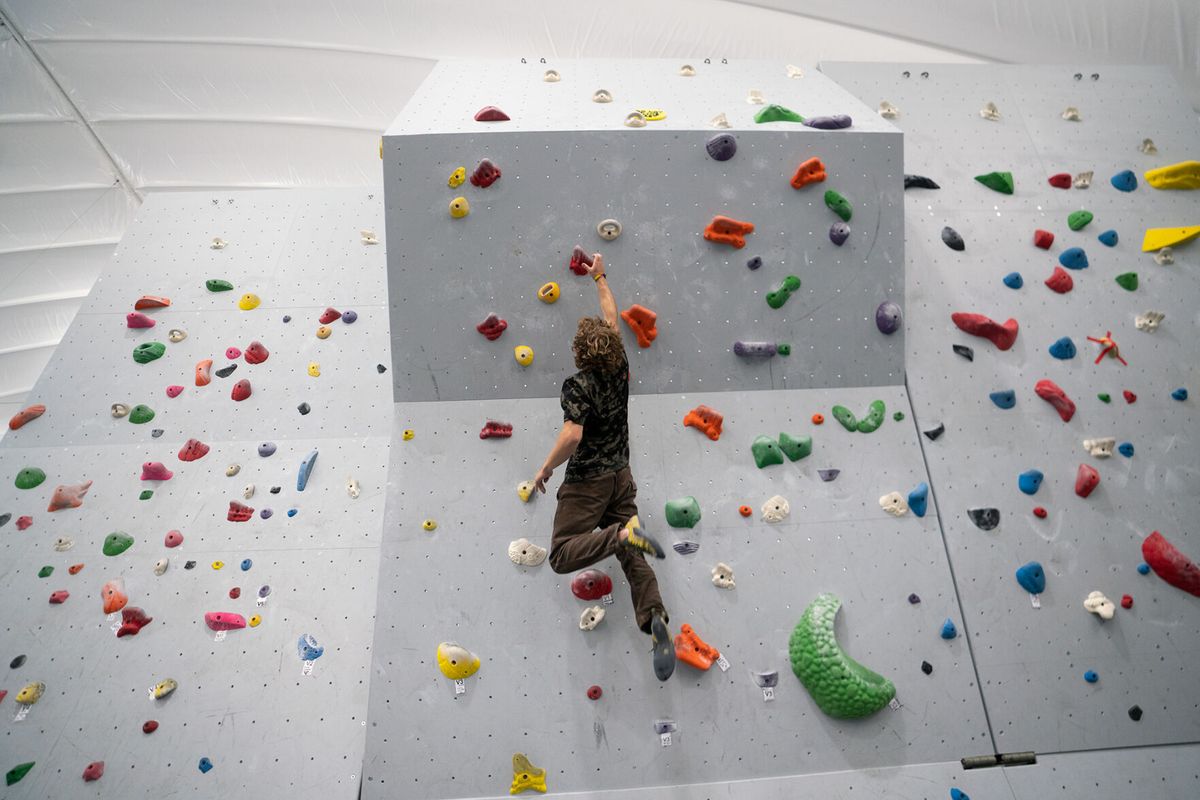
MSU’s North Dome Fitness Center comes alive at 5 p.m. The clank of dumbbells and the squeak of basketball shoes echo off the tall ceiling as students shuttle through the revolving door into the university’s temporary gym. As rap music blares from a speaker and students chatter energetically, a dozen individuals can be found crowded before a small, studded wall in the middle of the dome. These students, clad in chalk-dusted pants and narrow shoes, aren’t here to shoot hoops or pump iron: they’re here to climb.
In climbing, the community of students finds a stimulating challenge and a respite from classes — a thrilling escape from the world.
“Climbing gives me control in my life. No matter what’s going on in my week or how hard classes are, climbing lets me feel like I’m making progress,.” said Bryce Howard, a junior.
Tracing its roots to mountaineering in Europe, rock climbing has existed in various forms for centuries. In the U.S., the sport got its rise in California’s Yosemite Valley in the 1950’s and has been growing in popularity ever since. Over the years, climbing has attracted a strong following of doggedly determined athletes for its defined progression system, social and collaborative nature, and benefits to the mind and body.
Before anything else, rock climbing demands patience and persistence. Sarah Shenk, a junior, exemplifies the characteristic tenacity of climbers. “You’re sitting on the mat, staring at the same wall for hours, days or weeks,” Shenk said about encountering a difficult route. “Eventually, it’s just dumb determination, like ‘I really really really want to get this.’”
Climbing routes are categorized by difficulty; by practicing, developing technique and getting stronger, climbers can conquer a category and move on to progressively more challenging routes. This defined system of progress lends climbing a unique sense of satisfaction.
“It’s way more exciting to complete a route where you were challenged the entire way than to complete a route where it was easy,” Shenk said.
While slaving away on an irksome route (or ‘projecting’) can be a solitary act, rock climbing is more often a social and collaborative venture. Shenk describes a common scenario in which two climbers are working on the same route. “The other climber might say ‘Try this,’ or ‘Try that,’” she said. “Collaborating with the people around you helps make you a better climber.”
Sometimes, effective collaboration in climbing can be the difference between life and death. In lead climbing, the climber relies on a belay partner on the ground to catch them in the event of a fall. Too much slack in the rope, and the consequences can be severe. “You need to trust [your belay partner]. You’re trusting them with your life,” Shenk said.
Trust in a belay partner — or lack of it — can influence the way one climbs. “If you don’t fully trust your belay partner, you might climb more conservatively,” said Shenk. “If you trust the person to belay you, you’ll push yourself to the limit and try more difficult moves you might not stick.”
While rock climbing at face value is a fun fitness activity, to many MSU students it means much more.
“It’s an escape from whatever you might be going through,” said Ruben Kornbluh, a freshman. “It’s a place to just focus and get into a flow state, so it’s good for mental health.”
While climbing has therapeutic aspects, the sport’s appeal largely lies in its innate thrill. “I like the intensity of it, and the fear factor as well,” Kornbluh said.
Exposure to the elements in outdoor climbing can add to the excitement as well. “There’ve been many times when I’ve been climbing and it started storming,” Shenk said. “You have to clean the route as fast as you possibly can before you get struck by lightning.”
Currently, climbing on campus is limited to an artificial boulder near Yellowstone residence hall and a temporary wall in the north dome fitness center. To keep things fresh, MSU’s Outdoor Recreation Program cleans the holds and changes the routes at the north dome wall twice a month. “It’s nice to get some variety,” said Kailash Moore, an outdoor recreation staff member.
While the current climbing opportunities at MSU may be somewhat sparse, students have much to look forward to in the future. The university’s new $78 million Student Wellness Center, set to be completed in 2023, will feature a vastly expanded climbing area. According to Moore, the facility will include a 30-40 foot tall wall with 30 roped routes, as well as a bouldering area with twice the capacity of the current temporary bouldering wall.
While the thought of a sparkling new climbing facility is sure to make their mouths water, MSU climbers seem to be content with what they have for now. “If there are enough people working on it to change routes once in a while to keep it unique, then I think they’re doing a pretty good job,” Kornbluh said of the temporary wall.
“Obviously it’s not ideal, but I know that there’s a bigger gym being built,” said Soren Hughes, a freshman.
As long as they have chalk on their hands and clean holds above them, MSU climbers are ready to take off. “You’re going on the wall to just grab rocks and go up,” Hughes said, stretching his calloused fingers. Wherever, whenever, and however they’re doing it, climbers seem to have a good time. As one student at the North Dome wall put it, “Climbing is dope, rad and f-ing cool.”



Comments ()