
Confronting weight bias with the film “Your Fat Friend”
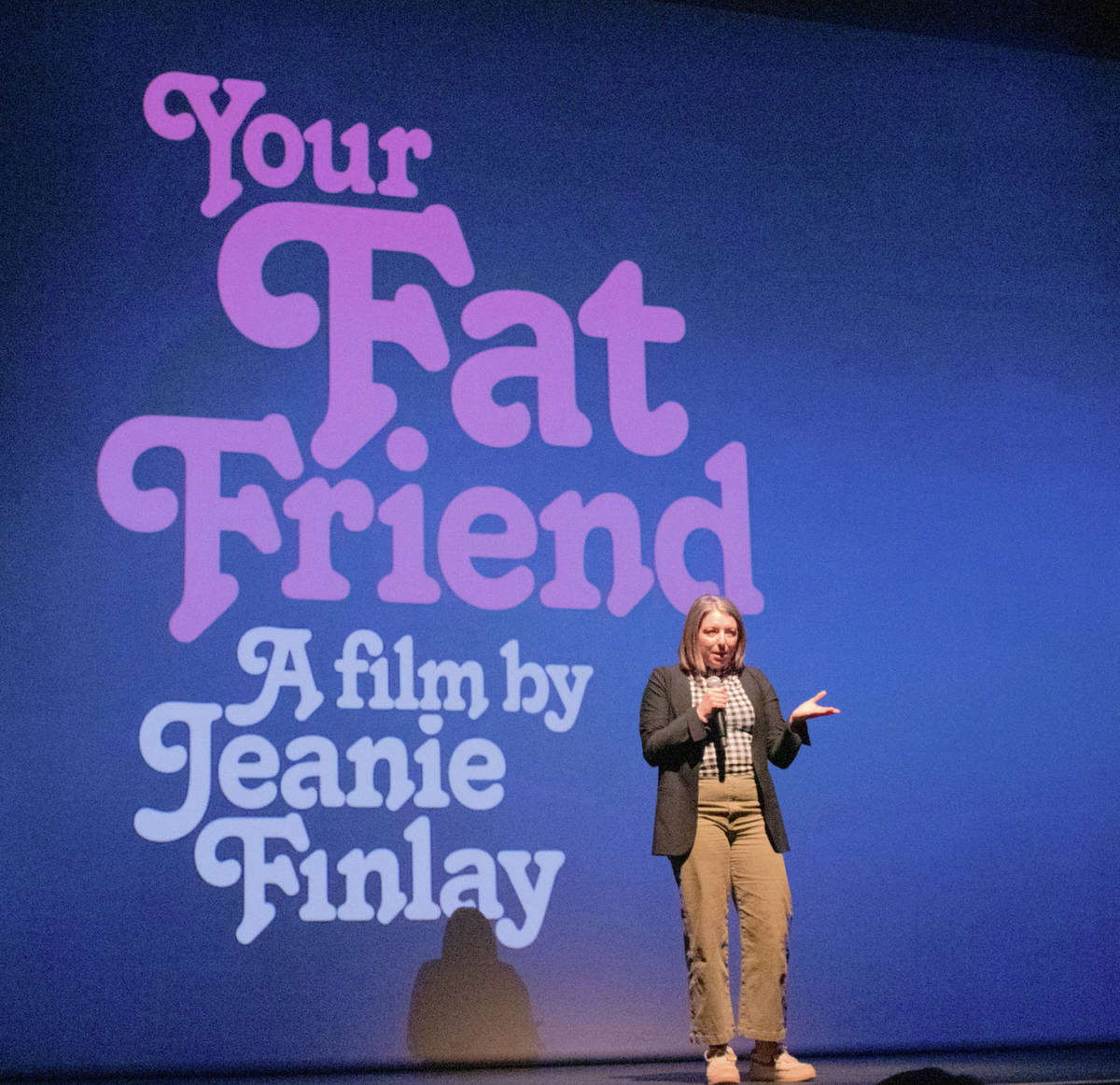
At the Emerson Center for the Arts & Culture on March 8, audience members whispered amongst themselves as a theatre screen faded into a forest scene. Then, a woman’s voiceover cut through the silence. “Just say fat,” she said. “Not curvy or chubby or chunky or fluffy or more-to-love or big guy or full-figured or big-boned or queen size or husky or obese or overweight. Just say fat.”
The voice belonged to Aubrey Gordon, the subject of “Your Fat Friend,” a documentary directed and produced by Jeanie Finlay and released in June of 2023. The documentary followed Gordon’s experience as a self-described “very fat woman” and her journey in publishing her first book, titled “What We Don't Talk About When We Talk About Fat.”
The impact of weight stigma is a central theme in “Your Fat Friend” where Gordon — who first gained recognition through her anonymous essays she began publishing in 2016 about life as a fat woman, according to her website — confronts the tension between wanting to advocate for fat acceptance and the vulnerability of stepping into the public eye.
While social movements have made strides in normalizing many minority statuses, bias against higher body weight has only intensified, according to Jessi Peterson, the director of the Food and Nutrition program within the College of Education, Health and Human Development (EHHD) at MSU.
“The Harvard Implicit Association (HIA) test has seen less implicit bias in race, sexual orientation and skin tone over a ten-year time period,” she said. The HIA is a reaction time-based task created by Harvard University in 1998 that measures implicit attitudes and beliefs. “Implicit weight bias saw a 40 percent increase in the early part of the decade.”
When “Your Fat Friend” was first released, Peterson knew she wanted to bring the film to the Bozeman community. “Most of my professional career has revolved around exploring and educating healthcare professionals on the impact of weight stigma [and] bias on health,” she said.
“With this vision in mind, I knew it would be important to offer an opportunity for people to explore the topic of anti-fatness beyond the movie which is where the idea of discussion came from.”
With donations from the Dean of EHHD Tricia Seifert, the Eating Disorder Center of Montana (EDCM) and Monte Nido (MN), Peterson was able to bring this screening to Bozeman. The EDCM is a Bozeman-based eating disorder treatment center and MN is a nationwide eating disorder treatment program.
Peterson facilitated a group discussion, asking the audience about the thoughts and feelings that arose for them during the film. “Through these discussions, people can share their own frustrations, uncertainties and personal stories,” she said. “Learning together and from each other is much more conducive to learning than just watching or listening to something in isolation.”
According to Peterson, body image is a pervasive issue, especially on college campuses. “In a recent study exploring mental health concerns among college students, 49.4 percent of the study sample listed body image as a major concern,” she said.
She emphasized that misunderstandings around weight and health often contribute to the issue. “The biggest misconception I hear from students and health care providers alike is that higher body weight and or body fat causes disease,” Peterson said. “It’s important to remember that one’s health is impacted by many different factors. There is plenty of research that has shown improvements in health outcomes with change in behavior regardless of change in body size.”
Peterson urged college students to surround themselves with weight-inclusive work. “My hope is that [people] will have a deeper understanding of how anti-fatness shows up in our world and that anti-fat bias comes from their internal, interpersonal relationships and societal experiences.”
Peterson also wants any students who may struggle with body issues to consider attending Nourish: Body and Self, a wellness group hosted by the Counseling and Psychological (CPS) Services every Tuesday from 2-3 p.m.
To read Gordon's essays, visit https://www.yourfatfriend.com.
For more information about the EDCM, go to https://edcmontana.org/.
To find out more about CPS’s group workshop, visit https://www.montana.edu/counseling/services/index.html#Group.
Comments ()