
Exploring Faith: Christ on Campus
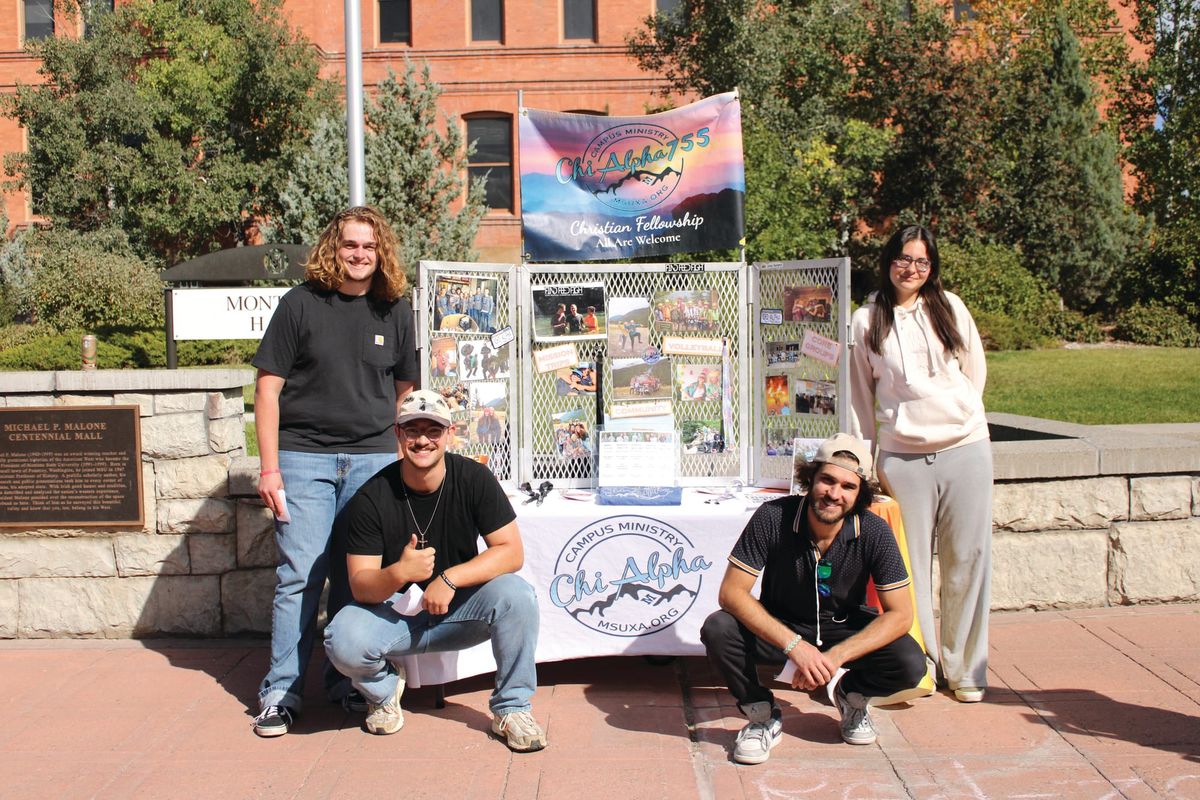
It’s clear to any reader that religion — specifically Christianity — has a strong presence and influence on campus. Many students have active interests in Christian groups, and their reasons for including themselves are by no means uncommon. To some, it provides a unique opportunity for insight into the ethical and moral dilemmas of adulthood as well as a strong sense of community. But there exists a gap in understanding between the students who take part so avidly and those that do not.
Sam McClain is a senior studying electrical engineering who attends the St. Anthony Orthodox Church in Bozeman. He spoke about finding community through one of the campus ministries when he first arrived at MSU. "These ministries want you to know that even though you may not agree on every single topic — like politically, or whatever it may be — if you both believe that there is someone named Jesus Christ who is the second person of the Godhead, that is something you can relate to,” he said. “That is something that you can confide in.”
Toben Mallo, an electrical engineering sophomore, mentioned a similar reason for his membership in campus ministry. "Sense of community is why I wanted to find a campus ministry," he said. He had that community in his high school youth group and wanted it back when he came to college.
Community isn’t all of it, however. Both Mallo and McClain described their groups as places that facilitate environments for important, difficult or rare conversations.
McClain spoke about the importance of spirituality and mental health.
“I think people often don't give enough credit to the spiritual side, or the mental side of things. If you have a healthy diet and you work out consistently it doesn't necessarily mean that you're gonna be happy or fulfilled in life,” McClain said. “Part of the spiritual component plays a lot into grounding everything we experience in life in reality. Things like love, things like justice, things like respect — these are things you can't really put in a test tube and measure.”
To Hadley Elgard, a sophomore studying English writing and philosophy, campus ministry is a place to explore those themes in a safe environment with people who think differently.
“I think that it is intended to be a place where people can explore and be open to a reality that they haven't understood before,” Elgard said. She described discussions as a way of exploring her own faith, highlighting how important engagement with others is. "If we're afraid to talk about those things and then we're afraid that our faith will crumble, well, then we should probably let it crumble," she said.
Elgard emphasized that her sister’s ministry, Light Co., accepts both believers and non-believers as members. “The goal of Light Co., is to create a space where the believer and the non-believer feel seen, known, loved and encouraged in their walks,” Elgard said.
Light Co. is not the only group on campus that makes room for any faith or belief. Mallo said that his campus ministry, Table & Grace, includes both Lutherans and Episcopalians, two Muslim students, a Buddhist and several agnostics and atheists. At a recent Wednesday dinner, he said the Muslim students shared their faith and cooked Pakistani food. "We are happy to hear one another's stories, hear one another's beliefs and learn and grow from them, even though we're different," he said.
Not all Christians on campus have the same experience with campus ministry. Sawyer Johns, a senior studying mechanical engineering, is an evangelical Christian whose evening labs conflict with ministry meetings. He spoke about his opinions on spirituality and those that share a different belief. “Just because they don't share my belief doesn't mean they're not awesome people. That being said, the spiritual aspect I don't think is entirely achieved without [religious study]. There's learning that happens there that we share together, but ultimately it's us drawing closer to God,” Johns said.
When asked if that was something that applied to all religions, he said, “No, because I believe Christianity is the only true religion.”
Students that aren’t religious describe a different experience with religious groups. Jamie Berge, an anthropology and sociology major, grew up in what she called a very controlling church. "That just turned me off of it forever," she said. Campus ministry members approach her often, she thinks due to her disability. "I've been approached by them a lot, which is really weird because I try to avoid them," she said.
"I'm always nice and I'm always polite and stuff, but please don't," Berge said. "If somebody goes out of their way to avoid you, don't come up to them."
Nicco Aray, a sophomore studying civil engineering, is an atheist. He said he struggles to credit a single "overseeing being" when he takes pride in his own accomplishments and sees so much suffering. He didn’t question that groups would welcome him, but he doubted productive discussion. “I do fear that I will be almost belittled for my beliefs of not thinking God is real in general. Having that be a core in my belief system and challenging someone else's belief system, who's centered around God, is not set up for productive conversation unless there's boundaries set up beforehand,” Aray said. “Like, ‘This is what I believe, this is what you believe, both can be true, but we need to respect each other.’ But if I was to just walk up to one of the ministry groups and be like, ‘I don't think God's real,’ that's not fair to them. That puts them on the spot and that's challenging.”
The people inside the ministries know the reputation. Elgard spoke about experiences in some of her honors classes. “There are some Christians in there who are very aggressive in a lot of ways, and I did see that it rubbed people a lot of the wrong way and made them very hesitant to [want] to join those college ministries," she said. Instead, she focuses on getting to know people before discussing faith.
Toben Mallo, who identifies as bisexual, said he understands why LGBTQIA+ students fear campus ministries. He mentioned an experience he had with one group he didn’t name. “I remember going up to Hyalite and singing and having a fun time, but then mentioned something about working at a queer feminist summer camp — and it was, I don't know. You could feel like everyone's shift to being like, ‘Oh, he's — he's one of those.’ [In] my personal group, I have not felt that, which is the reason I've stuck with it. I believe God calls us to love all people,” he said.
Talking about religion can undoubtedly be difficult, and many of the students interviewed disagreed on how to cross the barriers of belief to access important discussion. Mallo spoke about his experience engaging with Islamic members of Table & Grace as a way of listening to someone’s faith productively.
“Religion throughout humanity has so often been used as a way to create codes of morals and codes of ethics for people to follow,” Mallo said. “The majority of religions, especially older ones, have a lot of really nice things someone will say about the world, and good advice about how to go out and treat one another. I think to discredit that just because you don’t share a belief with someone is keeping you from knowing as much as you can about the world.”

Comments ()