
From the exponent archives: Bikeway petition starts Thursday
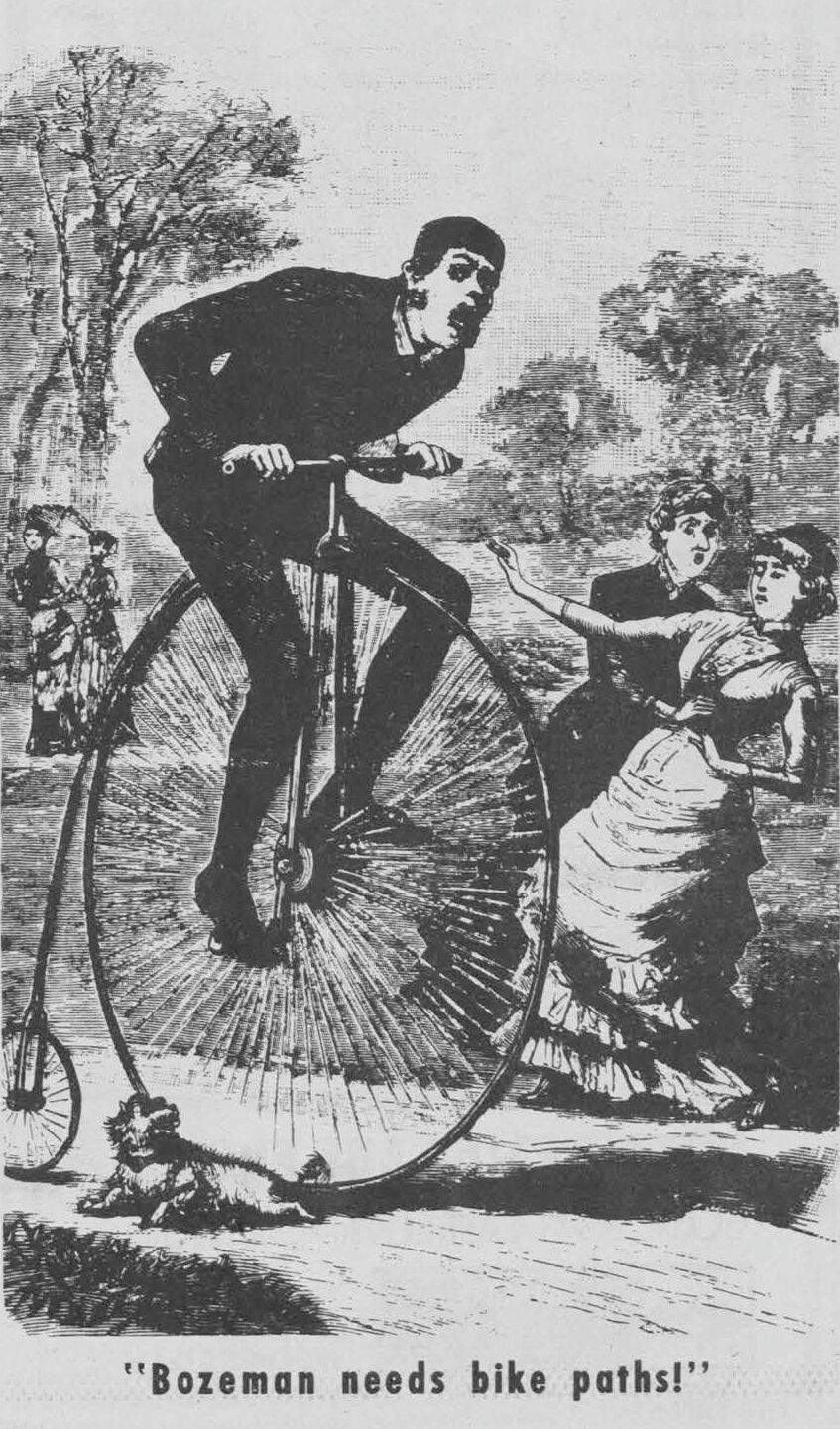
This story was published in the Exponent on November 13, 1973
There are about 6,000 bicycles in Bozeman now, which is about one bike for every three and one-half residents. Bike sales are on the increase because people are realizing that bikes are a mode of transportation that doesn’t pollute or consume energy sources, except calories. Now bicycles and automobiles in Bozeman are competing for the same space on the city streets. More bicycles means more congestion, as well as an increase in danger.
Four MSU students drafted a plan for a bikeway system which would provide specific pathways for these increasing numbers of bikes. The Gallatin Chapter of the National Women's Political Caucus is organizing an effort to convince the city commissioners and city manager that there is strong support in Bozeman for the bikeway system. Thursday, November 1 5, will be the kick-off date for the campaign. Petitions will be available in the SUB lobby for signatures to be taken to the city commissioners.
Two petitions will be circulated; the first endorsing the bikeway and the second endorsing a bicycle tax and mandatory licensing. Licensing will aid in recovery of stolen bicycles and the registration fee and fines for noncompliance will help to pay for the bike paths.
Federal matching funds for bikeways are available now but may not be by 1975. Timing of the proposal is critical. The two sources of funds from the Federal government are the Bureau of Outdoor Recreation and the Department of Housing and Urban Development. State financing to match these funds would be controlled by the Montana Highway Department and the State Highway Trust Fund.
One of the main considerations of the bikeways is safety. In the United States, bicycle related deaths were up 78% from 1960 to 1970. Several accidents have occurred in Bozeman in recent weeks. People on bicycles compete at a disadvantage with automobiles for the same space. Separate bikeways would be an obvious benefit in keeping bikes out of the paths of cars.
There are three basic types of bikeways, defined according to their relationship to existing roads and traffic patterns: the exclusive, the restricted and the shared. The names are self explanatory. Exclusive bike paths with no connection to roads would be the best for safety's sake, but restricted and shared paths will be necessary in parts of Bozeman due to lack of space and lack of funds.
Any type of bikeway would be better than none.
Other reasons for the bikeways are that more and more people are using bikes as a regular method of transportation, as well as families using them for a clean, healthy form of recreation. Bike paths will hopefully encourage even more people to use bicycles which will be a benefit to air quality, the health of the riders, the pocketbooks of the riders, the quiet of the city and especially the fuel shortage.
All facts and information are taken from a study done by Pat Carroll, Doug Tolland, Harvey Moen and Rich ltoh.
The following petitions will be circulating for signatures:
Whereas bicycles are a nonpolluting, non energy-depleting mode of transportation, extensively used in Bozeman, we the undersigned ask the City Commission to plan and implement bicycle pathways for better traffic control and safety in Bozeman:
We the undersigned believe that an annual bicycle license costing $5 should be required and enforced in Bozeman to provide some revenue for bicycle pathways and to ensure that bicycles are brought under state traffic codes.



Comments ()