
Glitter, gold and growth: A vulnerable reflection with Jessie Diggins
Editor’s Note: The content of this article contains discussion of eating disorders and suicide.
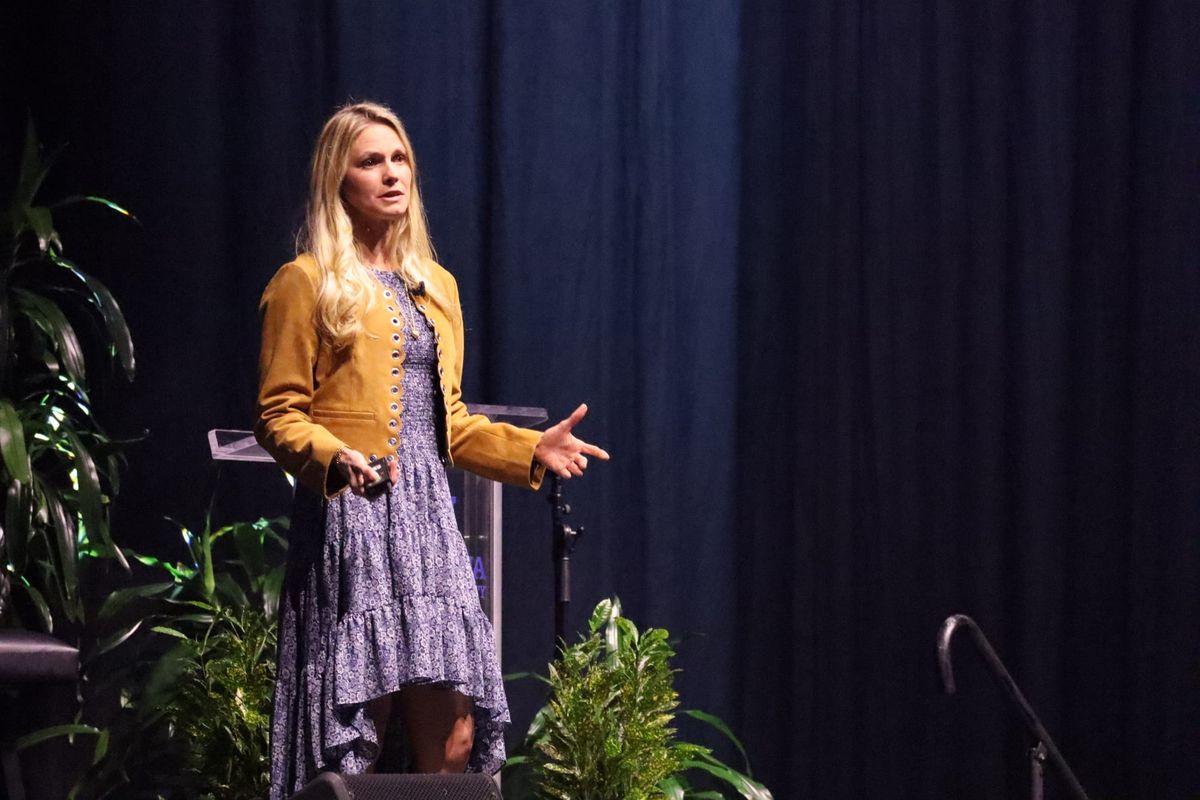
Around 3,000 people eagerly filled the Brick Breeden Fieldhouse on Oct. 29 to hear from Jessie Diggins, a renowned American Nordic skier. Student-athletes from elementary school to college, parents and community members were in attendance to hear from the athlete. The event was hosted by Bridger Ski Foundation (BSF) and the Office of the Dean of Students.
Diggins competed in four Winter Olympics and over 350 World Cup races. In 2018, Diggins and Kikkan Randall made history winning the first American gold medal in Nordic skiing. She retired from professional racing this spring.
At the event, Diggins spoke about powerful determination, racing for herself and she highlighted the importance of doing hard things while practicing self care. She also spoke about her experience as a teenager living with an eating disorder, learning about the importance of support systems and balancing the act of competing at the highest level.
She said the pursuit of perfectionism and a desire for control became unhealthy habits. As a young teenager, Diggins said she disguised the unhealthy habits as hard work and determination.
“I was closed off, angry with my parents for trying to talk to me about it and my self-worth had never been lower. I truly hated the person that I was becoming, and I could not stop,” she said during the speech.
According to the National Institute of Mental Health, an eating disorder is characterized by any disturbance in one's eating behaviors that disrupts body image perception and creates unhealthy dietary habits.
“Every 52 minutes, someone in the U.S. dies as a direct consequence of an eating disorder,” Diggins said during the speech.
According to Harvard Strategic Planning Initiative for the Prevention of Eating Disorders, nine percent of — or 93,512 — Montanans will have an eating disorder in their lifetime. Individuals with eating disorders are at a significantly higher risk of suicide, according to a 2024 PubMed article.
According to the Montana Department of Human Health and Services, Montana ranks as one of the top five highest suicide rates in the nation, with youth suicide rates being more than triple the national average for the same age group. Part of this can be attributed to a lack of access to behavioral health care.
Diggins shared that it is not always obvious when people are struggling. Sometimes, it can come across as training hard and dedication to the sport and can be very hard to notice in yourself and others. “It can quickly become more powerful than family, than love or even the will to live,” she said.
According to the National Association of Anorexia Nervosa and Associated Disorders, one in four U.S. student-athletes have an eating disorder. Leon Costello is the director of athletics at MSU. In an interview with the Exponent, Costello said that Diggin’s message was important for MSU student-athletes to hear. “For our student-athletes to hear the struggles that she has gone through personally, but to overcome them and see what she's achieved is a great message,” he said.
BSF works with 1,000 young athletes in the Gallatin Valley each year. The nonprofit fosters personal growth, athletic development and community wellness through accessible skiing and winter trail stewardship.
"The strongest teams I have ever been a part of were not built on perfection. They were built on honesty and kindness, on teammates who were willing to raise a hand and say, 'Hey, I need a little bit of help here,' and know that the team would have their back,” Diggins said. “That kind of vulnerability doesn't break a team. It's what makes it unshakable.”
Jack Christensen is the youth development director at BSF Nordic. “It's really awesome for our families, but also especially our young athletes to hear that from the best in the world, and understand the balance between physical wellness, mental wellness and athletic wellness,” he said.
Wesley Rizutto and Eleanor Hoegh Nordic ski for BSF. They are freshmen in high school and have been skiing with BSF for nine years. In an interview with the Exponent, they spoke about the connections they have made at BSF. “I really love the community. I have so many great relationships on the team,” Rizutto said.
Evan Weiss, the director of BSF, said that a large focus of the organization is to get kids outside and promote an awareness of mental health. Weiss said he appreciated the community partnerships that made the event possible. “The message of the story, and the community is like really, really all around about this,” Weiss said.
Grace Lux, a Kinesiology, health and fitness student and former Nordic skier for BSF, noted that eating disorders and mental health are not talked about enough. “Eating disorders and mental health take a lot of my friends, and friends of family and friends of friends,” Lux said.
Lux emphasized how strong of a community BSF provides for young athletes in the Valley. Along with providing top-tier athletic training and knowledge, the organization also has a larger focus on supporting the athletes’ mental health and well-being. This winter, Lux will serve as the head coach for BSF’s Nordic Intro Program.
“When you see an Olympian asking for help, it makes it a little bit easier to ask for help,” Lux said.
For more information on BSF, visit https://www.bridgerskifoundation.org/.
MSU Students registered in seven or more credits can meet with a registered dietitian in the Student Wellness Center for free. For more information, visit https://www.montana.edu/wellness-center/.

Comments ()