
Hausser Lecture provokes thought on Black sovereignty
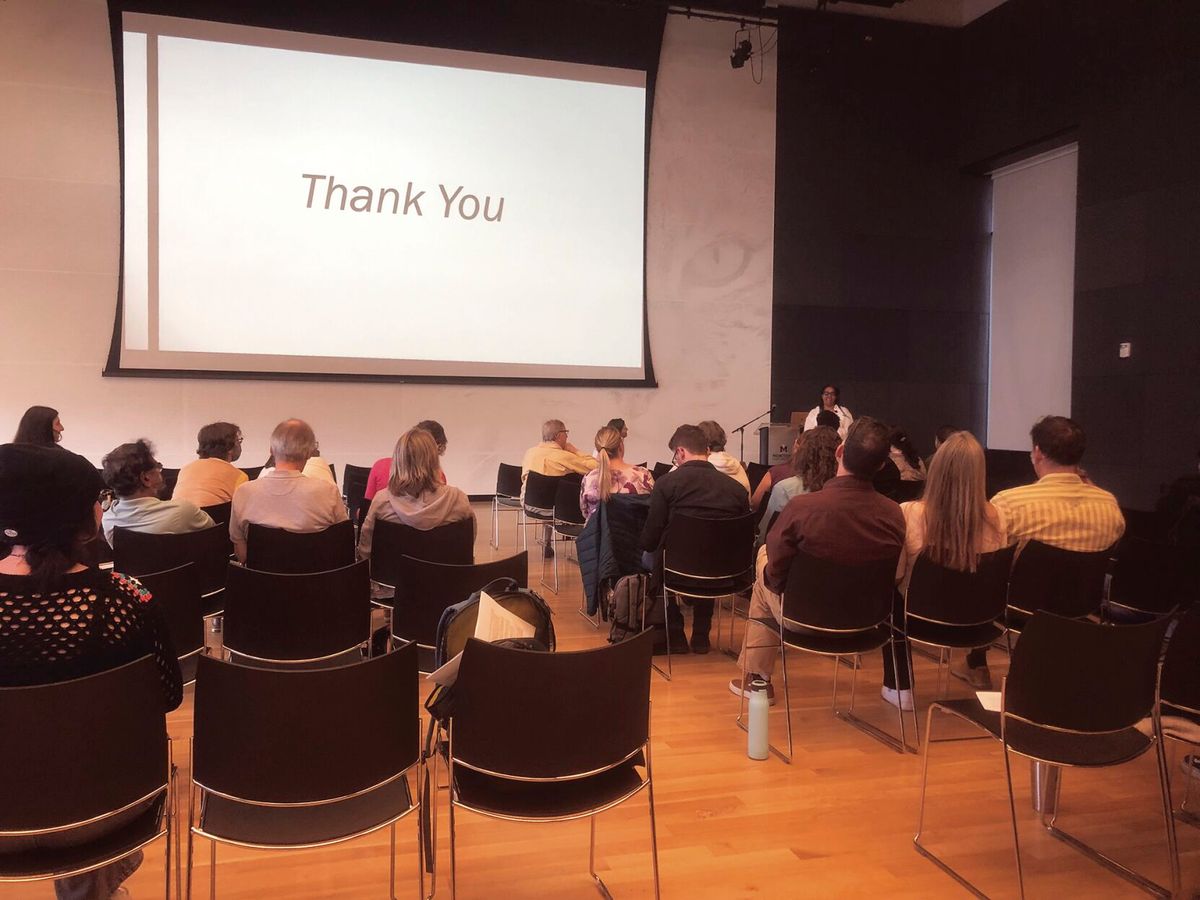
The Hausser Lecture — sponsored by the Margaret and Harry Hausser Fund for Excellence and the Department of History and Philosophy — welcomes speakers from across the nation to address significant global challenges and examine developments in philosophical theory. This year, Dr. Kristie Dotson presented the annual Hausser Lecture in Inspiration Hall on Friday, April 12.
Dotson teaches at the University of Michigan with focuses in epistemology, metaphilosophy and feminist philosophy. Her particular interest lies in the philosophical underpinnings of women of color and Black feminisms.
At MSU, Dotson presented a section of her book, tentatively titled “Love Politic,” which features a series of letters to influential Black women and explores shared experiences among Black women in the U.S. On Friday, Dotson presented “Dear Toni Morrison: Notes Towards a Sustainable, Black Sovereignty.”
At 5:30 p.m., organizers of the event gave those in attendance a series of footnotes that corresponded with the presentation. For those not familiar with Morrison's work, Dotson explained in the footnotes that Morrison often wrote about examining — and in Dotson’s opinion — rejecting “Black sovereignty” as a goal for a sustainable future.
“Part of the question I'm asking is, what does [Black sovereignty] mean?” Dotson asked. “It comes up a lot, I have a desire for it. [But] what does a sovereignty — much less a Black sovereignty — actually mean? And what might a version of it [look like] that isn’t replicating the worst versions in existence right now.”
Dotson explores the complex relationship between seeking sovereignty and perpetuating violence.
“We talk about state sovereignty,” Dotson said. “Where states say, I am an entity, and you must abide by my laws, and I have the power to execute this – because they have sovereignty. It is not always a bad idea to want a community where one is capable of having control over sustainable practices. The question I'm asking is, should we? If yes, what would it look like? [Specifically, a sovereignty] where we aren't relying on violence to create authority. I hope there's such a thing but I don’t know.”
In her lecture, Dotson examines that logic operating on self-preservation actually limits one's ability to fasten sustainable sovereignties.
“[Wasteland Logic] is the logic that begins to appear as common sense in a place where violence is every day,” Dotson said. “It’s a place like this, where people think, “I have to protect myself because of X, Y and Z.” [But those same people] are actually the ones perpetuating violence. You're protecting yourself, and now we need protection from you, and now suddenly, we all need protection. It looks like “common sense” because of all this violence happening. [As a result] I have to protect myself from violence, but then I end up being the person who shoots someone through the door. We live in a world where violence is the norm and now we have a common sense that perpetuates more violence: wasteland logic.”
Although Dotson does not propose a definitive solution, she emphasizes that in order to be truly sustainable, any new political theories must reject previous logics and should prioritize attending to our place on Earth.
“Place is now requiring us to attend to it,” Dotson said. “Climate change is now requiring us to attend to it — and what I’m saying is, lean into it. Lean into attending to the place. Lean into realizing that it is unseasonably warm and unseasonably cold. Let's expand that conception and then at that point, maybe we can start considering what a political organization can look like. But before that it’s just messianic nonsense — it’s just authority.”
Her message seemed to resonate with many in the audience. “There [are] so many wonderful visiting intellectuals, who come to [MSU],” Al Jaeger, audience member and retired university administrator, said. “That is something I take advantage of. There is a magnetism to this place that brings fascinating people here. I am very interested in people who are on the cutting edge of philosophy, [which Dotson] is. She is asking very pertinent and difficult questions that are not easily answered by what may be considered an exhausted philosophical construct that we were working from.”

Comments ()