
Head to Head: Which Season of the Olympic Games Reigns Supreme?
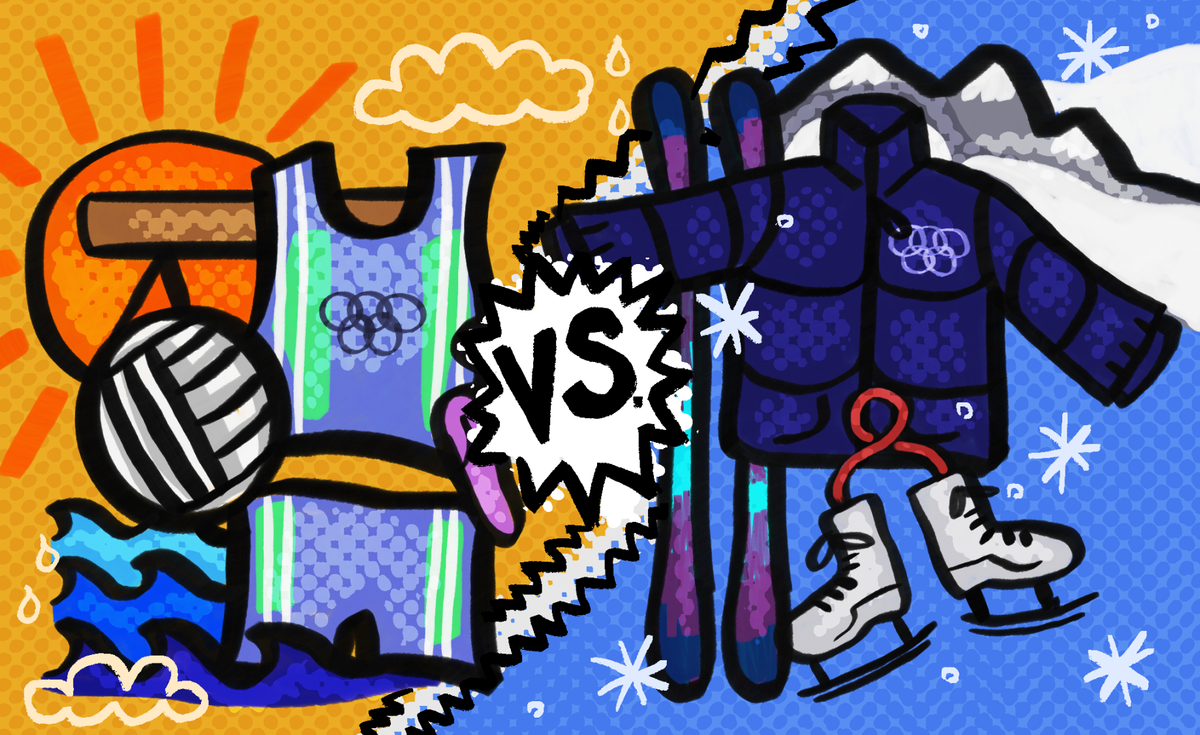
Every two years the world pauses to watch the Olympic Games. Whether they are held under the blazing sun or against a backdrop of snow-capped peaks, both showcase greatness. However, supporters of each insist their preferred season delivers the truest form of extraordinary athleticism. In this head-to-head, the two perspectives compete for gold.
The Summer Games Are Just Hotter
By Clare Genovese
It might be controversial to say in a town full of ski bums and lovers of all things snow, but the Summer Olympics are far superior to the Winter Olympics.
The Olympics website refers to the Summer Olympics simply as the Olympic Games, while the winter events are labeled as the Winter Olympic Games, showing that the Summer Games are obviously the original.
Further, there are more events to watch during the summer. According to the website, there are 16 sports in the Winter Olympics and 35 in the summer. The numbers don’t lie — the Summer Olympics clearly have much more variety than the Winter Games.
This variety matters. There is nothing worse than coming home after a long day, sitting down and turning on the TV, excited to watch the Olympics, only to realize that curling is on yet again.
“I don’t think curling takes any skill at all. I do not understand [it],” said Izzy Watson, junior political science and philosophy major. She said that for this year’s Olympics, she tried to learn the rules of curling because it was always on, but found it unrewarding.
“I watched the video where allegedly Canada cheated, and I don't understand,” she said. “I feel like all of curling is cheating.”
Watson loves the Summer Olympics for its variety of sports and the athletes' personalities. She said all of her favorite events, like gymnastics and tennis, take place in the summer.
Senior criminology major Micah Rich also shares my correct opinion.
“I think [the Summer Olympics] are more entertaining to watch,” Rich said. “There's a more diverse option of different things. A lot of winter sports are just downhill something.”
He also prefers the aesthetic of the Summer Games, citing their vibrant colors compared to the white glare of the Winter Games.
Rich’s least favorite Olympic sport is ski jumping, which he concisely — and correctly — described as: “Not entertaining in the slightest.”
The Winter Games Are Simply Cooler
By Vera Grabow
When blades hit the ice and skis carve into snow, fans settle in to watch what many consider the best version of the games. Winter sports demand a level of technical control that summer events cannot match.
The Summer Games are more traditional and feature more competitions, but bigger isn’t always better. The precision and slower pace of winter events allow storylines to breathe, letting viewers follow rivalries without flipping through dozens of channels.
Gallatin Valley local Josh Elliot said he finds the Winter Games particularly appealing because of their uniqueness. “There’s a bunch of niche-type [sports],” he said.
For Taylor Paterson, a sophomore in the pre-nursing program, the drama is what makes the Winter Olympics superior.
“You’re throwing yourself in the air, and it’s like, it’s crazier stuff. It’s just the suspense, like: is the dude even gonna land the trick?” she said. “I feel like the Winter Olympics are like Red Bull and the Summer Olympics are like tea,” she said.
It’s hard to argue with Paterson’s point when athletes like “quad-god” Ilia Malinin land a quadruple axel and freestyle skier Eileen Gu throws a double cork 1620.
What’s more impressive: a short track speed-skater traveling 35 mph, shoving up against their opponents, blades blazing beneath them on the unforgiving ice, or a track athlete running in circles?
Considering Bozeman’s access to winter recreation, it makes sense that the community might feel a stronger connection to the Winter Olympics.
“There’s more with winter sports here, so you can kind of, you know, relate to the sports more,” Paterson said.
Elliot also agreed that those immersed in outdoor culture find the Winter Games more exciting. “Winter Olympics are definitely for a specific group of people,” he said.
To reiterate: Bigger isn’t always better. The Winter Olympics are steeper, faster and colder, which creates a stronger audience impression.
When the world gathers for the games, there’s nothing better than snow-covered mountains as a cinematic backdrop.
“The Winter Olympics are just more gnarly,” Elliot said.
🌟🌟🌟🌟
While both the Summer and Winter Olympics deliver moments that define generations of athletes through world records and underdog victories, the viewer must decide whether the scale of the Summer Games outweighs the precision of the winter competition.
This debate may never freeze over or burn out, but it keeps the spirit of competition alive long after the medals are awarded.
Comments ()