
Headline: MSU’s New Shuttle System Is a Subpar Use of Resources
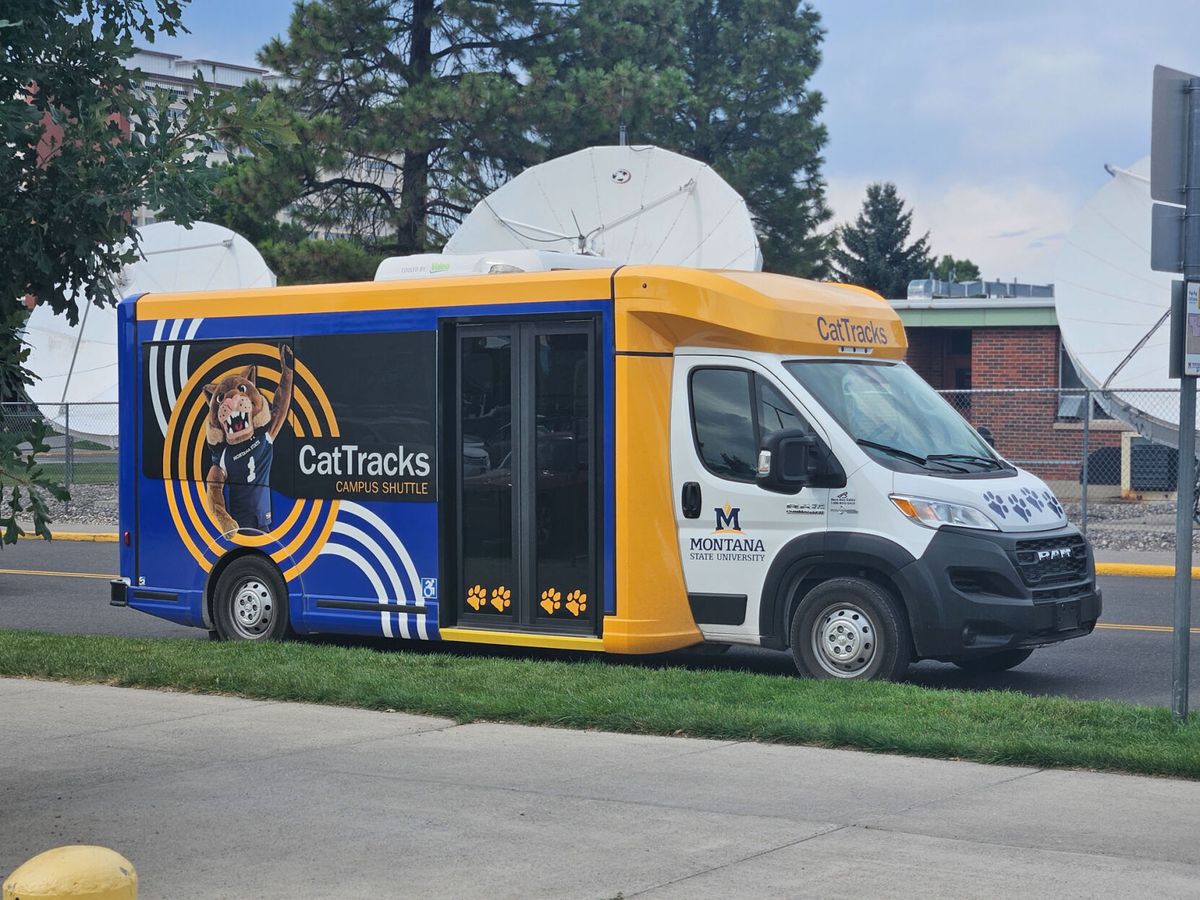
When the Exponent saw that the MSU CatTracks shuttle system had been advertised on the MSU website as “a quick and easy way to get around campus,” we knew we had to try it out. To put this claim to the test, opinion writer Izzy Watson and editor Marquart Doty tried the new shuttle system out.
Watson lives on campus and typically drives as a means of transportation. Doty lives two miles away from campus and usually walks or takes the bus. And so, our fearless reporters set out to answer one simple question: would CatTracks really be quicker and easier than either of these options?
The MSU CatTracks shuttle system was introduced to campus at the beginning of this semester and has two routes that circle the perimeter of campus from 7 a.m. to 6 p.m. on weekdays, according to MSU Parking Services. The Blue line serves key stops at 15th and Glacier, 12th and Garfield, 11th and Grant, Moose Lot 21 and the Nopper Building, while the Gold line stops at Bobcat Stadium, 11th and Lincoln, Centennial Mall, Rendezvous Dining Pavilion and the Strand Union Building (SUB).
Both routes take around 10 to 15 minutes to complete. The shuttle can be tracked by riders using a third-party app called Passio GO!, which typically updates in real time.
Watson:
On paper, the CatTracks Shuttle seems to be a reasonably time-efficient way to get around campus. However, in practice, there are many areas where the system falls short of this promise.
The Blue line promises to transport students from the Hedges to the Technology Park across 19th. With stops conveniently placed near academic buildings and parking lots, it seemed like an ideal solution for getting around campus. Or, at least the outer edge of campus. Since I live in the Julia Martin Apartments, the stop on 15th and Glacier would — theoretically — be helpful for me. I wanted the shuttle to be a resource that I could use daily.
When I decided to try and ride the Blue line, my hopes were dashed by the fact that I could not seem to find a time where the shuttle was even in operation. At certain times, it seemed to have stopped operation earlier than advertised, and one time, both lines were down for at least a whole day.
Finally, after many failed attempts, I was able to get on the shuttle. As I stood waiting, questions lingered in my mind: Who is this shuttle system really for? Was it something that students and faculty wanted, or was it a solution for a problem that didn’t even really exist?
The bus itself was clean and the ride smooth, offering a brief moment of comfort, but even these positives couldn’t make up for the shuttle's lack of punctuality and overall uselessness as a reliable transportation option. The frustration of waiting far outweighed any benefit the ride provided. A pleasant bus experience is meaningless when the system can’t be relied upon to get students and faculty where they need to go on time.
It is clear to me that the shuttle system falls short of its intended purpose, whatever it was. The system feels more like a well-intentioned idea that never fully considered the realities of campus life.
Doty:
I took the Gold line. The shuttle itself was brand new, super clean and even played music. It came right on time for me and was easy to track in the app. Students definitely use it — but not en masse.
To me, the route only seemed convenient if you’re in a pinch for time or can’t walk. The first stop was Bobcat Stadium, which takes me 10 minutes to walk to from the SUB. It took four minutes on the shuttle.
As a matter of fact, everywhere on the route is less than a 10 minute walk. I cannot imagine how saving students less than 10 minutes is a wise use of resources. Of course, the shuttle will be convenient when freezing temperatures hit, and is convenient for students who cannot walk. But I regularly walk 10 minutes from my house to the bus stop — even when temperatures reach the negative — with zero issues. I know lots of people who do the same.
My real concern when it gets cold — as is the concern of every commuter without a car — is how to get home when the Streamline stops running. Like many students, I have obligations that often keep me at the SUB or the library past the Streamline’s stop time at 9 p.m. Last winter, I slipped on the ice while walking home in the dark twice. I regularly have to bum rides home because it feels unsafe to walk at night in the winter.
Some universities like Maryland Institute College of Art or University of Chicago have evening shuttles that students who live within a few miles of campus can call for a ride directly to their house. While students do seem to use the new shuttles, they’re simply not the best use of resources. MSU should consider using the shuttles to help students get home after the Streamline stops running or to go out to places Streamline can’t reach like Belgrade.
While MSU’s shuttles could play a vital role in the campus community — like helping students get home at night — it seems they’re instead being used for trips that would only be a slight inconvenience to most students.
Ultimately, we decided that the CatTracks Shuttle System is not a transformative resource. Instead of serving more useful functions, CatTracks offers solutions for low-priority problems. It is a missed opportunity and fails to meet the potential it has to truly improve quality of life for students.
Comments ()