
How grad students work with Bobcat athletes
Thousands of fans file into Bobcat Stadium for home football games to cheer on the team, but few get to see the work that goes into keeping the players healthy enough to perform their best.
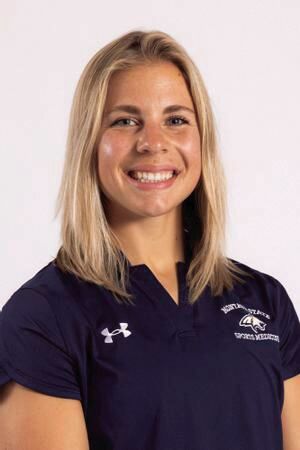
MSU has three graduate assistant (GA) athletic trainers who work for the football program while also pursuing their master’s degrees. Shian Hanks has worked at MSU since 2022; Anandi O’Neal and Olivia DeLuca both began working at MSU in July of 2023.
Under the direction of Head Athletic Trainer Rob Higgs the GAs will continue to help athletes at MSU, all while gaining valuable experience and striving for a master’s degree.
Each of the GAs has already completed a bachelor's degree in the sports medicine and other related fields and have become board-certified athletic trainers. “I’m certified, licensed and credentialed,” O’Neal said. “I’m a sports medicine specialist. I’ve got a couple letters behind my name.”
O’Neal explained that a typical day for a GAs involves arriving at the Bobcat Athletic Complex (BAC) before morning practice at six a.m. The trainers then prepare for practice by getting water, Gatorade and emergency medical equipment like AEDs ready. They also open up the BAC and the various training rooms in order to ready them for athletes’ usage throughout the day.
Once players begin arriving for practice, the GAs help them with their taping. Taping is the process of applying athletic tape to certain areas of the body to help stabilize muscles and bones during physical exertion. “Mostly ankles and wrists and stuff like that,” DeLuca said. “We have a couple of guys with elbows and knee [injuries] so we’ll do a specialty tape with them too.”
The practices are then carried out under the watchful eyes of the GAs, with each of them often working with a specific group of players, often divided by position. They support the players by helping them with any muscle tweaks or last-minute taping they may need, according to DeLuca.
After practices, it’s often time for players recovering from injuries to do their rehab sessions. Players just starting their rehab program are often accompanied by a GA throughout the early stages of the process to ensure all the required workouts are performed properly. “If they’re new, we stick with them a little bit more so they feel a little more comfortable,” DeLuca said.
Players continue to filter through the BAC throughout the day doing a variety of workouts or training, so at least one GA stays in the building at all times to support the athletes until all workouts are done for the day. This means that the GAs find themselves spending some days in the BAC from six a.m. to six p.m. with a break between 11 a.m. and two p.m., according to both DeLuca and O’Neal.
On top of all the time spent supporting the Bobcat athletes, these GAs are still students who have to find time throughout the day to do homework for their evening classes. “Whenever we have downtime, I try to get as much homework as I can done just because I really don’t have time throughout the day,” DeLuca said.
Athletic training is a demanding, time-consuming profession. Doing the job while attending classes leaves little time for other interests, so the GAs are conscious of the fact that they need to find outlets to decompress. “Athletic training can be a very fulfilling job when you work on someone and see immediate benefits or sometimes progressive growth as they recover,” O’Neal said. “But like all people, you need to take the time to take care of yourself.”
Another obstacle is that the injuries they see can affect them mentally. Relationships and bonds are formed with the players they spend time with so they share in the ups and downs that are hallmarks of any rehab process.
“It’s not about me. I can go home and deal with my emotions later. But when it’s a guy you’ve built this relationship with, it's tough,” O’Neal said.


Comments ()