
‘I realize that feels like a betrayal’: City Commission approves purchasing agreement with Axon Enterprise
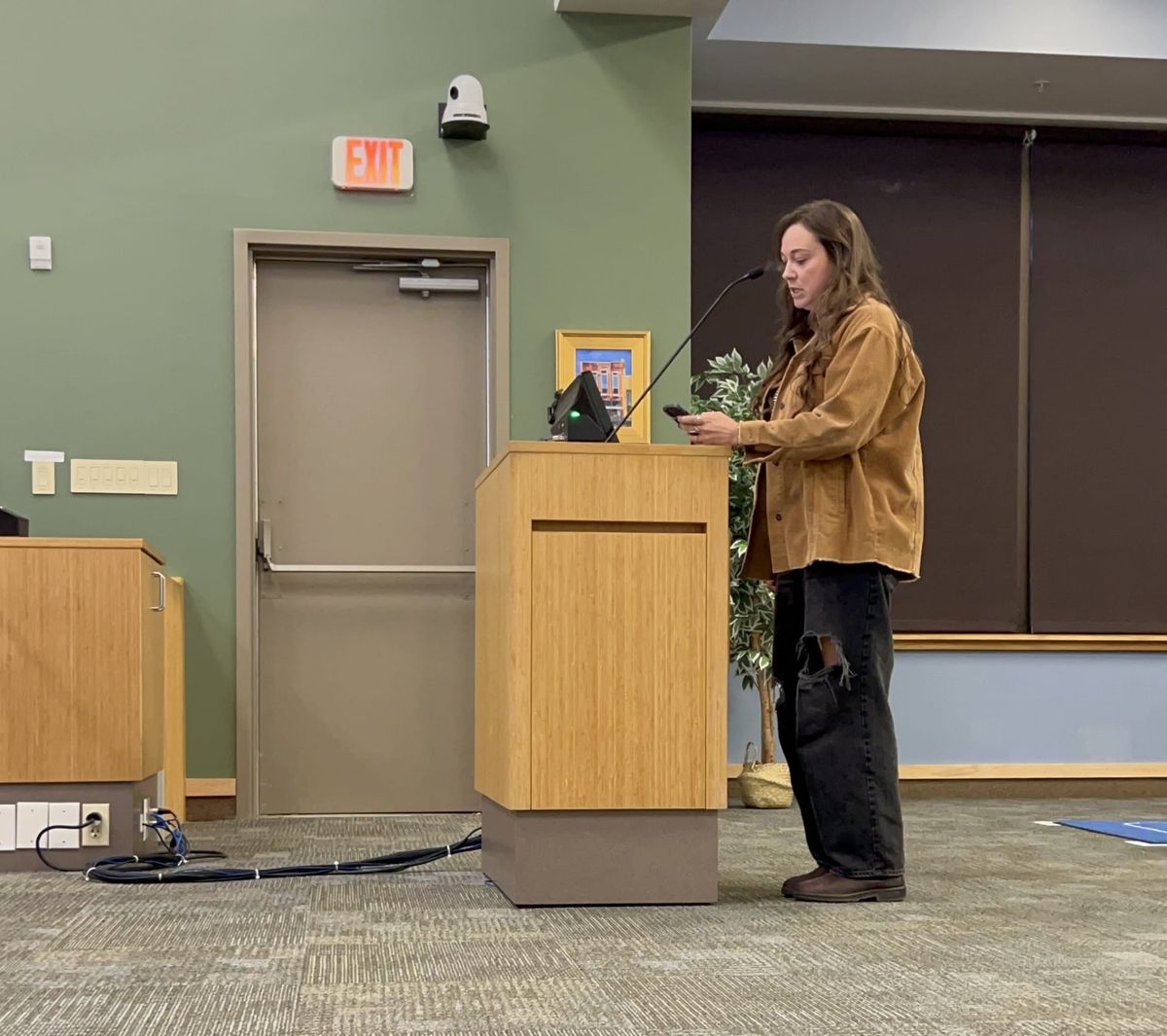
On Oct. 20, the Bozeman City Commission voted to approve a $2.4 million purchasing agreement with Axon Enterprise Inc. — an American public safety company — for body-worn cameras, tasers, patrol vehicle cameras and digital evidence management services.
The decision was met with heavy criticism from some members of the community who attended the 6 p.m. commission meeting and gave public comment.
Several attendees raised concerns about privacy and public safety related to the use of AI, facial recognition features and cloud-storage. Many speakers asked the commissioners to postpone consideration of the purchasing agreement to allow for further community discussion.
The commissioners affirmed their stance following public comment, moving to proceed with the consent agenda, ultimately voting to approve the purchase agreement.
“I am going to vote for this item tonight. I realize that feels like a betrayal,” said City Commissioner Alison Sweeney during the meeting.
Daisy Baertschi, a member of both Montana 4 Palestine and Bozeman’s chapter of Freedom Road Socialist Organization, said they heard about the agenda item and the two organizations were immediately concerned about why Bozeman was signing a purchasing agreement with the company.
In their public comment, Baertschi told the commission that Bozeman’s purchasing agreement with Axon would contribute to a broader surveillance economy in which private technology companies profit from the expansion of surveillance capabilities.
“I think the most important part is that society and the companies and the structures that exist in it do not ever exist in a vacuum — and nor do the decisions of politicians exist in a vacuum. There is a money trail everywhere,” Baertschi said in an interview with the Exponent. “And the question that was raised tonight is do we give two and a half million dollars to a corporation that is known for wanting to expand the surveillance net on Americans, which is an extension of American foreign policy at home — this pressing down of American foreign power, particularly on the Middle East, and then at home here with the Department of Homeland Security.”
Baertschi said they expected the vote to go through despite the public comment.
“[Sweeney] said it, ‘This feels like a betrayal,’ this feels like a slap in the face,” Baertschi said. “They ran on certain principles. Many of us voted for them on those principles.”
Mayor Joey Morrison said surveillance systems, specifically Flock Cameras, has been a controversial topic.
“These are not poles around town with cameras on them,” he said in an interview with the Exponent. “That's never been part of it.”
Bozeman Police Department’s (BPD) Deputy Chief Joe Swanson said Montana law restricts law enforcement's use of facial recognition and requires a search warrant for specific uses. Further, Swanson said Axon’s body cams do not offer facial recognition capabilities. The in-vehicle cameras have license-plate recognition technology, but Swanson said that feature will not be turned on and officers will not be able to switch them on.
According to him, the new equipment is intended to improve reliability, evidence storage, data management and the transfer of evidence to prosecutors.
“Privacy is extremely important to people in Montana, and it is to us,” he said “[We are] ensuring that we are safeguarding the information the best way possible.”
Additionally, Swanson said the $2.4 million dedicated to purchasing and restoring equipment had already been approved into the department’s biennial budget.
Morrison said that the purpose of the commission room and the meeting of the commission is to conduct the business of the city.
“It’s not that decisions are already made,” he said. “But there are probably decisions before the one that's on our agenda that have been made and have narrowed the sandbox of what we are discussing.”
According to him, this confusion can cause tension.
“I think it starts to frustrate community members and it frustrated me, as a member of the public, [when people] — without understanding what was going on — show up and say, ‘Turn this down, vote no on this, never look at this again.’ And it's like, okay, that's not an option. We have a policy, the community clearly wants us to have dash cams and body cams for our law enforcement.
“[BPD] went through a process to determine the best possible vendor and negotiated a good contract,” he said. “So it could look like there's decisions that have already been made. But the reality is our staff followed a policy that was set by the commission and set by the community for years and years and years — for decades now.”
For Baertschi, the frustration and building mistrust can be traced back to previous disagreements between the commissioners and some members of the public.
“I remember Douglas Fisher talking about how he didn't actually want more police officers — he wanted police officers positioned better,” Baertschi said. “And what has he done so far to actually stop the influx of hiring police officers? It's not publicly held.
“Especially watching Mayor Morrison — a working class candidate elected by the tenant union. It is very disheartening to hear from them. It feels like a betrayal. And to them, it isn't. Because they can hold their values and they separate them from their political actions. But to us, it's all the same,” Baertschi said. “We see nothing about what they personally believe — we see what they do and we feel what they do. They affect public policy and it's very shallow.”
Morrison said his door will remain open for conversation.
“I was once a community organizer who was turning out people to public comments, just like they did last night,” Morrison said. “And [I realized] that, that isn’t how things get done — you can’t just cajole people into doing what you want.”

Comments ()