
India Night Celebrates Togetherness in the MSU Community
“India is a garland, made of flowers of different colors and different qualities,” Sreekala Bajwa, Dean of the College of Agriculture said, smiling out into the crowd at India Night last weekend. “And as I look into MSU and the Bozeman community, that is the metaphor that comes to my mind. We have people from different parts of the world, bringing different cultures, different foods, different experiences and perspectives.”
On Saturday, Oct. 29, the SUB ballrooms came to life with gentle Desi acoustics and low conversation as the chairs filled. On a stage adorned with star-shaped string lights and golden candles, Indian Students Association (ISA) President Toral Gupta explained how happy she was that “[The ISA] is here with you all after so long.”
The last India Night was in 2018. This chilly October evening marked the return of a beautiful MSU tradition.
India Night honors Diwali — a traditional Hindu celebration — and it’s arguably the biggest festival in India, according to Venkata Krisshna, ISA’s social media manager and former president.
India Night kicked off to a full crowd. The overarching goal of the event was “to showcase diversity, culture, art and the food of India,” said Tejas Bajwa, one of the masters of ceremonies (MC) of the occasion.
India Night, along with celebrating Diwali, intended “to share the culture and the diverse lifestyle of India and to promote the togetherness that we follow,” said Krisshna, the second MC of the India Night event.
Krisshna is a mechanical engineering Ph.D. student at MSU who was born in the coastal city of Chennai, India, in the Tamil Nadu province. “[Diwali’s] background is deeply rooted in mythology. But despite it being a Hindu festival, everybody celebrates it,” he said.
Diwali originated, Krisshna explained, as a celebration of the return of God — through an avatar named Rama — to a city in India.
“Rama was a prince,” Krisshna said. “He was an incarnation of the God [Vishnu] himself. But due to some promises that were given in a political situation, he had to denounce the throne and go into exile with his wife, Sita, for 14 years. And during the exile, Sita was abducted by an evil king.”
“Rama was able to save Sita and bring her back to his kingdom. And when he brought her back, is when the story of Diwali started,” Krisshna said.
“The people of his kingdom were so happy. They loved Rama and Sita. They lit up the entire [kingdom] with lamps, lights of all sorts. That's how it started — an entire kingdom coming together to welcome Rama and Sita back home,” Krisshna said. “[Rama and Sita] are basically incarnations of God. So, the people were welcoming the blessings of God back to their kingdom and country. That's the story of Diwali. Diwali is about prosperity, it’s about welfare.”
Sreekala Bajwa expanded on this explanation during the opening presentation of the night. “It’s spiritual. It’s a celebration of the victory of good over evil, light over darkness, and enlightenment over ignorance,” she said. “It's also a celebration with the family and community members.”
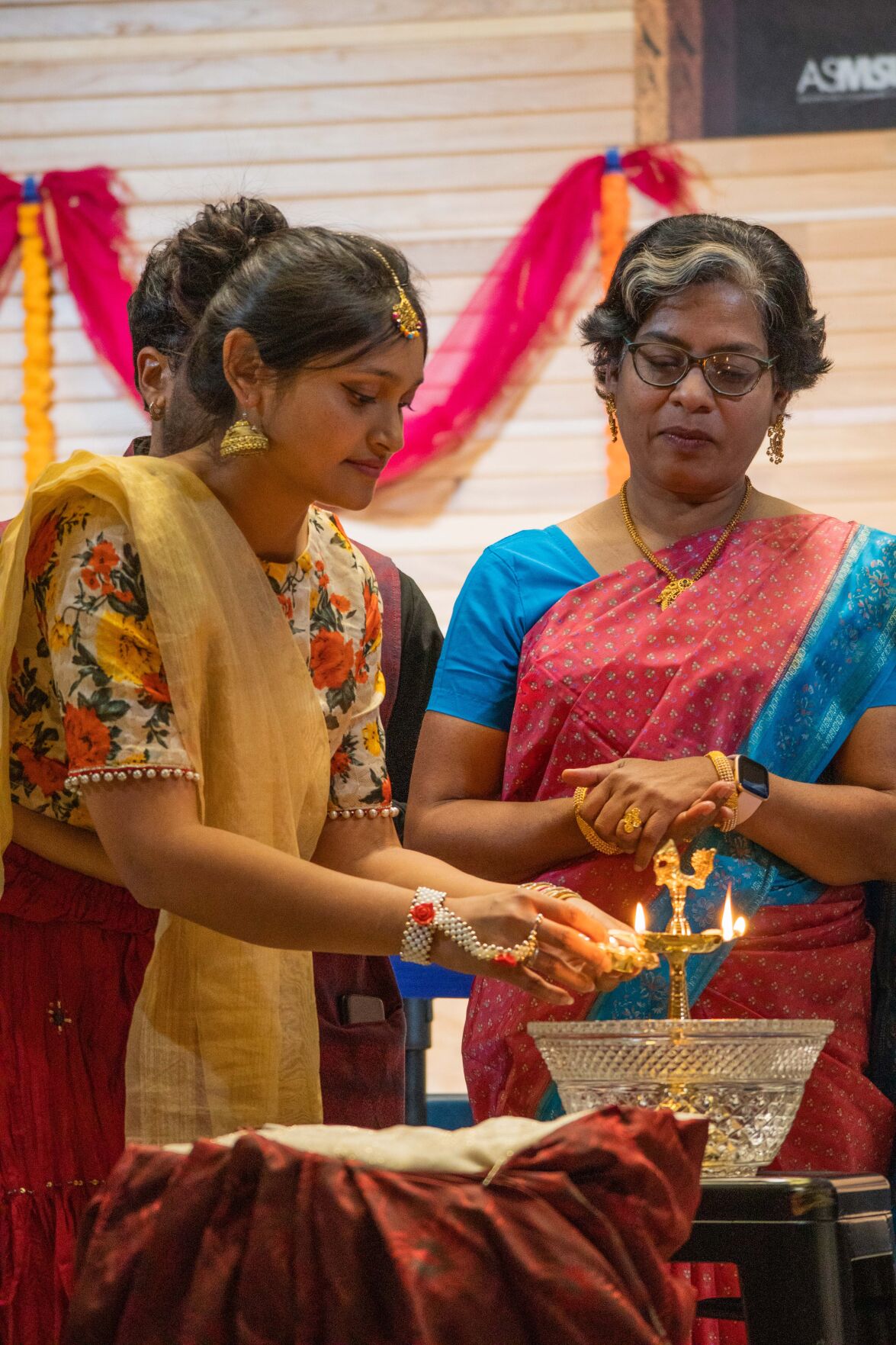
Some Indian decorations that were shared with the crowd included small diyas, handmade clay lamps that symbolize the victory of light over darkness, as well as a rangoli in front of the stage. Rangolis are traditional decorations drawn on the floor before a home to bring prosperity to the family inside.
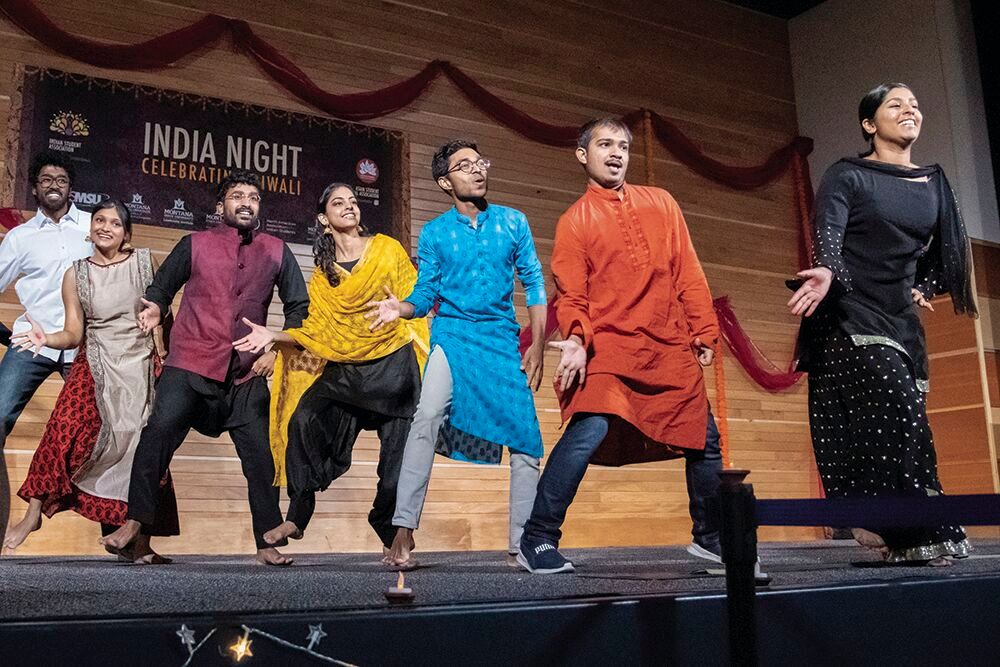
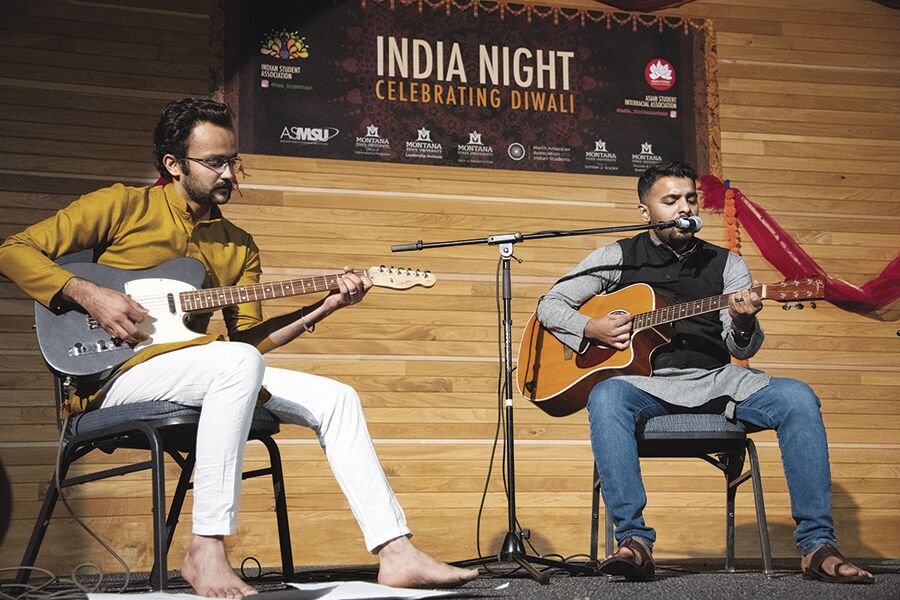
Set to a backdrop of carnation garlands and rose-pink sarees hanging from the walls, India Night saw many talented performers — dancers, singers and musicians alike — wow the crowd with their skills and demonstrate some cultural talents of the Indian population of MSU.
After seven wonderful acts, the finale stole the show. As the swirling fabrics of dancers — ivory, orange, white and blue — flashed in the spotlights, everyone in the crowd seemed to be smiling. The performers’ joy was infectious, and their energy even more so. Attendees clapped along, sang, and shouted. Small children danced in the aisles as dozens of cameras fixated on the scene.
“All of us love to perform, and the added bonus is that we are showcasing our culture to the community that loves to see it,” Krisshna, who performed during several of the acts as well as the finale, said after the event. “Even if I make a mistake, I smile.”
Dilpreet Bajwa, department head of MSU’s Mechanical and Industrial Engineering college, explained the purpose of the performances that occurred during India Night. “It helps those who aren't Indians to learn how celebrations happen in India,” he said. “This is an opportunity for undergraduates, graduates, faculty, and the community to come together and know each other.”
Dilpreet Bajwa was born in India and immigrated to the U.S. in 1993. He began to work for MSU in 2019. He and Sreekala Bajwa helped the ISA this year with logistics for India Night, as well as performance tips. Explaining his own connection to Diwali, he reminisced on his experience in his home country. “[India Night] connects us with our culture,” he said. “It's nostalgic, it reminds us how we celebrated.”
India Night was an effort that required the collaboration of several groups. The Asian Students Interracial Association (ASIA) and the ISA worked together to bring the event together. Bree Achong, the director of outreach for the ASIA, explained, "We all try to help not only MSU students, but the Bozeman community at large become invested and help celebrate Asian cultures, as well as make it a space of learning and respect.”
However, the ASA and ISA were not the only groups that supported India Night. The finale dance included members of the ISA, ASIA and the Bangladeshi Students Association. An Indian dinner was prepared by the ISA and the Sri Lankan Student Association and helped by University Catering Services. However, most of the actual cooking was done by students and crafted with love, Krisshna said.
“Without a community to celebrate it with, Diwali is meaningless,” Krisshna explained during the performances. “It's not just the community of Bozeman we are with tonight. It's Bozeman and beyond as well.”
After the event, Dilpreet Bajwa said he was touched and humbled by how it came together..
“It was fantastic. It was brilliant. [The students] were able to put everything together, raise funds, organize and train performers in a short time,” he said. India Night offers a glimpse into a very multicultural country to Americans. It is a garland of many flowers. Everyone has a different scent. It represented India from East, West, North and South — all over the country.”
Krisshna said there’s no harm in wanting to know more about another culture. “There is nothing wrong with asking a question,” he said. “And I think an event like this is going to answer questions for students who have them.”
The ISA, which has roughly 50 members, also intends to put on a three-day student retreat next semester to support student mental health, Krisshna said. The retreat will feature anxiety-reducing techniques such as “meditation, breathing exercises and yoga.”
However, the ISA’s primary objective is to continue to promote the community that is so present in India. “That's the goal of ISA — to promote the culture of India and the togetherness,” Krisshna explained. “There's one concept in Indian culture, it's in Sanskrit. It's called Vasudhaiva Kutumbakam. It means that the entire world is one family. And in everything we do, we try to follow that.”
The clamor of ‘togetherness’ continued on long after the performances were done as attendees stuck around to enjoy the food and company and the low music continuing to play under the chatter of hundreds of different histories.
Comments ()