
Indigenous beadwork event threads community
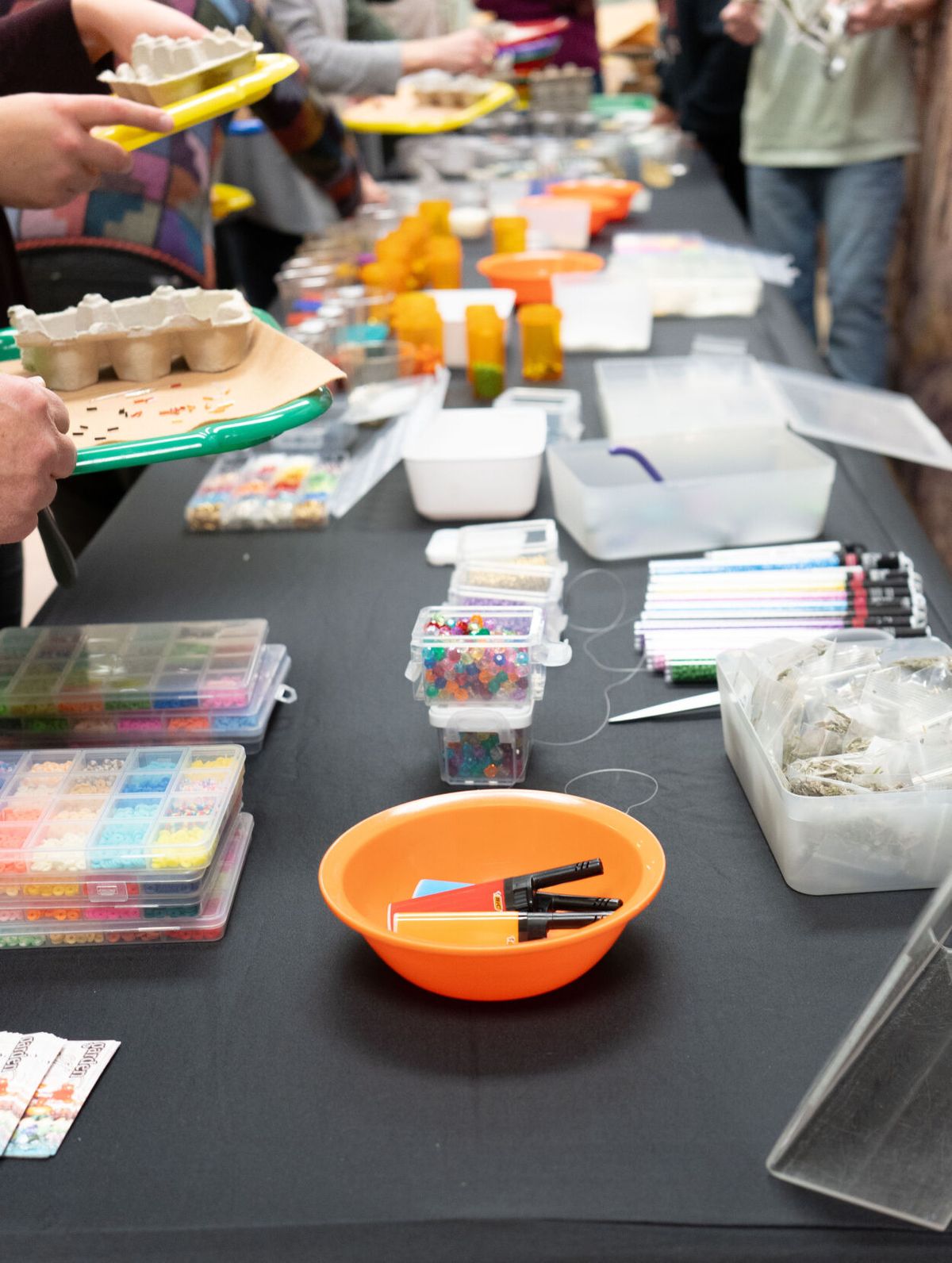
The Museum of the Rockies (MOR) recently held an educational event inviting participants to learn about the beading styles and practices of different Indigenous cultures.
On Friday, Jan. 30, attendees made jewelry at “Beading Our Stories: Beading Earrings Workshop,” which was created and taught by MOR Museum Education Specialist MaggieJo Widdecombe.
“I have been wanting to do a workshop like this for a while,” she said. "This is the first one — kind of a pilot.”
Widdecombe is a descendant of the Red River Métis Tribe in Canada. She grew up on the Northern Cheyenne Reservation in Ashland, where she learned beadwork from her auntie and by watching other elders.
“In the Native way, we really believe that it takes a village to raise a child,” she said. “So, you have relatives that are not by blood, but you are adopted through that [community].”
The class began with a presentation from Widdecombe on the history and significance of beadwork to Indigenous tribes.
She said her own work combines two styles: the Métis beadwork — involving lots of floral patterns — and the Cheyenne way, a more contemporary method that features triangles.
During her presentation, Widdecombe said different color schemes have unique meanings for tribes. For example, the Crow Apsáalooke tribe has a very distinct pink color, known as crow rose, or crow pink. They don’t usually use black in their beading, as it's a color of mourning.
The Northern Cheyenne will often incorporate sunset or fire colors like reds, oranges and yellows, according to Widdecombe. “They use a lot of colors that are associated with the medicine wheel, which is red, yellow, black and white, traditionally,” she said.
There were a variety of beads available to participants, including imitation bone beads, metal charms, plastic basketballs and all sorts of colors of crow beads, which are smaller, glass beads often used in Indigenous beadwork.
After the presentation, attendees picked out beads and began working. Participants Ali Holst and Kaia Batton both said the hardest part of the project was picking out colors.
“It was cool to have the history aspect,” Holst said. “I wish I had a little more thought going into my colors to tie into the storytelling piece — it's just colors I like.”
For this workshop, attendees were shown how to make one classic earring design. “In the future, I want to expand it so we can do different things,” Widdecombe said.
She added that she’d also like to include designs such as the earrings she wore that day, which were thicker circular pieces that required a more complex technique to create.
Each participant had printed instructions to assist their creative process. “It takes a lot of patience,” Batton said as she meticulously strung the small beads onto her thread.
Holst, who discovered the workshop through her friend, said that after arriving, she sat down at a table in the classroom and started chatting with some other participants.
“We just met each other, but we're friends now,” Holst said. “[The class] is great, I feel like I'm a bit of a perfectionist, so this is a little hard, but I'm enjoying it.”
Widdecombe said she was very excited to share her knowledge and love of beading. "My goal for this workshop is to just introduce this topic to people,” she said.
“[People] might think, ‘Oh, this is just a Native thing,’ but beadwork has been around for thousands of years, and a lot of cultures do it. It's not just Indigenous peoples,” she said.
Widdecombe believes beadwork can help bring people together. “It’s a good tradition to pass on, it gets passed on through generations, and it's a really fun thing,” she said.
For more information on the MOR, visit https://museumoftherockies.org/.

Comments ()