
Isabel Allende celebrates heritage and storytelling at MSU
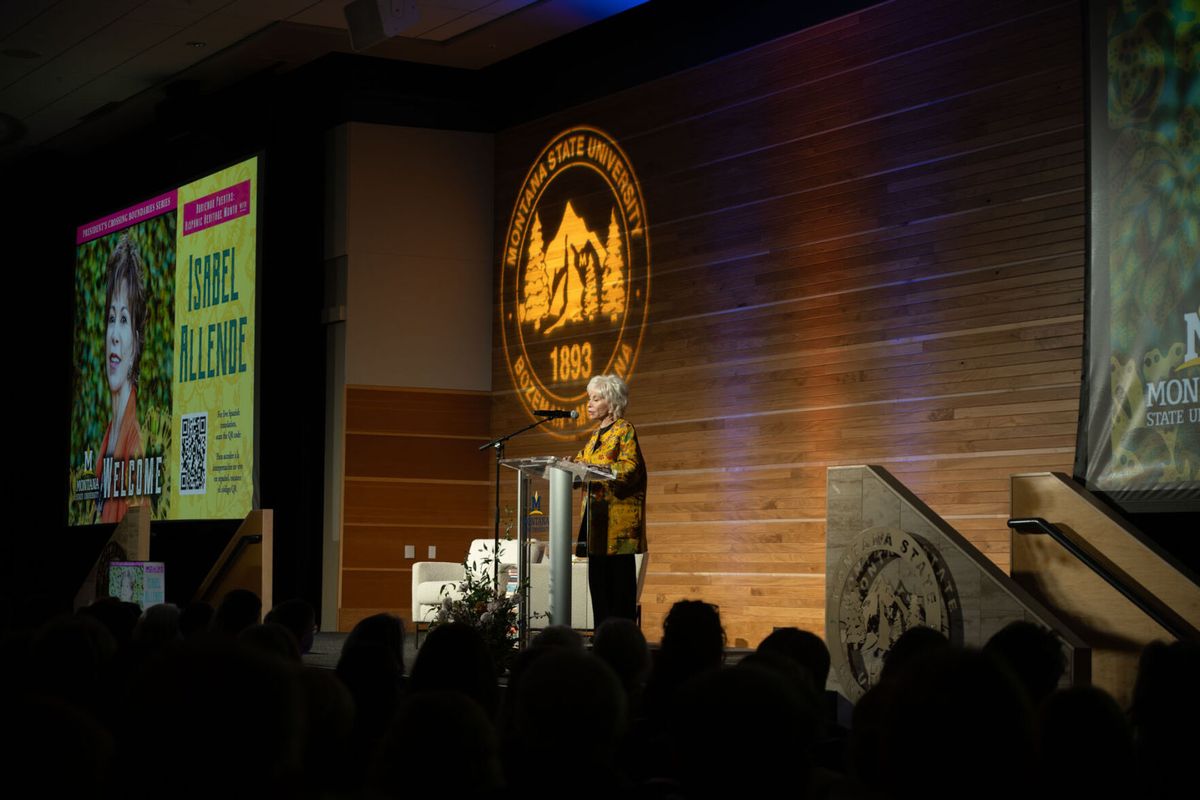
Last Monday, the stage in SUB Ballroom A held two white armchairs centered between a tall stack of books and a glass top fashioned to serve as a statement table. With the books provided by Renne Library staff, the table represented a mere fraction of Chilean-American author Isabel Allende’s life work.
On Sept. 30, MSU hosted the second annual “President Crossing Boundaries Speakers Series.” According to the MSU website, the series “welcomes speakers to campus who have gone on remarkable journeys to cross seemingly impassible boundaries.”
For the second series of the 2024 school year, MSU welcomed Allende, the author of 27 novels that have been translated into more than 40 languages. The event, titled “Abriendo Puertas: Hispanic Heritage Month with Isabel Allende” was intended to celebrate the influential Latina figure. On stage that night, Allende spoke about her life's journey, followed by a Q&A with MSU President Waded Cruzado.
Allende is known for her visionary narratives that intersect with critical historical context. Her novels marry the worlds of romance, history and Allende’s personal journey. During her speech, Allende spoke first of her childhood. She was born in Peru, but moved to Chile with her family. However, in 1973, her father’s cousin and president of Chile, Salvador Allende, was overthrown by members of the Chilean Armed Forces. Allende, who was 31 at the time, worked to arrange safe passage for those wanted by the perpetrators of the coup — until she was placed on that same wanted list and forced to relocate to Venezuela.
“I have been a foreigner, a refugee, an immigrant,” Allende said during her speech while recalling her earlier life. It was then that Allende explained she began her journey into the world of literature. “Writing has helped me survive. It’s given me the capacity for joy. I am a very happy old woman.”
Her novels often discuss the realities many Latinx communities navigate. Because of this, Allende was a perfect candidate for the speaker series that fell during Hispanic Heritage Month. A driving force behind this choice was junior and chemistry student Gavin Thorson.
“It all started when I was co-director of the Honors Presents Lecture series for [the] last academic year,” Thorson said. “Last summer when we were talking about big speakers that we could get to bring, I suggested to Dean [Ilse-Marie] Lee, at the time that we could bring Isabel Allende and she said, go look for the money. So, I started looking for that and it turns out that most department heads and important people don't care if a sophomore asks them for money.”
Nevertheless, Thorson — who described himself as a language enthusiast and an avid fan of Allende’s work — persisted and was able to arrange this speaker session to further celebrate Hispanic Heritage Month.
“I like learning things,” Thorson said. “Allende gives me an opportunity to both read my lovey-dovey stuff and understand the historical context. That's what she gives to — I think — a lot of people. Particularly in that time period of like, in her earlier career, like 1950 to 1980, because [it follows historical moments] of feminism and the dictatorship in Chile. And then, nowadays, she's writing about these modern border crises. So just a lot of [exposure] to things that we don't hear about.”
Thorson further explained why he believes that reading Allende’s novels is a critical part of understanding immigration rhetoric in the U.S.
“Because we don't have to be this English language [hegemony]. That's required nowhere. That's written nowhere in the law. Hispanic Heritage Month means, yeah, we can talk amongst ourselves. We can connect like that,” Thorson said. He explained that many of her novels follow the stories of migrants, and encourages everyone to read these stories as they are probably ones they haven’t heard before.
“And when you think about what's happening in the world today and how we deal with people moving around, [it is a reminder] that everybody requires a little bit of grace in how others treat them, because we don't know their full story,” Thorson said.
Thorson said that he values Allende’s work because she’s had the gauntlet of human experience and also knows how to talk about it.
“She's an excellent writer and she's able to communicate these hard truths and these exciting truths and just so many things about the human experience that a lot of writers, some of them men, don't know how to say,” he said.

Comments ()