
Magical discoveries in the center of Bozeman at the Cabinets of Curiosity
Story Mansion typically sits quietly in the heart of Bozeman, but for two weeks between March and April, the fictional Raven’s Eye Society showcases their revelations in their “Cabinets of Curiosity” exhibition.
This is an event put on by Random Acts of Silliness, a Bozeman organization that aims to “build community by sparking whimsy and creativity in the young — and young at heart — through original and engaging art installations,” according to its website.
Walking into the Story Mansion, visitors are introduced to the layout of the exhibit: nine cabinets each with different magical displays. They are also given a small booklet with information on each exhibit. In addition to the cabinets, there are letters hidden around the rooms that visitors must take note and arrange to fill out the anagram on the last page.
To the immediate right of the entrance is “Luella’s Phonarium,” an exhibit by Luella Sybilla created by artists Marla Goodman and David DiGiacomo. Sybilla sought to preserve the sounds of various natural occurrences such as trees and moonlight, as well as the singing of fairies and mermaids. In each drawer of her cabinet — sorted by specimen — there are artifacts from these creatures and places, such as shells, small glass bottles and jewelry.
In the same room lies the work of Rosemary Vivalter — also known as Kelly Hartman — who was a founder of the lepidopterology field, or the study of butterflies who mimic the appearance of plants to camouflage themselves. All of the butterflies in Vivalter’s collection are native to Montana, such as the Papilo lupinus, a swallowtail butterfly with the resemblance of the lupine blossoms, the first species she discovered.
To the left of the main foyer of the mansion lies “Wilde’s Mystic,” a collection of work from the eccentric Wilde Wunderly, also known as Deva Gallagher. On her cabinet lies a plush box of plants and insects petrified in copper, as well as a notebook with many sketches of her discoveries in the world she called the “Mystic,” such as the Night’s Robe and Sliplace flowers.
In the latter half of this notebook, past a page called “A Return to Reality,” Gallagher reveals her creative process. In one entry, she describes the metalsmithing process of the petrified plants and insects, saying she used a method called “chasing and repoussé,” where the metal is shaped on either side by various tools and then heated to soften it.
In another entry, Gallagher simply states, “Cutting butterfly wings out of watercolor paper requires a sharp blade and a steady hand,” which anyone who has worked with this material can relate to, as watercolor paper is prone to tearing, folding and having fibrous, unfinished edges if cut with a dull tool.
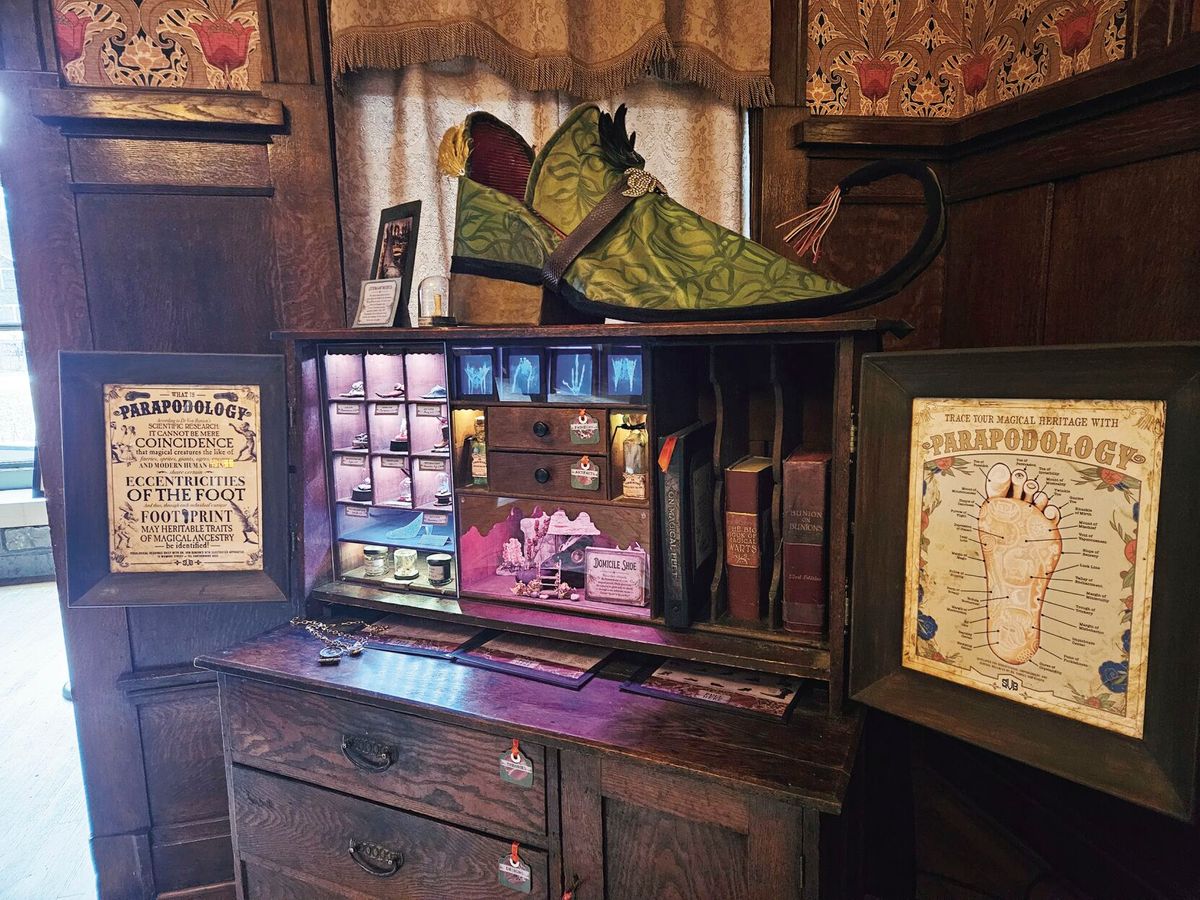
In the room adjacent to the entrance is Dr. Von Bunion’s Podarium, a collection of footwear from creatures such as fairies, elves, gnomes and unicorns. Most curiously, on top of the display sits a small glass cloche encasing a small foot labeled “human foot for scale” next to a massive paper-mâché replica of the shoes worn by the levitating giant.
There is much more to discover at this exhibition and there are fun ways to interact with each installation, such as dimming and brightening the light in a cabinet with butterflies and plants in order to witness their “shared energetic web,” or visiting the podarium and finding out who their magical ancestors were through the discoveries of Von Bunion.
This exhibition runs through April 14, and other events and installations organized by Random Acts of Silliness can be found on their website: https://www.randomactsofsilliness.com/.

Comments ()