
Make Room for Bees
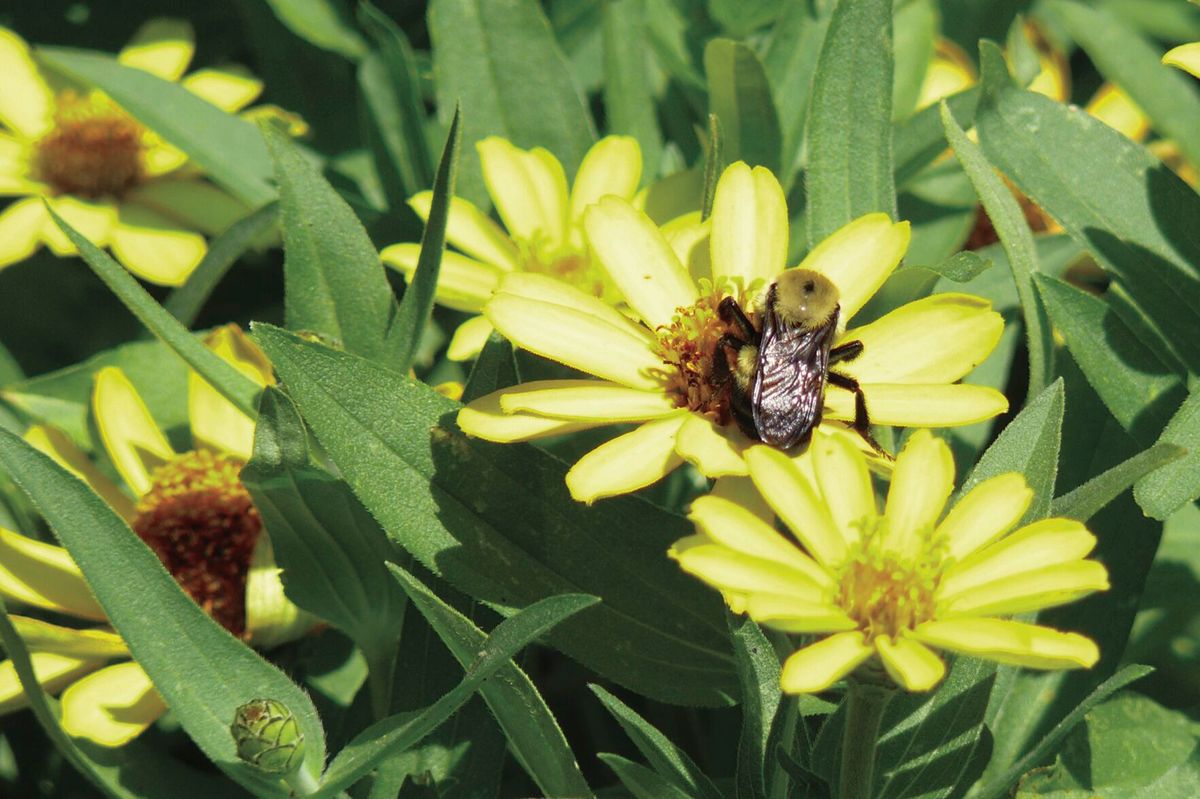
If you ever hear the sound of a lawnmower, part of the noise includes the screams of the native bees being blended.
Just kidding.
However, this statement is correct in spirit because native bees can set up nests under leaf litter and in plant stems — even though they don’t scream. MSU has an interesting record when it comes to landscaping around campus. Most of it is just grass, but they planted a few vegetable plants next to the Strand Union Building. There is also an initiative to create landscaping with native plants around campus — but the correct efforts are not far-reaching enough to support the local insects.
Has anyone noticed the native plant section on that small strip of dirt near the Leon Johnson Annex or the indigenous gardens surrounding American Indian Hall? The fact that there is land sectioned off for native plants is great and seeing it used to culturally enrich campus is a great idea — there just needs to be more of it.
MSU is dedicated to creating a campus that is inhabited by all different kinds of animals. The presence of ducks, crows, rabbits and owls means that MSU is functioning as a part of the landscape.
However, the problem is that when it comes to the smaller creatures of the insect variety, this college campus has issues. There is a push and pull between the clean-cut landscaping of campus and what is actually beneficial for the environment.
When people think of bees, they usually think of the social, hive-minded European honey bees. However, the vast majority of our native bees are not social and live solitary lives in small tubular holes in the ground. These include long-horned bees, metallic green bees, leafcutter bees, mining bees, mason bees, digger bees, sweat bees, sunflower bees, polyester bees, orchard mason bees, digger bees and small carpenter bees, according to MSU’s bee identification guide and the U.S. Forest Service’s Native Wildflowers and Bees of Western Montana guide.
The native plants around campus make it seem like the landscaping is set up to benefit our local pollinators, when in reality there are no artificial nesting sites provided for our native bees.
In order to create places for native bees to live, campus should instead turn these areas into functional bee resorts with added floral flair. It can be as simple as drilling holes in a block of wood — a practice which provides solitary bees a place to establish their next generation. They could also implement native plants that bloom during active periods of these bees as well as creating nesting sites that can turn parts of campus into functional pollinator gardens.
A research project completed in 2016 headed by principal investigator Laura Burkle, an ecology professor at MSU, examined the effect of native perennial flower strips on native bee population density and pollination services. The research displays just how many bees show up within these perennial flower strips. This report shows that there is high bee visitation from native bees in these strips. So, all we have to do is put up little houses to create beautiful pollinator resorts.
The goal here is not just to build bee houses. In order to create a landscape that is able to support all walks of life, native bees must be provided for. Researchers are quickly understanding the importance of native pollinators in our environment. There is an opportunity present to diversify the look of the campus and create environments for local pollinators to live.
Comments ()