
MSU alumnus shares paleontological findings about Arctic dinosaurs
People tend to envision dinosaurs roaming in a hot and humid rainforest, but new research by an MSU alumnus working out of Fairbanks, Alaska, shows that dinosaurs not only lived in the Arctic — they thrived there.
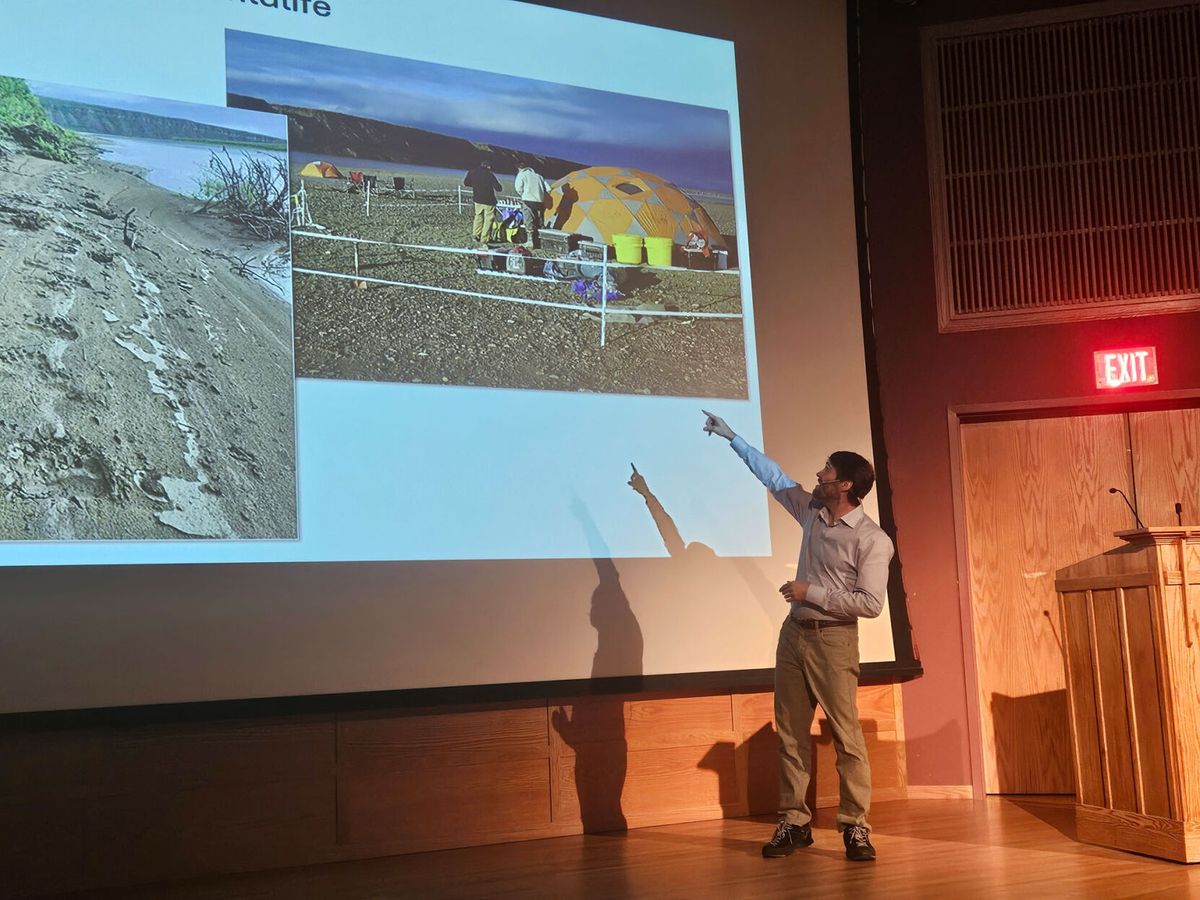
On Thursday Nov. 7, the Museum of the Rockies (MOR) hosted their monthly “Presenting Prehistory” lecture. This time, Pat Druckenmiller — esteemed paleontologist and director for the University of Alaska’s Museum of the North (UAMON) — returned to Bozeman to present his research and share his experience of looking for fossils in the North Slope of Alaska.
Druckenmiller received his Master’s in biology from MSU and worked for the MOR before moving to Alaska in 2007 to work as the Earth Sciences curator for the UAMON. He has spent the last 18 years studying dinosaur fossils specific to the Arctic.
“Alaska, which hadn't really traditionally been on the map as it were for dinosaurs, actually is a really great place to find them,” he said. “What we find is super informative from a scientific standpoint because these were the northernmost dinosaurs that lived on Earth. [They] were living out at the extremes of temperature, climate and latitude.”
During his lecture, Druckenmiller recounted the fieldwork expeditions on which he and his crew — other researchers and graduate students in the paleontology field — ventured. He said the majority of their work takes place along the Colville River and on the Prince Creek Formation, about 501 miles north of Fairbanks.
“The areas we collect stuff are very challenging places to work,” he said. “It's very difficult fieldwork. It's very expensive. Everywhere we go, pretty much, we have to fly in or use boats to get there. You know, you can't drive up to any of your field sites. So that makes it challenging.”
Druckenmiller told the audience that he and his team work primarily in the early spring months, explaining that the Prince Creek Formation is made primarily out of loose sandstone and shale. His team relies on the permafrost to maintain the stability of the slope throughout excavation.
As of today, Druckenmiller and his team have discovered 13 non-avian species of dinosaur previously unknown to science, only four of which have been named so far. For future species identification, he said that he works with the local Iñupiat tribe to create names that are both accurate and specific to the history of the land.
“[Dinosaurs] are fascinating animals. The dinosaurs we find up there tend to be primarily unique to Alaska. They're not the same ones we find here in Montana,” he said, explaining that the unique nature of the landscape lent itself to a unique host of paleontological life.
“I think one of the big things that's fascinating for people is just that the environment they lived in is so unexpected,” Druckenmiller said. “The Arctic was forested. [The] climate is changing pretty darn rapidly today. And sure enough, you know, there is a good reason to believe that someday we'll have forests in the polar regions again. It's kind of a lesson for the future.”
Druckenmiller expressed the importance of paleontology to our modern world by drawing comparisons between our evolving climate and the climates of the past. He emphasized the perspective to be gained by investing time, money and resources into his work.
“The polar regions are changing faster than any other parts of the world because of global warming. First we were saying the poles were changing twice as fast as the lower latitudes, but actually it's more like four times or more faster at polar latitudes,” he said. “We're seeing changes happen very quickly in real time. And the rapidity of that change is a good lesson for what [is] going to be seen at lower latitudes, but maybe over longer times. You can take it or leave it, but you can't deny that this world can and will probably look very, very different 100 years from now.”
Members of the Dead Lizard Society (DLS) — MSU’s paleontology club — attended the lecture and noted the significance of having a researcher like Druckenmiller lecturing in Bozeman.
“It turns out [paleontology is] a pretty small field, so that's kind of what I took away,” Sophia Cajune, a paleontology student and officer of the DLS said. “It’s just like, whoa, I grew up watching documentaries that had Arctic dinosaurs in them, and now all of a sudden, here's one of the lead researchers of Arctic dinosaurs, who happened to go to MSU.”
Cajune also explained that though she likes dinosaurs, the lecture also touched on mammals, birds and fish which are all equally important parts of the ecosystem. “It's not just dinosaurs, it's everything. It's been happening for millions of years,” she said.
The MOR holds the “Presenting Prehistory” lectures every first Thursday of the month. To find the events schedule, visit https://museumoftherockies.org/calendar.
If you are interested in joining the DLS, contact the club by email deadlizardsociety@gmail.com or follow them on Instagram @deadlizardsociety.

Comments ()