
MSU students should protest more
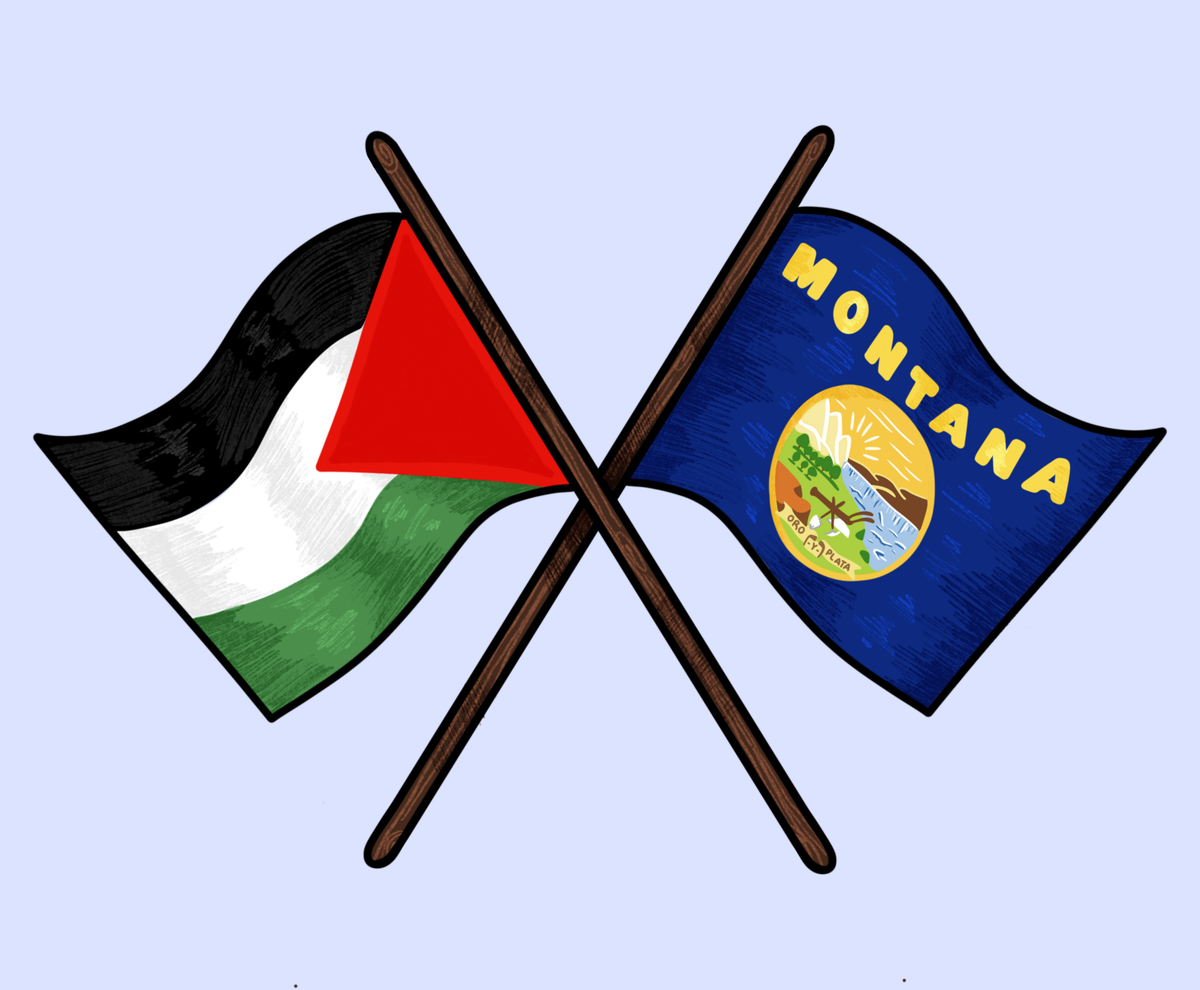
The week before finals last spring, I overheard a student talking about an upcoming student strike for Gaza. I found one Instagram post by Montanans for Palestine which boasted the caption “NO CLASS. NO GRADES. NO FINALS. STRIKE FOR GAZA ON MAY 1.”
When I asked my other classmates if they would be participating, not a single one of them had seen the post or heard any word of a strike. They all planned on attending class, which settled it for me — I wouldn’t strike either. Like the rest of my classmates, I would finish out the school week, and on Friday, I would participate in the “Tour de Franzia,” a boozy wine-bag-fueled bike race through the neighborhoods of Bozeman.
Everyone I knew had heard of the “Tour,” and by 7 p.m. on Friday, May 3, hundreds of participants had gathered at the starting location to partake in the mass act of binge-drinking. The annual “Tour,” which is entirely student-organized, is an impressive display of student unity.
It is one that should make us question our inability to partake in larger movements — particularly political ones.
On Friday, May 3, while we swerved down 11th Street, dodging cops with our Bota Boxes tucked precariously in our armpits, students from the University of Michigan (UM) carrying pro-Palestine banners clashed with law enforcement outside the University art museum.
During my time at MSU, I’ve seen very few on-campus student demonstrations, so the lack of activism last spring wasn’t a surprise. But in light of the national student protests, I had to wonder why word of the “Tour” had spread swiftly while the “Strike For Gaza” remained largely off of everyone’s radar.
To better understand the scarcity of political activism at MSU, I spoke with Sophia Fortunato, a member of Montanans for Palestine and a former student at UM. Fortunato, who was heavily involved in activism during her time in Ann Arbor, told me that most universities are inherently good places to hold demonstrations. “They’re big walkable places. Socially, they breed activism. It’s a lot of people coming into a larger understanding of the world, of their place as an adult, of their beliefs,” she said.
What separates UM and MSU is UM’s long-standing precedent for student protests. “Different universities have different systems and structures that can make it easier at an institutional level to support political activism,” Fortunato told me.
This is true. While MSU states that students have the right to peacefully demonstrate, student activism hasn’t been integrated into campus culture. In fact, MSU culture is built around escaping politics. What unites the student body — besides the “Tour de Franzia” — is our shared love for the land, be it through outdoor recreation, agriculture or spirituality. Most of us relish slipping out of phone service. But as Fortunato points out, there is a reason why we feel this need to escape. The world can feel like a pretty tough place, especially when we’re constantly hearing whispers of genocide.
We often choose to run from these problems rather than stand up to them. Is that because some of us have the means to sneak off into the wilderness and quietly tend to our own needs? It’s easy to pin a lack of political action on privilege, but Fortunato fears that mindset can foster hostility among activists — which isn’t terribly productive for inspiring any sort of larger movement.
“Shaming people into feeling motivated and passionate about helping other people with nothing in return doesn't work,” she said. “We need to find ways that we can meet people where they’re at. What do they care about? What are their priorities? And is there a way to make those align? Is there a way that we can make it so everyone feels brought into this?”
Of course, activism won’t appeal to everyone, and Jonah Henderson — an MSU student and an organizer with Montanans for Palestine — didn't think that diversity was an issue. “On all college campuses,” they told me, “especially larger ones like MSU, there’s students and faculty of all backgrounds and educational levels. There’s always going to be opposition towards those who speak out. I don’t think there’s an abnormal amount here. But MSU students are notoriously super busy and there’s not really any prioritization of liberation work.”
The MSU student body generally appears too apathetic to partake in any sort of radical activism.
I told Fortunato this, and while she agreed that the Bozeman community comes across as apathetic, she didn’t think it was necessarily due to indifference. “The core of apathy is a feeling of helplessness,” she said. “We see apathy when things are ongoing. The conflict between Israel and Palestine has been going on for decades. And people are feeling apathy even now, with what has [been happening] in the last few months.” It can be disenchanting, Fortunato explained, to hear about all of these student protests without really seeing any changes being implemented by universities or the government.
I think a lot of people share the attitude of senior environmental science student Olivia Lynch, who told me “I don’t know how much me skipping class is going to cause a ceasefire.” She’s got a point.
While a handful of universities have agreed to divest from companies who profit from the conflict in Gaza, most institutional boards have voted against divestment or taken a stance of neutrality.
Students have succeeded, however, in sharpening national attention towards the war on Gaza. As a student body, even if we aren’t demanding University divestment, we, just like any student body, have the capabilities to sway public opinion with our collective voice.
So we have the numbers and if Fortunato is correct, we have the political awareness. What’s missing?
Not much. We simply need to take that first step forward. And, yes, that’s a big step. “When you are protesting, you are inherently bucking up against a power that is bigger than you. That’s really scary,” said Fortunato. “But no one has to protest on their own. Protesting is an inherently community-based action.”
Really, it’s as simple as just showing up. Attend a rally off-campus or work with a pre-existing activism group. “Be willing to start small,” Fortunato advised. “You don't have to go from a campus that has had nothing into something like what we have been seeing at other universities, like encampments or large campaigns. You can't expect to be the next Columbia or UM, making national headlines right away. But you are a big state school. The ingredients are there.”
So just show up. Although that May 1 strike seemed terribly daunting last spring, I realize now that I wouldn’t have been alone. There is a whole community that would’ve appreciated that extra body. One extra body. We have to start somewhere.
Comments ()