
Navigating winter risks at “MSU Snow and Avalanche Workshop”
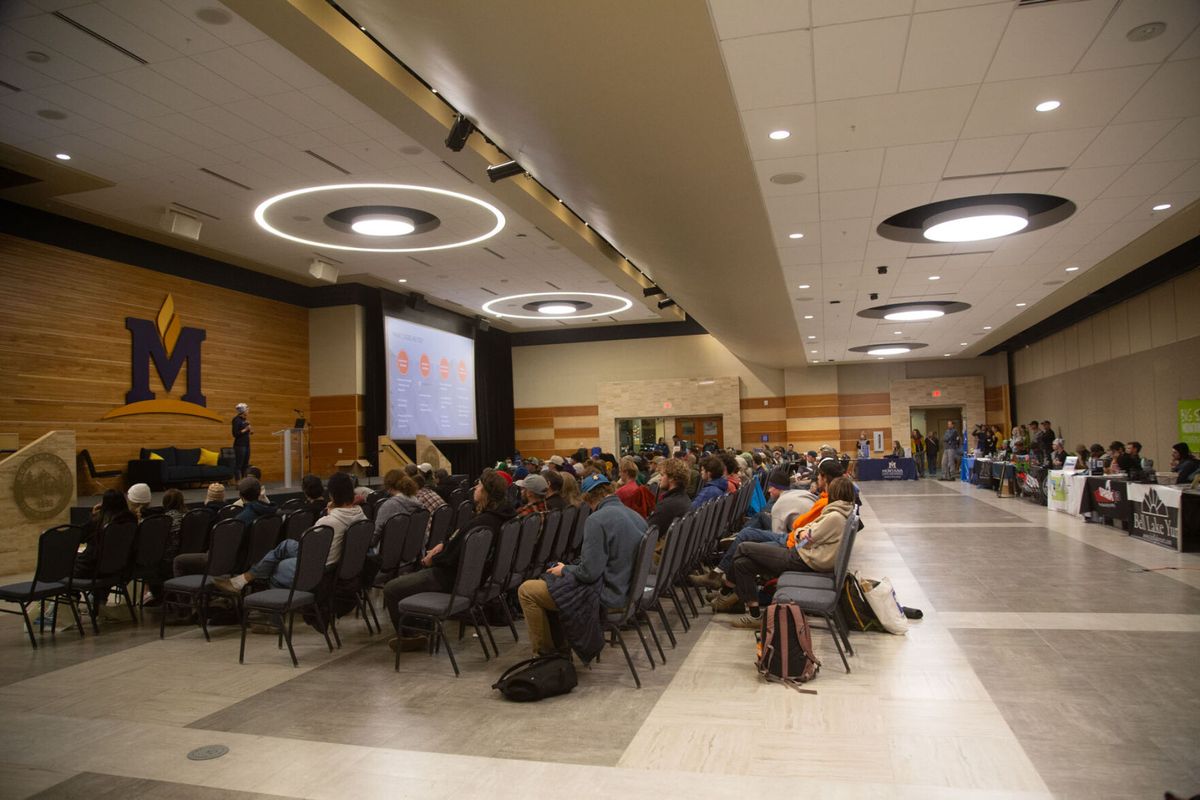
MSU took the opportunity to remind students about snow safety by hosting the 10th-annual “MSU Snow and Avalanche Workshop” in SUB Ballroom A on Wednesday, Nov. 13.
The workshop consisted of a meet-and-greet with vendors — where various small businesses and nonprofits set up booths around the ballroom — snow safety awareness presentations, research presentations and an open panel discussion.
While MSU provides many opportunities for new students on campus, the University’s proximity to the Bridger Bowl Ski Area offers something that many other college campuses nationwide do not: great skiing. On top of that, the MSU student population has grown significantly over the years — this fall’s enrollment exceeded 17,000, according to the University Registrar — meaning there are more people now than ever who might require snow safety education.
MSU Dean of Students Matt Caires, who was a speaker at the event, didn’t ski growing up. “I went out to graduate school, to the University of Vermont, and I met an old-timer out there,” Caires said. “He asked me, Do you ski? I said, no, no, I don’t ski. He says, well, you’re not gonna have any friends here.”
Now, even though Caires was talking about his own experience at a completely different school, his story could be uniquely representative of the MSU experience as well, due to many students on campus taking part in winter recreation. In fact, winter activities are so popular for students on campus that it’s likely you won’t find a classroom without at least one person who’s given them a try.
However, those who choose to make the journey to nearby Bridger Bowl or any other ski resort this winter should also consider avalanche safety measures. The decision to do so could quite literally be life or death.
According to MSU’s Extension Office, 25-30 people are killed in the U.S. each year by avalanches, with many more injured in those incidents. On top of that, 90 percent of avalanche incidents are caused by someone in the affected party.
Caires specifically mentioned the 18-25 year-old demographic during his talk Wednesday night, saying that the MSU statistics mentioned combine both warm and cold-weather recreational activities.
Since I’ve been Dean of Students we have lost 84 students in some kind of accident or fatality,” Caires said. “Every single one of them are incredibly tragic.”
It’s important to note that Caires revealed that the second-leading cause of student fatalities at MSU is outdoor recreation, contrary to nationwide statistics that ranks suicide second-highest. “One of the realities of going to school in Montana is we work hard and we play hard,” Caires said. “Some of those activities and the way we play are dangerous.”
The risk associated with these outdoor winter activities should be especially considered by those coming in from out of state, as they could run into issues on brand-new terrain. Even Nata de Leeuw, who earned her master’s degree in snow science, said she still learns something new every day.
“Being a good rider or skier doesn't equate to knowing about the backcountry,” de Leeuw said. “You can be an awesome skier or rider but have mostly stuck to ski hills, and going outside of the boundary is a totally different thing, they’re two completely different skills. So I think remembering to always be humble and you’ve always got something to learn when it comes to snow science [is important].”
Those who chose to attend the event in-person for the first hour could speak with vendors from various areas of snow and avalanche expertise.
Tom Thorn, an avalanche forecaster at Big Sky Resort, has watched the mountain grow quite a bit over his 20-plus years as an avalanche forecaster and that it’s the younger generation of winter activity enthusiasts that push further into the unknown of the backcountry, he said. Similar to Caires, Thorn knows that college students are an at-risk demographic when it comes to snow safety and does his part by offering avalanche safety courses.
“I set my courses up so that college kids can take these courses without needing to buy all the expensive gear, like a beacon shovel and probe right at first, or touring gear, and they can jump right in with the education,” Thorn said. “They [can] get their hands on some of this rescue gear, they can use different types of beacons to learn which ones they like best, before they go out and invest hundreds of dollars in this kind of stuff. It’s really set up and built for people just getting into it, like college kids would be.”
To access snow and avalanche resources provided by MSU, go to https://www.montana.edu/extension/lila_extn/avalanchesafety.html, and to contact the event’s speakers or learn more about their organizations, head to https://www.montana.edu/outdoorrecreation/saw/index.html.

Comments ()