
Professor from Arizona State provides a picture of humanity’s past, present and future with fire
If you have spent a summer in the Gallatin Valley, you know that the dry months between July and September are synonymous with smoke and haze from wildfires.
Until last week, smoke from the large Remington fire — which has burned 196,368 acres in southeastern Montana and northeastern Wyoming since Aug. 22, according to the Montana Department of Natural Resources and Conservation — brought haze and poor air quality to the Gallatin Valley.
Four years ago, in September of 2020, the Bridger Foothills fire burned 8,000 acres and destroyed 30 homes, as reported by the Bozeman Daily Chronicle. Today, when looking west towards the Bridgers, onlookers can still see the burn line, which stopped just above the prominent “M,” a famous symbol of the University nestled in the valley below.
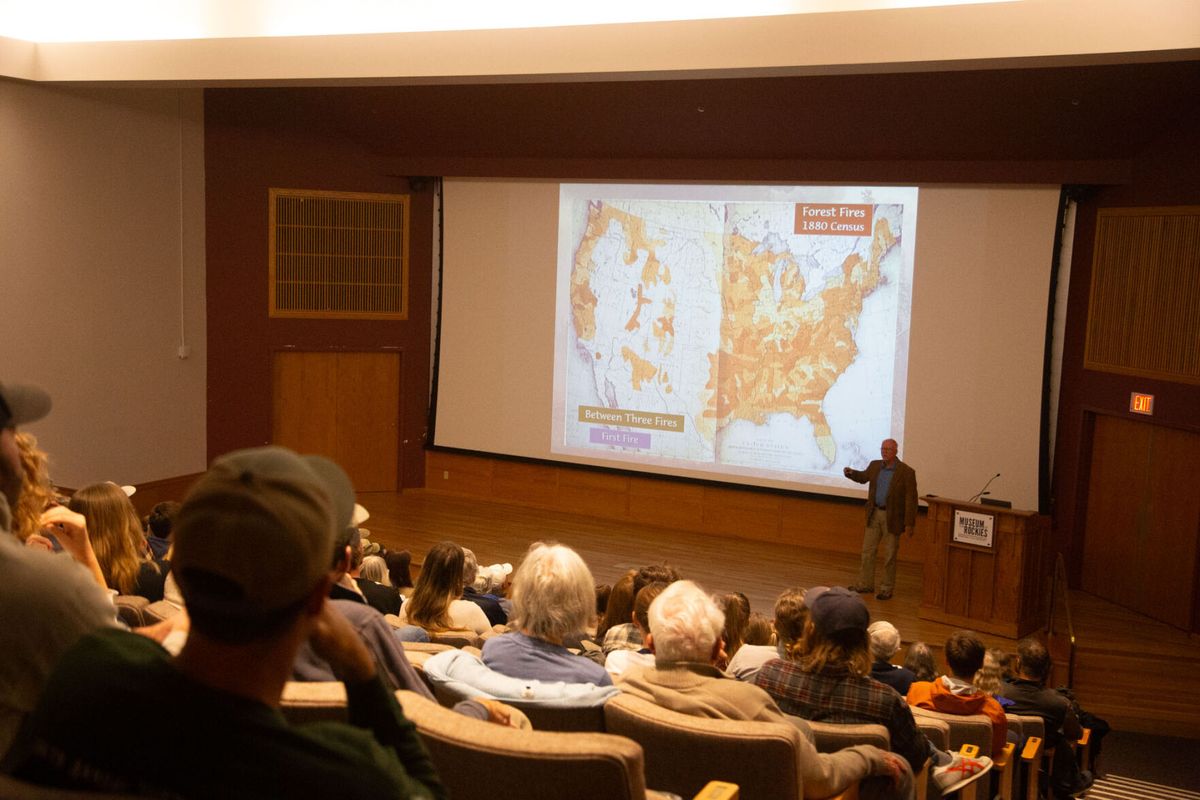
On Sept. 12, the Museum of the Rockies hosted Stephen Pyne, fire historian and an emeritus professor at Arizona State University (ASU). The lecture, titled “Between Three Fires: Understanding America's Fire Scene,” illustrated what humanity's relationship with fire has been in the past, what it is today and what it might be in the future.
According to his biography on the ASU website, Pyne has authored over 30 books — mostly on the history and management of wildland and rural fire — and is currently completing a multi-volume fire history of the U.S. and its regions since 1960.
“We are a uniquely fire species,” Pyne said. He continued to delve into humanity's changing relationship with fire, which he divided into what he called the three fires.
As described by Pyne, fire throughout history can be divided into three categories: the first fires are caused by lightning or other natural causes. Second fires, which he described as a “tamed, quasi-domesticated fire,” are human-started and used as a tool to shape landscapes, provide space for agriculture or even escape wildfires.
“At the end of the last glaciation, a fire-wielding creature met a fire receptive world,” Pyne said during his lecture explaining the concept of second fire.
Third fire type revolves around technology. In the pre-industrial era, scientific developments “changed how fire could be applied to restructure the ways we live on earth,” Pyne said. All the lights, heat and electricity we are accustomed to in post-industrial society are the result of fire — specifically the burning of fossil fuels.
The transition from first and second fire to third fire — what Pyne calls the “pyric transition” — came with a number of consequences. Our growth into an industrial society separated the world into two landscapes: living and lithic.
“Fire has been around for a long time, but with a series of checks and balances,” Pyne said. Once a living landscape, such as wildland, forest or grassland has been burned, the fuel is depleted and the fire stops burning. Lithic landscapes, on the other hand, contain no ecological checks and balances. The fires which power our modern lives burn day and night, wet or dry, thanks to the coal, natural gas, or other fossil fuel which feeds them, according to Pyne.
During his presentation, Pyne traced the beginnings of this shift to the invention and proliferation of the steam engine. In what he called “colonization by steam,” the railroad opened up new land for clearing, leaving enormous piles of slash in its wake. Unlike a living landscape — which requires several years of drought-like conditions before providing the conditions for a mega-conflagration – the slash piles provided them in just a few weeks, leading to “mega-fires.”
At the beginning of the 20th century, large destructive wildfires like these led the newly-established United States Forest Service (USFS) to place fire-suppression at the top of their list of priorities, according to Pyne. With something akin to a “fire-abolitionist” stance, the USFS did their best to stop all fires. This effort was supercharged when they received a huge number of surplus military vehicles in the years after WWII. Mechanized almost overnight, the USFS countered fire with internal combustion and was extremely successful.
However, by the 1970s, it was clear that this “zero-fire” stance was doing more harm than good. By not allowing fire to cycle through environments which had evolved to burn periodically, ecological mosaics were replaced by mono-cultures. The conditions for large conflagrations became more common and deadly. Since the USFS has changed its approach to fire management since the 1970s, allowing fires to burn when they don’t threaten lives, homes or livelihoods — Pyne claimed that we are still not doing enough.
“Mega-fires today are a pathology of a developed world,” Pyne said. “It is no longer about living with fire, it is about living in a fire age.”
As we look to the future, Pyne said that we need to return to a mutually beneficial relationship with fire — one where we accept that wildland ecosystems will burn — while doing our best to make those communities on the edges of forest and grassland fire safe.
At the end of his presentation, Pyne responded to claims that we have no precedent for the times which rush rapidly towards us; explaining that the narrative of the past is insufficient for the future. “I’ll reply to those who say the future is not only dire but strange,” he said. “I think we have a great narrative: the unbroken saga of fire.”
Comments ()