
Sarah Johnson-Palomaki’s book explores Hollywood’s relationship with gender
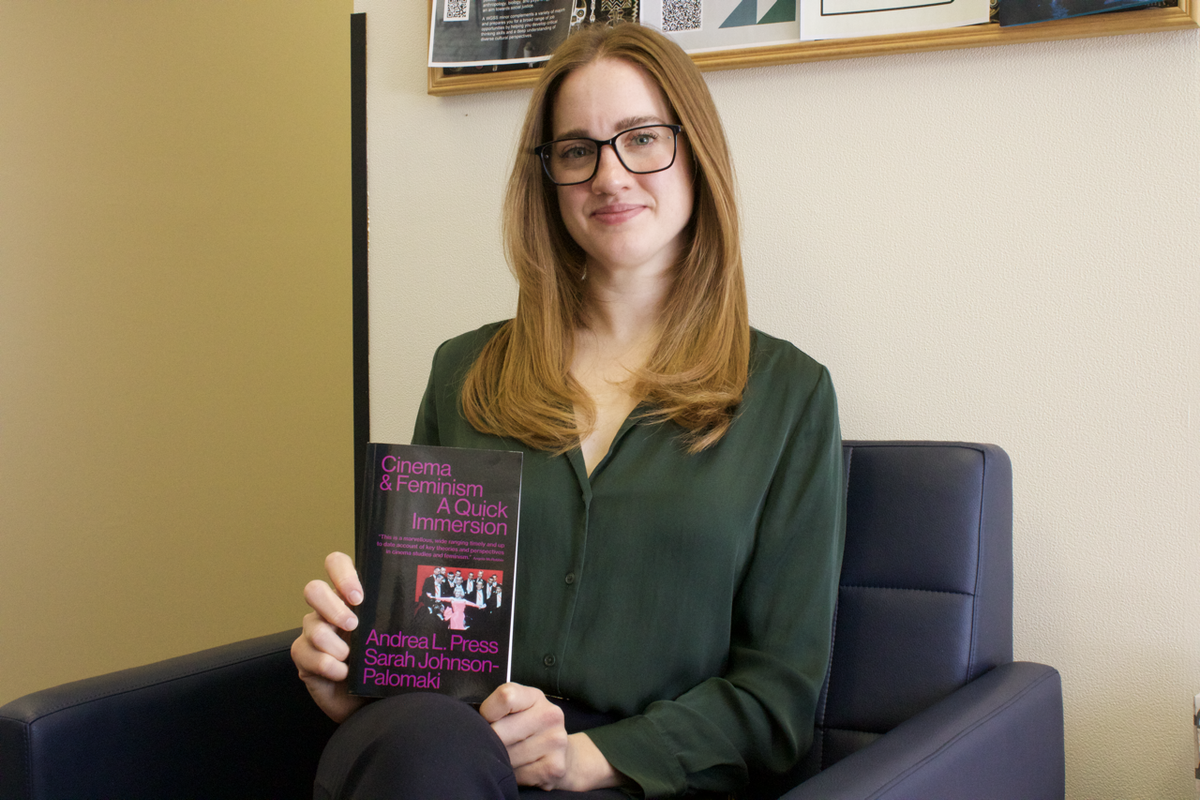
When Sarah Johnson-Palomaki — better known to her students and colleagues as “Dr. J.P.” — walks into a classroom, she carries more than a stack of lecture notes. She brings several years' worth of her research and literature, including chapters of her new book, “Cinema and Feminism: A Quick Immersion.” The book challenges readers to contemplate the way media interacts with audiences — especially through the lens of gender.
Johnson-Palomaki's academic journey started at the University of North Texas, where she received undergraduate degrees in sociology and radio, television and film. She explained that before college, she had never even heard of sociology and discovered it by taking a class to fill a core credit. She said her mentorship with her sociology professor had a profound impact on her decision to pursue the field of study.
After her undergraduate experience, she continued her education. She earned her master’s and doctorate at the University of Virginia in sociology. She joined MSU’s sociology program in 2019 and has taught both introductory and advanced sociology classes since.
“I feel that the MSU student body in particular, compared to other institutions that I have taught at, are coming from quite diverse backgrounds — particularly regarding their [socioeconomic] class. They are quite willing to develop a sociological imagination,” Johnson-Palomaki said.
Sociologist C. Wright Mills first coined the concept of the sociological imagination in 1959. He defined it as the ability to see the connection between individual experiences and larger social structures.
In her recently released book, “Cinema and Feminism,” Johnson-Palomaki and her co-author Andrea Press examine Hollywood and its relationship with gender.
“It’s looking at the history of film and the history of feminism and the complex relationship between the two in an American context,” Johnson-Palomaki said.
Angela McRobbie, Emeritus Professor at the Goldsmiths, University of London praised the material in the Amazon summary of the book, saying: “This is a marvelous, wide-ranging, timely and up-to-date account of key theories and perspectives in cinema studies and feminism. It is accessibly written with lively critical analysis of popular film texts.”
The book is part of the “Quick Immersion” series — a collection of introductory texts about various scientific topics intended to be public-facing and accessible. As a professor who teaches mostly introductory classes, Johnson-Palomaki explained why she loves media as a vehicle for sociology.
“Pop culture is a common language that brings people’s walls down. By focusing on pop culture, I’m able to skip past a lot of barriers to learning,” she said. “I love talking to people using the world that they are familiar with and excited about.”
Johnson-Palomaki said she intends to go beyond discussions of representation and inequality and emphasize a larger concept of gender.
“I feel like a lot of students assume that talking about gender means talking about inequalities negatively impacting women. Discussions of gender should be so much broader — not just talking about challenges, we're also talking about the pleasures and playfulness of gender,” she said.
On representation, Johnson-Palomaki explained that people outside her field often cite a lack of representation as the root of the problem. “I want to go beyond that so that people are considering the power that producers have and the power that audiences have,” she said.
Her ultimate goal is to show that when audiences have limited access to feminist representations in media, they tend to get creative. “[Audiences] make lemonade out of lemons,” she said. “Look at what fans have done with J.K. Rowling's work, it’s become an entity of its own.”
Johnson-Palomaki explained that she sees sociology as a form of critical thinking — learning to analyze the world in general, not just in an academic way, but in every facet of our lives. Moreover, she wants all her students — humanities or otherwise — to walk away with an understanding of the importance of media and digital literacy.
“In our media-saturated world, I want them to be as critical about their own media as they do towards media they don’t like,” she said, emphasizing that critical thinking is essential for navigating today’s media landscape.
Students can find “Cinema and Feminism: A Quick Immersion” on Amazon at https://www.amazon.com/Cinema-Feminism-Quick-Immersion-Immersions/dp/1949845389.


Comments ()