
“Scaling New Heights” highlights mountain goat conservation
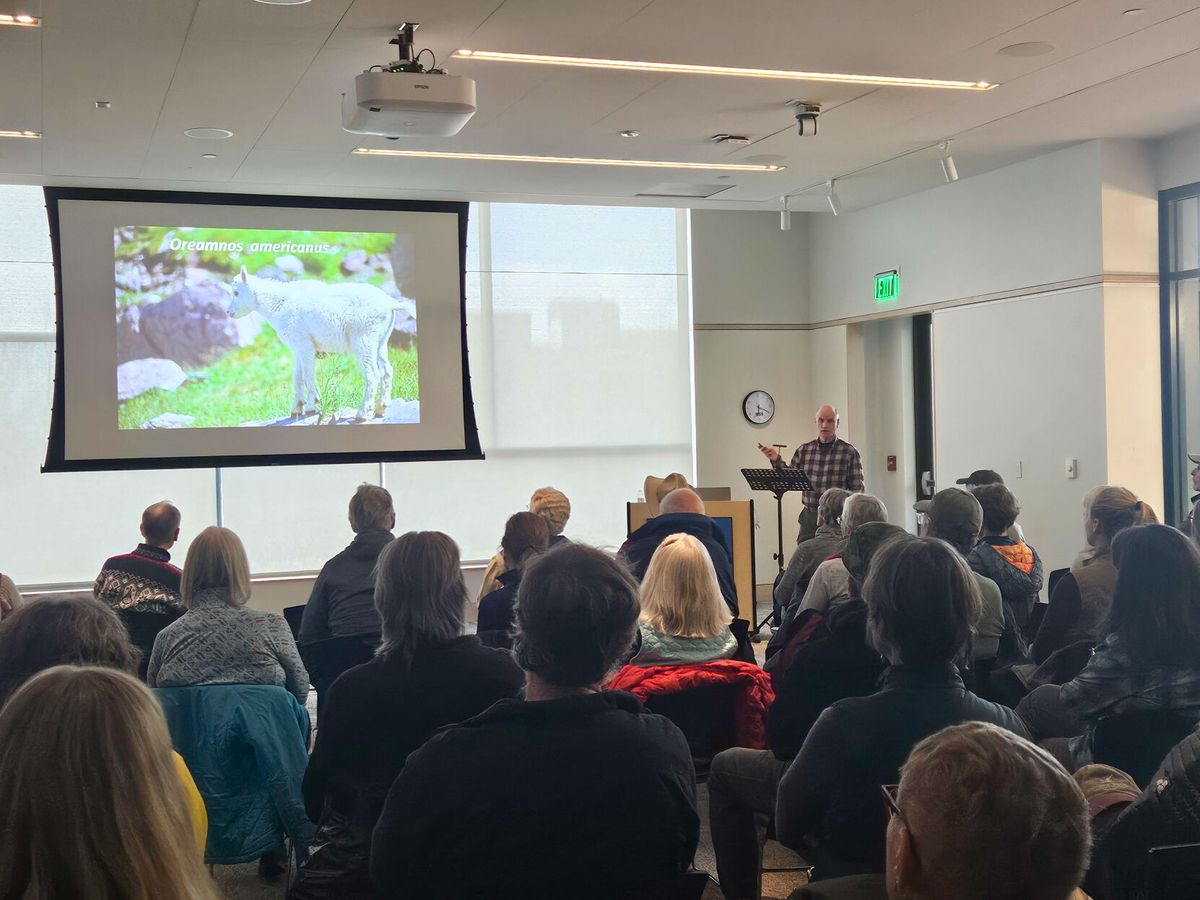
Although mountain goats are known to quite literally live life on the edge, these animals now face a host of threats entirely outside of their control. However, mountain goat expert Bruce Smith is working to spread awareness of their plight.
On April 2, the Bozeman Public Library hosted “Scaling New Heights,” an event where Smith — a wildlife biologist, educator and author — discussed his knowledge of mountain goats, the threats facing their populations and different means of goat conservation. During an interview with the Exponent after the presentation, Smith expressed awe for the creatures. “The mountain goat was the most elegant animal I ever saw,” he said.
Smith is also a member of Wild Montana’s Gallatin-Madison chapter, which organized the event. According to its website, Wild Montana is a grassroots conservation organization that works to protect Montana’s wild public lands, waters and wildlife.
According to Smith, although mountain goats live near Bozeman in the Gallatin and Bridger ranges, the creatures are rare — primarily inhabiting high alpine environments in Northwestern America. For this reason, they are often overlooked in discussions of conservation.
However, Smith explained that mountain goat conservation is essential. According to him, human activity poses a major threat. As road development, timber harvesting, recreation and oil extraction increase, more of their remote habitats have become vulnerable.
Moreover, because mountain goats have extremely low reproductive rates, hunting can cause severe population declines, Smith said. During an interview with the Exponent after the event, he stressed the importance of hunters understanding the difference between male and female goats.
Because females raise the offspring, hunting them can significantly affect the population's ability to reproduce and sustain itself. “Even when hunting is removed, sometimes the goat populations are slow to recover if they do it alone, so we’ve got a lot to learn,” Smith said.
According to him, Montana still has around 3,700 mountain goats today. However, since the 1960s, the mountain goat population has declined in 77 percent of the hunting districts they inhabit, and many of these districts now prohibit hunting them.
Smith said climate change is another major threat. “Warming is happening two to three times faster at high elevations and latitudes,” he said. He summarized glaciologist Daniel Fagre's 2003 research, which found that the glaciers in Glacier National Park (GNP) could completely disappear between 2030 and 2035. When GNP was established in 1910, it was home to around 150 glaciers; now, only 25 remain.
Without snow, mountain goats lose their thermal regulation — the ability to keep a stable internal temperature. Smith recalled seeing goats panting with their tongues hanging out on a 90-degree day in GNP.
“What we are seeing now is literally the tip of the iceberg,” Smith said, warning that climate change will impact people in younger generations the most.
Smith also described a major statewide mountain goat survey he co-led with biologist Nick Caesar in 2013. With this research, they aimed to digitize decades of scattered population data, analyze long-term trends and survey wildlife managers across Montana. The results showed that from 1960 to 2015, Montana’s native mountain goat populations declined by more than 70 percent.
According to Smith, this decline was mainly a result of habitat degradation and overharvesting. Small, isolated herds were hit especially hard, while introduced populations — goats relocated from native ranges into new areas — fared much better, comprising 69 percent of Montana’s total mountain goat population by 2006. However, Smith explained that introduced populations can’t replace native ones, especially in terms of biodiversity and ecosystem balance.
During an interview with the Exponent, Smith emphasized the importance of advocating for mountain goats. “I want people to understand that we have precious species like mountain goats out there that we don’t think about — because they're out of sight, out of mind — and [that] they can become advocates for them,” he said.
At the end of his presentation, Smith reminded the audience that as our world continues to warm and human activity extends further into the backcountry, protecting animals will require thoughtful action. “If we lose mountain goats, we lose something irreplaceable,” Smith said.
For those looking to support mountain goat conservation and protect Montana’s public lands, Wild Montana offers opportunities to get involved through service projects, advocacy and education. To learn more, visit wildmontana.org.


Comments ()