
Ski film “Feel It All” explores mental health and recreation
Trigger warning: This article contains discussions of suicide.
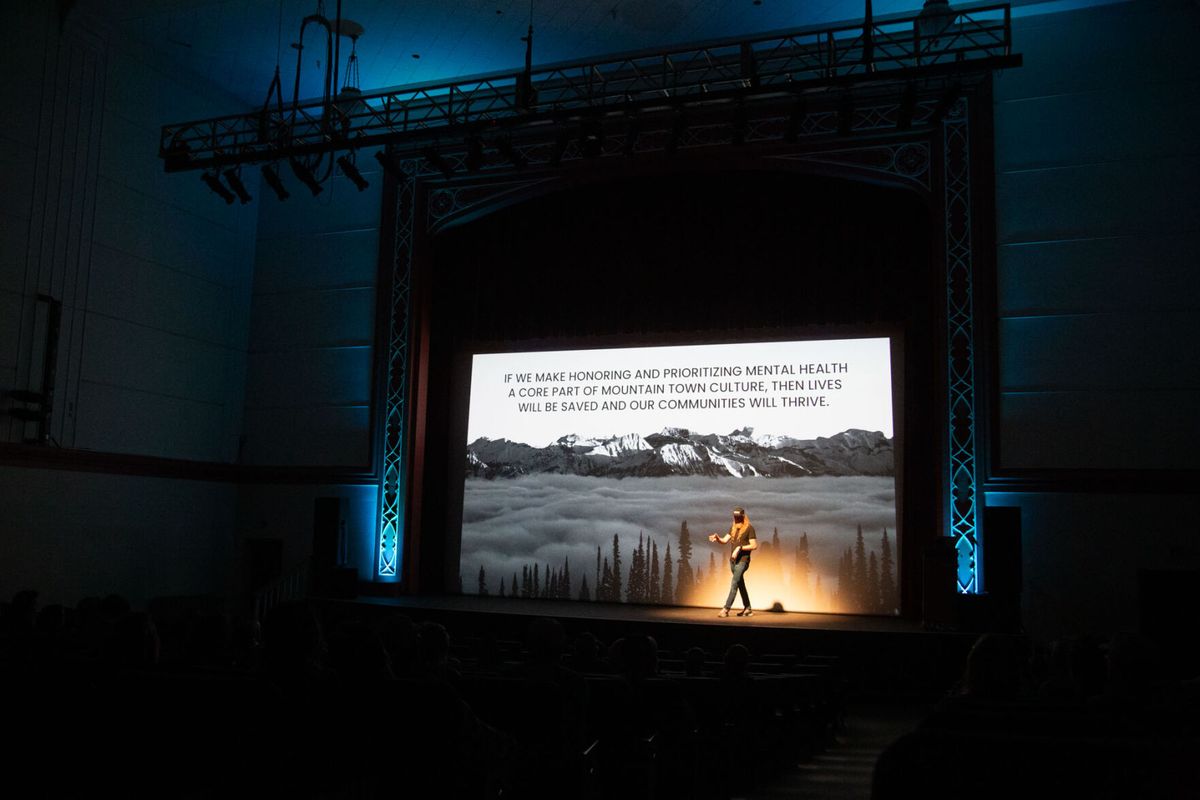
On Wednesday, Sept. 4, Bozeman community members gathered to watch the short documentary “Feel It All” by professional skier, hiker extraordinaire and filmmaker Drew Peterson. His movie centers around mental health, and explains how nature and exercise intersect as a force for healing. After the film, Peterson held a keynote speech on the film and hosted a question and answer session for the audience.
The event, held at the Emerson Center for the Arts & Culture, was co-sponsored by nonprofit organizations Suffer Out Loud, Bozeman Health and mental healthcare provider Charlie Health. Peterson’s emotionally driven documentary took him two years to create and centers around his commitment to running the “Leadville 100” in Leadville, Colorado. According to the race’s website, the “Leadville 100” is a 100-mile run in which participants gain 15,744 feet of elevation. A unique component of the “Leadville 100” is a prize of a belt buckle if completed in under 30 hours and 25 hours for a larger buckle.
The film opened with an emotional scene of Peterson proclaiming, “I don’t want to be alive anymore,” which set the stage for the large topics the movie would later address. “Feel It All” explores the complexities of mental health and suicide through metaphor. Throughout the film, Peterson builds an allegory between his “Leadville 100” race and his mental health journey.
Peterson shared that he is clinically diagnosed with Type II Bipolar Disorder and uses his platform to help spread awareness of mental health in mountain towns like Bozeman. His commitment began after a rock cut his arm open while he was skiing with a friend. He made it clear how traumatic an experience it was, calling it an inflection point.
“In skiing, every turn is how we interact with the mountain, but really, it's an inflection point of the path that we're on. That rock fall accident is the greatest, most important inflection point,” Peterson said during his keynote speech.
As a skier and runner, Peterson has suffered many injuries. As a result, he has spent extended bouts of time unable to participate.
“When my teacher would ask what I wanted to be when I grew up, I always answered a professional skier, and as an adult, that was the only identity I had and the only identity that mattered, but then when I’d go through injuries, surgeries, years of rehab, I felt completely detached from who I was,” Peterson said in his speech. He explained that these injuries from skiing left him in an identity crisis.
“Wrapping skiing into my personality was what made it my identity,” Peterson said in the movie. His injury is the focal point of the film and the allegory he builds. His skiing accident was an inflection point in his life and understanding his recreation-centric identity has led him to find other factors that make up his identity including skiing.
Peterson explained that the way people associate their recreational activities with their identity may lead to harm. Recreation-centric identities can become a way to equate self-worth with skill. Falling short of unreal expectations can leave a person confused and in pain.
A similar point Peterson addressed revolved around exercise as a healthy outlet for mental health. The National Library of Medicine confirms that exercise directly positively benefits people’s mental health. However, Peterson — as an ultra-marathoner and professional skier — seems to go beyond the normal amount of exercise, so how can someone so active still harbor deep negative feelings?
“Exercise isn’t a substitute for real help,” Peterson said. Speaking of his experience, incorporating therapy alongside exercise routines allows people to better prioritize their mental health.
Peterson’s mission to spread awareness through his films helps to build community. His work relates directly to people who attend MSU; according to the National Institute of Mental Health, suicide is the third-leading cause of death for ages 15-24.
Peterson asked all who heard his message to “Feel It All” — feel the happiness, the pain, the sorrow and the joys of life.
To learn more about Peterson’s “Feel It All” documentary, visit https://drew-petersen.com/feelitall.
Comments ()