
The Grading System Doesn’t Help Students Learn
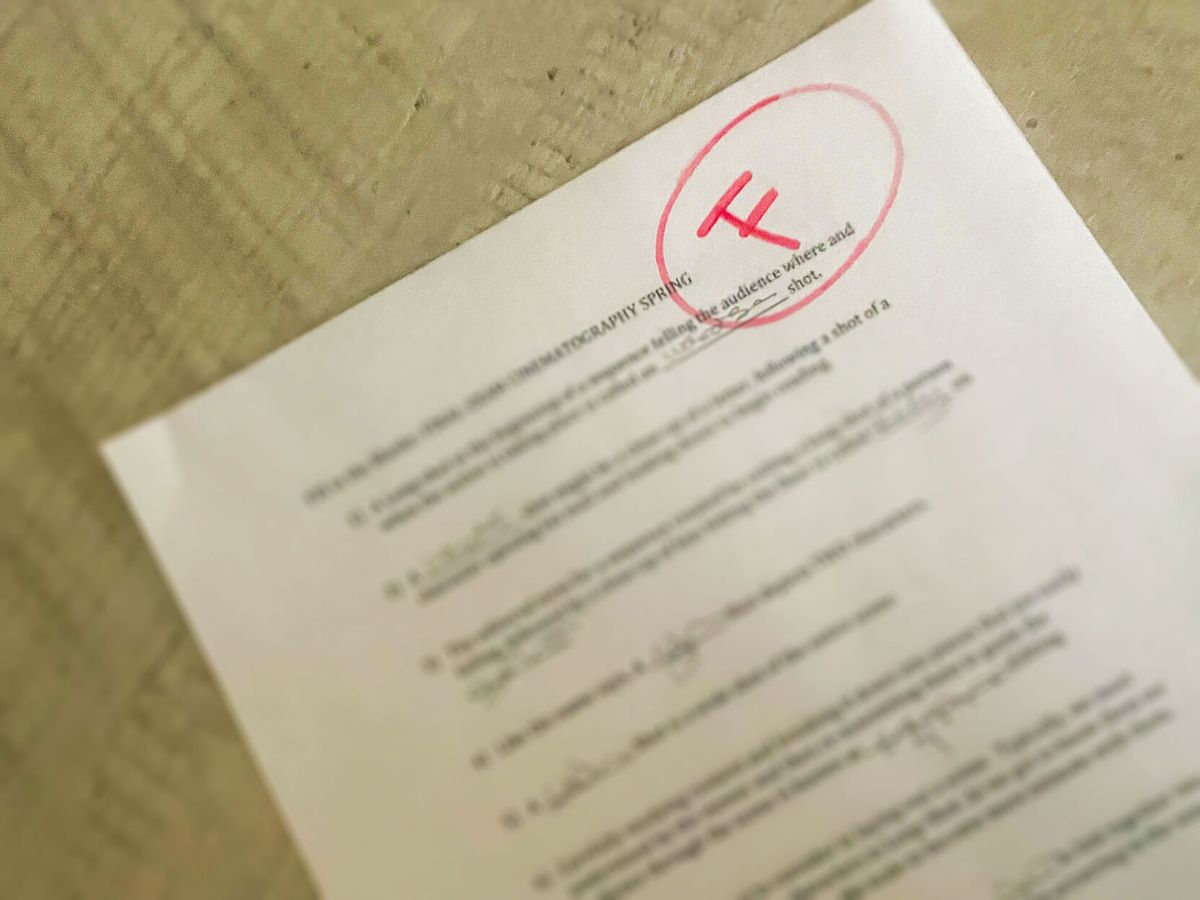
Imagine you’re comparing your grades with a friend after a test. One of you studied for hours while the other barely opened their textbook, but you both earned the same grade.
The depth of a student’s academic understanding cannot be captured by a simple letter grade. While efficient, this kind of grading system does not account for a student’s actual understanding of course material and disregards individual differences in learning, especially those of neurodivergent students.
The grading scale also leaves too much room for failure, resulting in academic anxiety and students assigning their self-worth to their grades. Moreover, students who fail a course have to retake it and usually don’t receive the academic support they need in the process.
Psychology professor Katherine Kujawa said they believe generalized testing and the letter-grade system prioritize memorization over application of information to real-life situations.
“Can a student apply the information they’re presenting? Can they think about it constructively, or create ties to different concepts that were more difficult to consider if you don’t have a deeper understanding? That's where I see a really big divergence of understanding,” they said.
According to its website, MSU standardized its grading scale in 2024. It fails any grade below a C, so the lowest grade students can pass with is 70 percent.
The margin for failure — anything below a 30 percent gap — is simply too large, and encourages overworking and burnout rather than deep and active learning.
Sociology major Riley McCall said the American grading system as a whole has created a culture where students’ academic and social worth are measured by their report cards.
“If you get an F on something, your life is over,” she said. “In our culture, it’s not okay, like you have to be the best, and if I wanted to go to law school, I have to be the best and stand out.”
According to a 2025 article published by Grand Canyon University, about 80 percent of college students reported struggling with burnout at some point during their college years.
Additionally, students working overtime to understand the material might not be getting the help they need.
For example, Kujawa believes that large lecture classes don’t teach students proper learning techniques, which negatively affects their grades.
“We’re not necessarily teaching students to learn,” they said. “They don’t know what study and learning methods are actually associated with better learning.”
Another example would be neurodivergent students — such as those with autism and ADHD — who struggle with executive functioning, communication and emotional regulation.
According to a 2020 PubMed study, students with ADHD in particular struggle with working memory, which is the ability to use and manipulate processed information for a short period of time.
While ADHD is widely known for causing deficits in attention, autistic students’ memory is more particular — that is, exceptional memory for things that interest them — but they also have problems with working memory, according to a second 2020 PubMed study.
Essentially, the standardized testing system has failed to account for the working memory and executive functioning issues prevalent among neurodivergent students. Instead, these issues are seen as a lack of motivation and effort.
Additionally, according to a 2023 PubMed study, standard classrooms can foster a conditional view of an “ideal” student, in which differences in learning and ability are seen as abnormal or negative.
Because of these difficulties, neurodivergent students face higher drop-out rates compared to their neurotypical peers, according to a 2020 PubMed study.
Unfortunately, despite the struggles, grades are also used to determine a student’s academic or vocational progress, according to Kujawa.
“It’s super frustrating when you have students coming in and they’re like, ‘I need this grade to stay on my scholarship,’ or ‘I need this grade to be able to apply for nursing school,’” they said. “If you’re only ever doing or learning to get that grade, you’re not actually learning the materials at a deep level.”
If a student can’t achieve high enough grades for a scholarship or to apply for higher education, they might be cut off from their dream job or from attending school at all.
English major Melissa Rollins said that MSU’s grading criteria also discourages going above and beyond, since the highest possible grade you can get is an A.
“There doesn’t seem to be a lot of motivation to work hard. If I can't have an A plus, why would I put in the extra effort to get a 100 in the class?” she said. “There’s no real difference between just giving the bare minimum and working my ass off.”
The grading system focuses too much on good numbers instead of real learning and understanding, failing to account for individual nuances in learning methods. Consequently, the students who can’t catch up inevitably slip through the cracks.
Comments ()