
The not-so-mortifying ordeal of being known with David Brooks
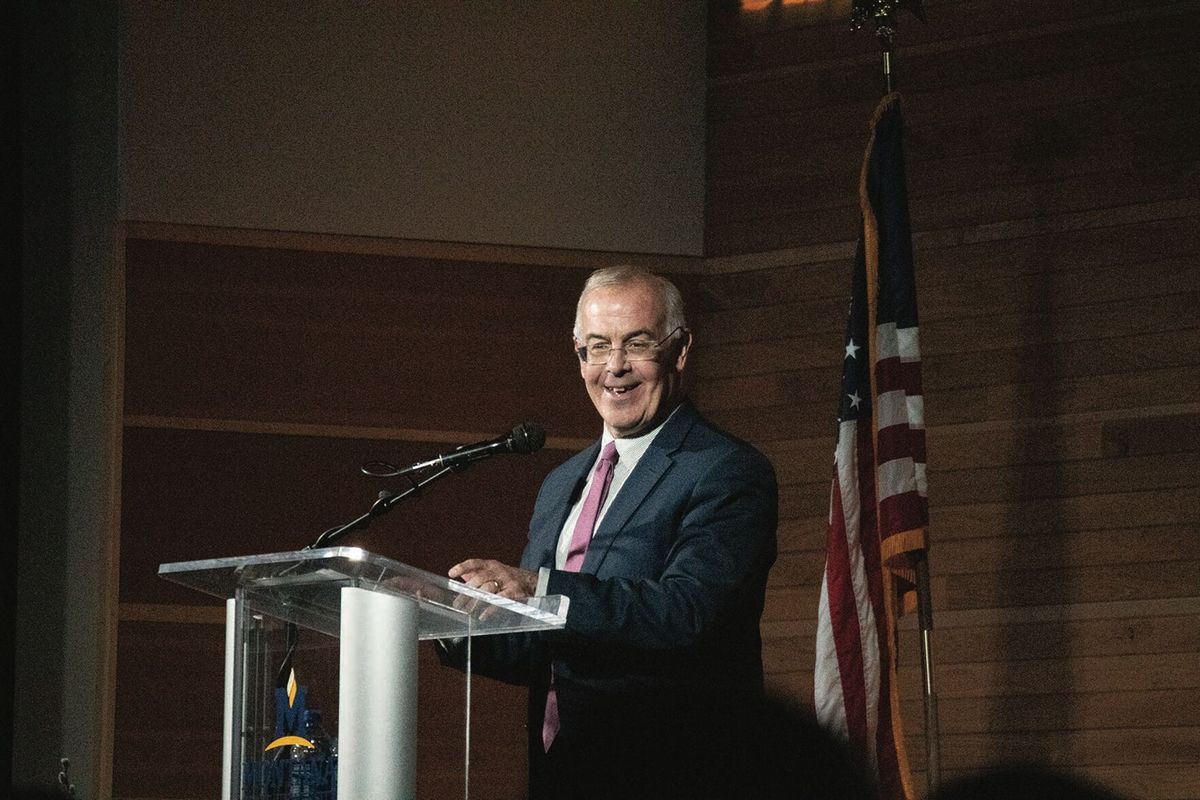
“We all have an innate desire to be good,” David Brooks — a decades-long journalist and commentator — said to an intimate audience in the Procrastinator Theater the afternoon of April 18.
The audience sat collectively contemplative as Honors College Dean Ilse-Mari Lee moderated and audience members posed questions. Honors administration was in attendance, as well as Bozeman High School students and a handful of MSU honors students.
Brooks, who studied at the University of Chicago, has been an opinion columnist at The New York Times (NYT) for over two decades, and has reported on every presidential administration since Ronald Reagan. Through his work, he approaches questions of culture and politics from the perspective of empathy, then seeks analysis. His recent pieces in The NYT comment on everything from consumerism to Republican isolationism in the post-Trump era.
He came to MSU on April 18 to speak about his most recent book “How to Know a Person: The Art of Seeing Others Deeply and Being Deeply Seen,” which was published in Oct. 2023.
The book discusses the importance of human interdependence and encourages “[fostering] deeper connections at home, at work and throughout our lives,” according to its blurb.
The afternoon before Brooks’s evening talk at 7 p.m., the Honors College held a Q&A in the Procrastinator. It began with a description of his work and the lessons he’s learned throughout his career as a writer and commentator. Many of them, naturally, pertain to his time getting to know others, meeting interesting people and adjusting to global and interpersonal challenges.
One interpersonal affair Brooks touched on was the collective human experience of grief. He said, “I’ve found that when people have suffered something, they sometimes don’t need deep conversation, they just need to sit there in the quiet.”
He described the practice of sitting shiva in Judaism, where family members will gather and bring food for those mourning. “It’s a very wise and beautiful ritual, because it surrounds the bereaved with people, and it also gives the bereaved person something to do for a week,” cueing the audience to chuckle along with him.
Shifting to discuss a different kind of grief, a Bozeman High School student asked a question about the permeation of social media in everyday life. Brooks replied that at that moment, his phone had been broken for over 24 hours. “I’m about to have a nervous breakdown,” he joked, adding that he didn’t want to miss “some masterpiece” on Twitter.
The discussion culminated with a quote from Brooks that conveyed his decades of experience in reading others, as well as his sociological sentiments. “The world is really complicated, and you should be careful how you think you can control it.”
The Q&A concluded just before 3 p.m., but as students filed out, Brooks and Lee stood at the front of the room, answering questions and thanking everyone for coming.
The last few to leave were Brooks, honors faculty and members of the Bozeman community. The whole experience can be best summed up with the motto of Brooks’s own University of Chicago: the Latin phrase “crescat scientia; vita excolatur,” translated to English as “Let knowledge grow from more to more; and so be human life enriched.”
Comments ()