
The Tasmanian tiger gets a new breath of life
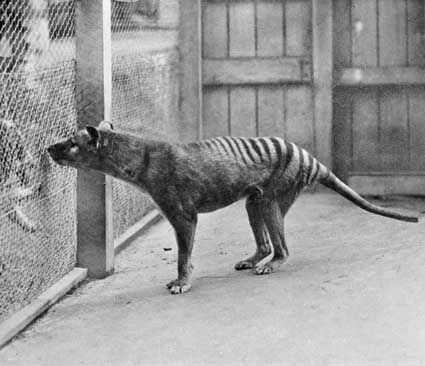
There are multiple videos and pictures of Benjamin in his final years in the Beaumaris Zoo in Hobart, but after watching the new colorized version of multiple clips of Benjamin walking, laying down, and yawning, it is hard not to feel slightly emotional.
This past Tuesday, Sept. 7, marked the 87th anniversary of the death of the final Tasmanian Tiger, Benjamin, in the Hobart Zoo in Tasmania, Australia. This anniversary was notable due to the National Film and Sound Archive of Australia (NFSA), which released a colorized video clip of Benjamin. Although Benjamin died in 1933, Tasmanian Tigers had been eradicated from the Tasmanian backcountry for decades prior due to a government-issued bounty for tiger skins.
The colonial government of Tasmania believed that the tigers were the reason for steady livestock loss among northwestern Tasmanian farmers. Although tigers were already in danger in the mid-late 1800s due to a colonial culture of environmental domination, the true culprit of a majority of the livestock loss in Tasmania were feral dogs. Nonetheless, the tiger was an easy target for the government to villainize since little scientific information was known about them other than the common knowledge that they were shy, cunning animals.
After tigers were hunted to near extinction towards the turn of the century, scientists and entrepreneurs realized the unique behavior and characteristics of the animal, such as their unclear genealogy/ancestry, stiff tail, unusual gait, exceptional wide jaw flexibility and the (typically) 27 stripes that line their back and tail. Businessmen sought to exploit the Tasmanian tiger and display it at international fairs and zoos, while a small number of scientists tried to sustain the tiger population. There are multiple videos and pictures of Benjamin in his final years at the Beaumaris Zoo in Hobart, but after watching the new colorized version of multiple clips of Benjamin walking, laying down and yawning, it is hard not to feel slightly emotional. Although artificially colored, the video displays the beautiful light brown coat that is typical of a tiger, as well as the striking vertical stripes that wrap around tigers’ thighs.
There are many Tasmanians who believe the tiger still lives. Backwoodsmen and writers such as naturalist Col Bailey have claimed their own post-extinction sightings, as well as others from Tasmania, southern mainland Australia and Papua New Guinea. There are many remote areas of Tasmania that receive no direct human contact for months or years at a time, a point asserted by writers to support the supposed survival of the tiger. Whether Benjamin was the last of the Tasmanian tigers or not, the story of the tiger is an important reminder of the reciprocal and consequential nature of the human relationship with our planet.
The newly-colorized video of Benjamin can be found on the NFSA’s Youtube channel, or at https://www.youtube.com/watch?v=6gt0X-27GXM.


Comments ()