
Traveling T. rex exhibit makes stop at Museum of the Rockies
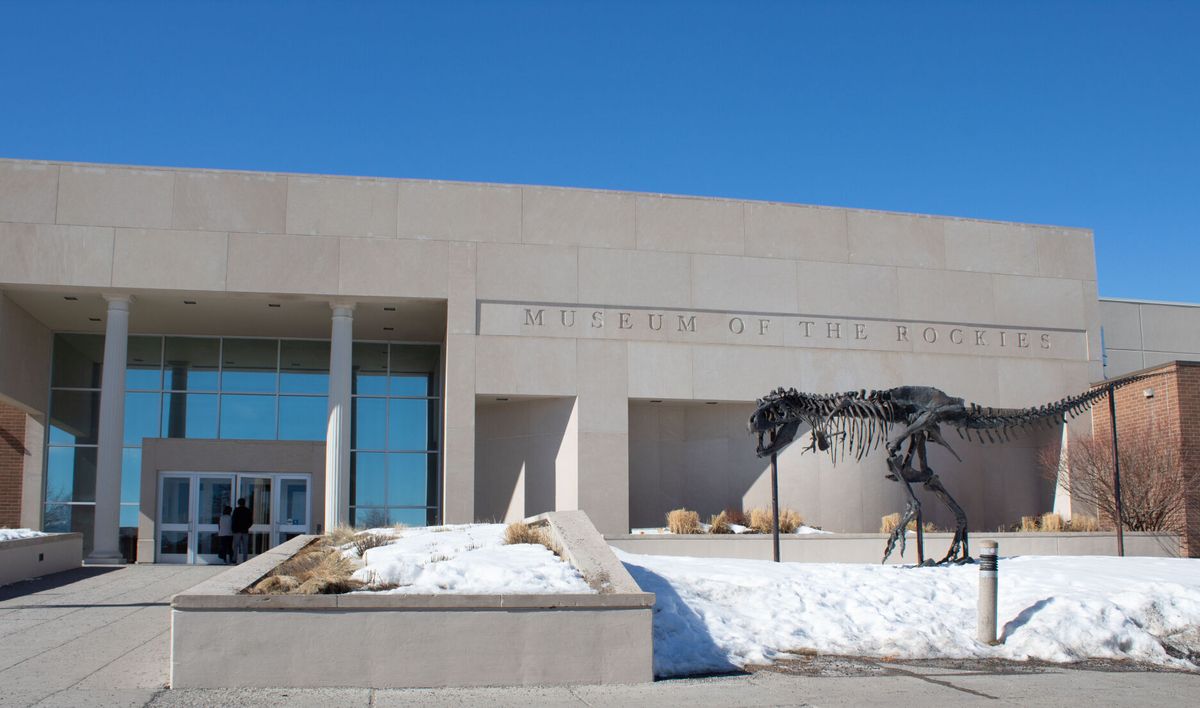
At 13 feet high with each of its teeth the size of a banana, SUE the Tyrannosaurus rex (T. rex) has stomped its way into the Museum of the Rockies (MOR).
“SUE: The T. rex Experience” exhibit — which arrived at the MOR on Feb. 8 — features a full-scale cast of the most complete, best-preserved T. rex specimen ever found,according to the MOR website.The exhibit offers local dinosaur lovers an intimate look at one of history’s apex predators.
Informational plaques scattered around the MOR detailed the history of the exhibit. SUE’s skeleton was found in 1990 by paleontologist Sue Hendrickson, who the skeleton was named after. The fossils were unearthed in the Hell Creek Formation (HCF) in South Dakota (SD). The HCF is an intensely studied geological formation that stretches over portions of Montana, SD, North Dakota and Wyoming. From there, SUE was later bought by Chicago’s Field Museum (CFM) at an auction.
According to the “SUE: T. Rex Experience” tour schedule, the CFM created a traveling exhibit in September of 2020. SUE has since been traveling around the U.S. Before fossilizing into the MOR, SUE was roaming free at the Saint Louis Science Center.
“I began talking with the exhibit team at [CFM] in 2019 after I heard they were going to update the SUE traveling exhibit so it would be similar to the permanent exhibit,” said Scott Williams, director of exhibits for the MOR. After the update, the MOR agreed to host the exhibit in February.
The MOR’s Curator of Paleontology John Scannella explained the paleontological significance of the MOR hosting SUE. “Typically, you’d need to travel to [CFM] to see SUE. This traveling exhibit brings this incredible animal and the creatures it shared its world with to Montana,” he said.
According to Scannella, 2025 marks the 120th anniversary of the naming of the T. rex. “[The] MOR houses one of the largest collections of T. rex [specimens] on the planet, and it’s great that during this special anniversary year that SUE — one of the largest and most complete [T. rexes] ever discovered — will be visiting MOR,” he said.
The exhibit’s plaques challenged preconceived notions about the T. rex. The plaques asserted that the prehistoric creatures had only two fingers instead of three and debunked the idea that T. rex and Stegosaurus lived 80 million years apart. Additionally, the exhibit explained that T. rexes were not just hunters, but scavengers as well.
“One of the frequent misconceptions about dinosaurs in general — but large theropods like T. rex in particular — is that they would have been these blood-thirsty monsters,” said Thomas Cullen, the scientific advisor for the traveling exhibit. “The reality — of course — is that they were real animals, so they would behave like a real predatory animal would. That means it likely had long periods of inactivity and would not be getting into pointless fights.”
The exhibit, which will be on display until Sept. 7, features interactive elements. Visitors can experience “SUE’s breath” inside a wooden carving of her head, imitating the stench based on her diet. They can examine the cast of her arm with callouses from healed injuries and test their “SUE intelligence” by answering various T. rex-related trivia questions. Additionally, the exhibit also features a short CGI rendition of SUE hunting.
“With videos and sounds and smells, [the exhibit] can transport you — if only for a moment — to the Cretaceous period,” Scannella said. “It is beautifully done. From time to time, I’ll go upstairs just to see this massive animal for a moment and imagine it living and breathing right there in the exhibit hall,” he said.
First-time MOR visitor Gina Pilot commented on her favorite feature of the exhibit. “I liked SUE’s breath. It smells so bad — like what did I just inhale?” she said.
Her husband Jurgen Pilot said that he appreciated learning about SUE. “SUE’s arthritis is relatable. You don’t really think about the wear and tear of a hard life when you think about dinosaurs,” he said. “I loved the visualizations of the environments and just recognizing things and being like, oh, I didn’t know there were dragonflies back then.”
For Scannella, the exhibit is more than just a scientific display — it’s a source of inspiration. “I wouldn’t be where I am today without the help, encouragement and guidance of [my] teacher through the years,” Scannella said. “Hopefully, I can do my part to help the next generation on their journey to becoming the scientists of the future.”
Tickets for “SUE: The T. rex Experience” are $20 for adults and $13.50 for MSU students.
For more information, visit https://museumoftherockies.org/.

Comments ()