
Was the Bobcats' White House Visit Political? I Asked Students to Find Out
The views and opinions expressed in this article are those of the author and do not necessarily reflect the views of the MSU Exponent, its editorial staff, advisers, or Montana State University.
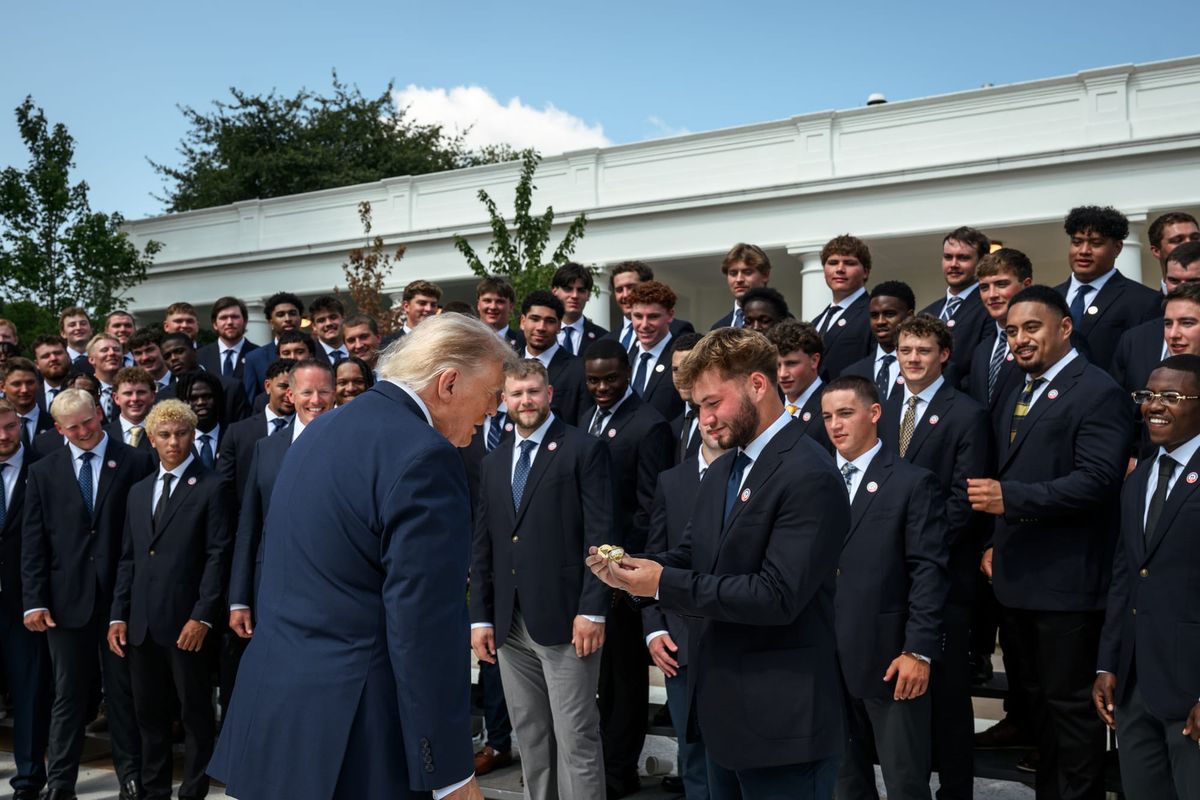
When news broke that the MSU football team visited the White House, it sparked discourse in the Exponent newsroom about the politics of the event. Some of my colleagues argued that the presence of Rep. Ryan Zinke, Sen. Steve Daines, Gov. Greg Gianforte and MSU President Brock Tessman shifted the heartwarming tale of national recognition into something that felt politically sinister and manipulative.
I'm a contrarian, myself. I couldn't help but recognize the precedent of inviting national champions to meet the president and tour the building where the highest level of governance takes place. Drawing the line between politics and precedent is difficult.
Jake Vigen, defensive end and graduate student, was one of the many players who toured the White House and met the president.
"Growing up you see all the professional teams getting to go to the White House and meet the president and take pictures,” Vigen said in an interview with the Exponent. “No one saw it that way [on the team]. I don't think it was too big of a deal. We're all Americans. This is a once in a lifetime opportunity."
Jake's sentiment was hard to argue with. If I were offered a tour of the heart of American politics, could I really say no?
Jonah Varilek, a mechanical engineering student said when asked the same question:
"I think if you are worried about it being a political act, you need to pick up a hobby, possibly, because it's really not that deep. If a [Congressional] Act or something else were to get passed, I can understand being concerned about that. The White House is a symbol of greatness and prosperity in America, and if you win and you're great, like the Bobcats, you should be celebrated."
Benson Leavitt, a cell biology major, expressed an alternative opinion:
"I think any sort of interaction with political figures is a political act. We live in Montana, and it's a red state. That doesn't mean that going with the perceived majority is apolitical. Taking our sports team and visiting the president is endorsing that,” he said.
“[This reflects on the University] poorly. I just think our school is more wrapped up than we ought to be with an administration that doesn't care at all about our education or our well-being,” he said. “They've done so much to hurt young people and line their own pockets. It's very irresponsible for our school to be conducting themselves this way."
Leavitt referenced the appearance of Jack Horner, an MSU professor who retired in 2012, in the 2016 release of the Epstein files. Needless to say, he was not wild about another association between MSU and characters with their name in the files. President Donald Trump’s name is mentioned more than 38,000 times in the most recent batch of Epstein files according to the New York Times.
Perhaps it was simply a good photo-op, and the answer to this question is stated in a brisk response of few words. Perhaps the appearance of a simple photo-op signifies the growing relationship between MSU, an R1-rated research university, and the Trump administration — which has cut or frozen $177 billion of research funding since the start of his term, according to PBS.
In coming to the answer of this question, I can’t help but feel a growing empathy for the members of the football team. I interviewed Vigen at 8:45 a.m., after struggling to raise myself from the comfort of my bed and brewing a rushed cup of coffee. The players were finishing their first workout of the day, and they were already discussing later ones. The precision of their exercise, the dedication they have to the team and the camaraderie they share with each other is undeniable. This is why the Bobcats were Football Championship Subdivision (FCS) national champions. These players deserve recognition and have my admiration.
Varilek said to join the triumph and celebrate the greatness of the team alongside Montana congressmen, the governor, the U.S. President and MSU President Brock Tessman — or at least to pick up new hobbies. But I can’t ignore Leavitt’s apprehension to his University acknowledging greatness in a White House that holds such a clear disdain for higher education.
Among many problems I have with the Trump White House, I can’t help but remember the time President Trump briskly responded in few words to a female reporter's follow-up question about Epstein: “Quiet, piggy.”
In a world where truth is so elusive, the answers we choose become more and more important. Is a university not a place of answers in our world? A place that worships questions?
When the MSU president takes photos with President Trump in his White House, what is MSU choosing to stand behind?
If nothing else I’ve learned one important thing: I clearly need to pick up a hobby. Perhaps billiards? Perhaps sewing? I suppose I shall collect more coins, and ask fewer questions — but oh, what a disappointing resolution this is.

Comments ()