
What is CI-132?
At the turn of the 20th century, the War of the Copper Kings — a battle for control of the copper mining industry — raged on in Butte. The fight resulted in widespread political corruption and eventually led to the passage of several acts, each aimed at preventing future government corruption.
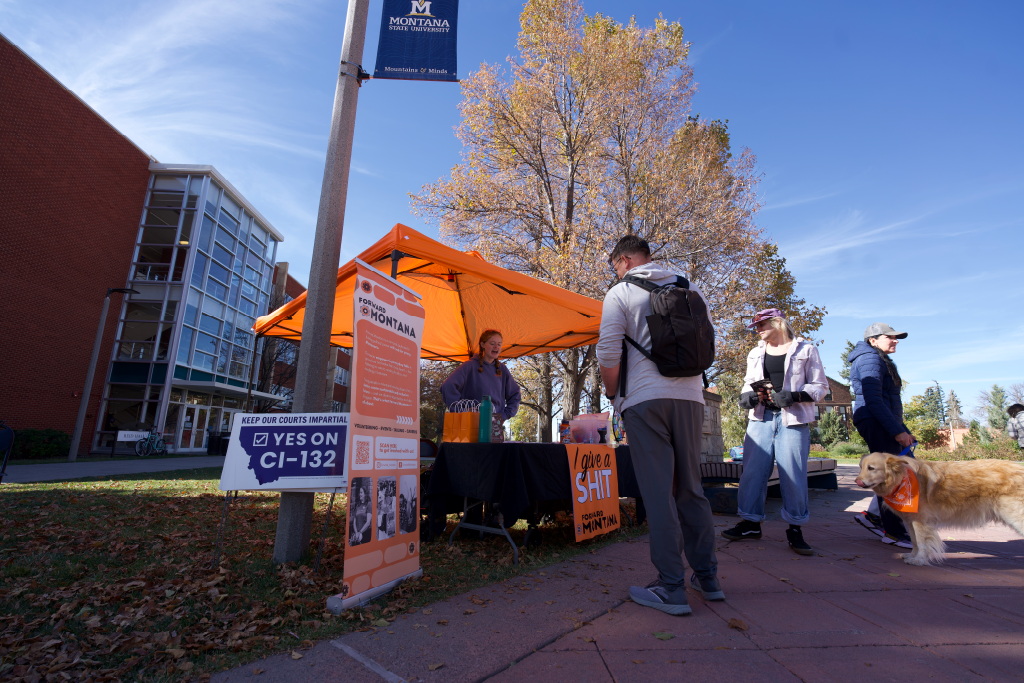
Among these was the 1935 Nonpartisan Judiciary Act, which eliminated political party affiliations from judicial ballots. This election cycle, Montanans for Nonpartisan Courts is attempting to solidify nonpartisan judicial elections into the state constitution with Constitutional Initiative No. 132 (CI-132), according to its website.
CI-132 has gained support from grassroots organizations such as the Northern Plains Resource Council — a conservation and family agriculture group that organizes Montanans to protect water quality, family farms and ranches and a unique quality of life, according to its website.
“We’re here to make Montana better for Montanans,” said Tracy Toulou, a member of the Yellowstone Valley Citizens Committee and the Democracy Project within Northern Plains.
According to Toulou, there has been a recent push to change the nonpartisan nature of judicial elections and to allow or require partisan designation. If passed, CI-132 would create a constitutional amendment requiring judges to remain nonpartisan.
“Constitution trumps the law,” Toulou said. “If you have something in the constitution, it guides what the law does.”
Toulou, a retired attorney, said he has seen judicial races in states such as Wisconsin become very partisan in recent years and is concerned about that happening in Montana. When it comes to choosing a judge, Toulou said what matters is that the candidate understands the community and the law.
In April, the Montana Republican Party (MTGOP) passed a resolution formally opposing CI-132. In an April 13 press release, MTGOP stated that CI-132 “seeks to cement a progressive judiciary in the state by preventing judicial candidates from informing the public of their political affiliation.”
Rather than removing politics from the judicial process, MTGOP said that nonpartisan judicial elections obscure politics and give a false pretense of neutrality.
Toulou said when he worked as an attorney, not having to worry about a judge’s politics was comforting. “I don’t see how putting a partisan label in front of somebody helps them make those sorts of decisions,” Toulou said. “I don’t see how that would ever make it more fair.”
In 2025, House Bill 39 (HB-39) passed in Helena and repealed a previous state law that banned political parties from financially contributing to judicial candidates. Toulou said that, in a way, HB-39 was a wake-up call. “The partisan politics was starting to edge into what would have been a pretty pure system,” he said.
Unbiased courts are the basis of American democracy, Toulou said. “People should feel comfortable going to the court just as who they are,” he said. “It shouldn’t be how much money you have or what organization you belong to.”
Toulou said that, while the judicial system might feel esoteric, the courts impact every Montanan at some point in their lives. “A judge is going to have a real and immediate impact on everybody,” he said.
Most judges aren’t dealing with the major issues in front of the Supreme Court, Toulou said. Instead, they are the judges deciding traffic fines or dealing with personal injury cases, child custody and property issues.
“It’s really important for people to understand that this is something that is going to impact them,” he said.
Toulou encouraged people to vote for CI-132. “It’s really, really important for people to get out there and vote on this,” he said.
To learn more about Montanan’s for Nonpartisan Courts, visit https://yeson132.com/.
To read MTGOP’s resolution, visit https://mtgop.org/wp-content/uploads/sites/41/2026/07/CI-132-Resolution.pdf.

Comments ()