
Wolves’ endangered species status under review
Widespread eradication of wolves began in the late 1800s as new settlers in the West faced livestock conflicts with the native predator. By the mid-1900s, wolf packs were nearly extinct in the lower 48, according to the National Park Service (NPS).
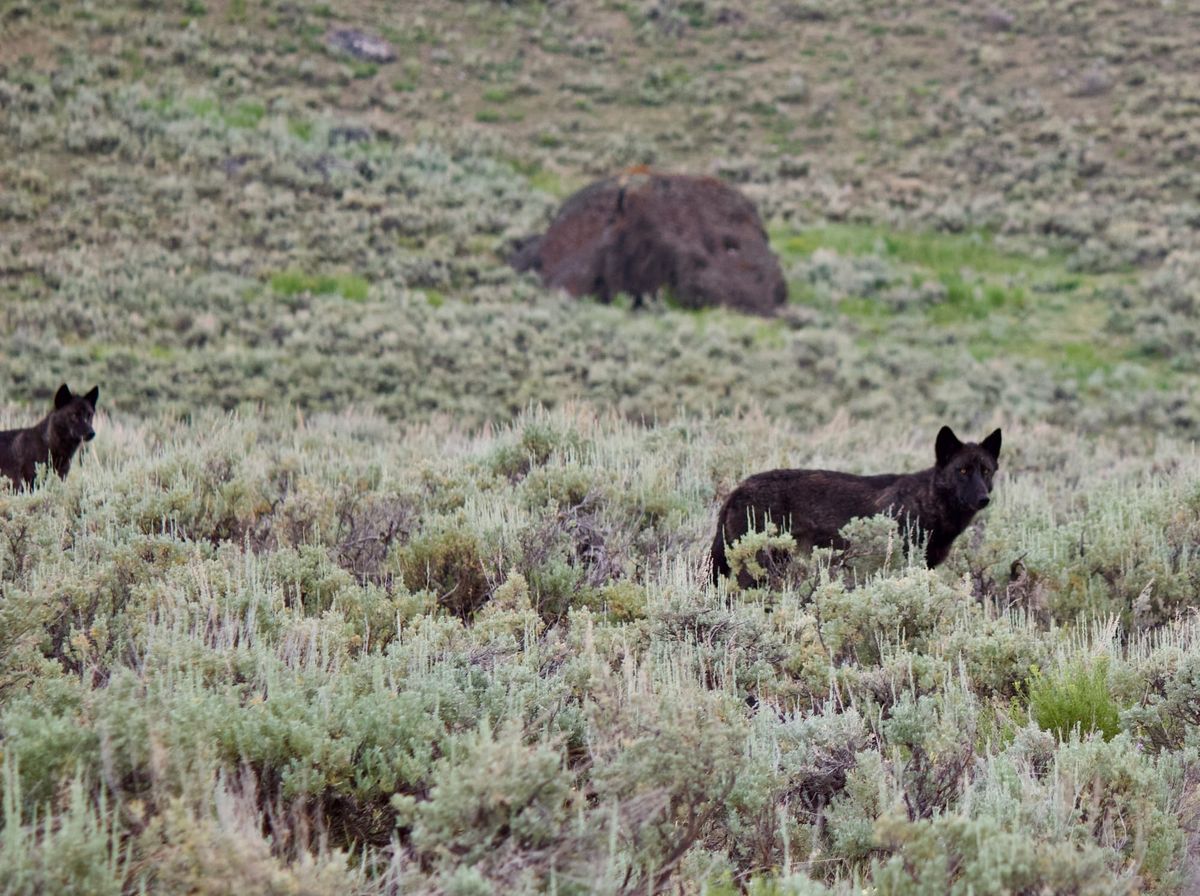
Widespread eradication of wolves began in the late 1800s as new settlers in the West faced livestock conflicts with the native predator. By the mid-1900s, wolf packs were nearly extinct in the lower 48, according to the National Park Service (NPS).
When the Endangered Species Act (ESA) was enacted in 1973, wolves were among the first animals to be listed as endangered. Today, wolves are classified as threatened in Minnesota and endangered in 44 states, excluding Montana, Wyoming, Idaho and the Eastern thirds of Washington and Oregon.
On Friday, Sept. 4, President Donald Trump signed Executive Order 14425, titled Supporting America’s Ranchers. The order gives Secretary of the Interior Doug Burgum 90 days to determine whether gray and Mexican wolves have met the criteria for delisting — which means to remove from the endangered species list — or downlisting under the ESA. If these wolves have met the criteria, the order states, the administration will begin reducing or removing federal protections for them.
Section four of the ESA lays out the steps involved in downlisting — for example, from endangered to threatened — or delisting entirely. Delistings can occur as a result of both extinction and recovery. For species that are delisted due to recovery, the ESA requires U.S. Fish and Wildlife Service (FWS) to help monitor the species for at least five years.
Gray wolves were first delisted in Montana in 2009. A temporary relisting in 2010 resumed federal management of wolves and in 2011, authority was permanently assigned to the state of Montana. Because of this, Montana will likely see little to no change in wolf management practices as a result of the executive order, according to Molly Parks, the carnivore coordinator for Montana Fish, Wildlife and Parks (FWP).
“The more recent executive order — to my understanding anyway — doesn’t really impact us,” she said.
However, the remaining 45 states currently operating under federal authority could gain full management control of wolf populations inside their borders.
Montana has an extensive history with wolf populations. The last wolf in Yellowstone was killed on the Northern Range in 1926, according to John Winnie, a professor in the Department of Ecology.
“It was park policy to eliminate predators, except for bears, so that good animal populations would grow,” he said. As a result, the elk population in the park began to grow rapidly and in response, the Park Service initiated an aggressive culling program.
“The general public did not approve of [Yellowstone’s] heavy-handed management of elk, and the Park Service was pressured to come up with an alternative,” Winnie said. “In 1968, the Park Service adopted natural regulation, which was essentially a nature-takes-its-course, hands-off approach.”
The large elk population led to a decline in vegetation, as elk are the dominant herbivores in Yellowstone. Bison populations also declined as a result. After wolves were reintroduced, elk numbers began to fall steadily, bison populations increased and plants began to recover, Winnie said.
Though wolves are no longer classified as endangered in Montana, their management is still highly debated. FWP uses public comment to build guidelines for their wolf management plans.
“There’s a lot of different perspectives, a lot of different folks that are potentially implicated in different ways, and we're trying to identify and acknowledge potential impacts and just balance those competing interests,” Parks said.
The 2025 management plan — which hadn’t been updated since its creation in 2003 — integrates new research and monitoring methods into the framework.
“A lot had changed on the ground in the sense of how we were monitoring and estimating the population,” Parks said. “So essentially it was just time to just update the plan with new information, better information.”
During development of the plan, FWP held scoping meetings to gather public concerns and ideas, many of which surrounded the hunting and trapping of wolves.
“There’s a lot of different views on hunting and trapping, and the idea of trying to help folks understand that this is one way that we can manage that population and manage those impacts is something that we strive to do,” Parks said.
Another concern, and the driving matter behind the recent executive order, is wolf-livestock conflicts.
“Wolves cost ranchers even when they don’t kill cattle,” Winnie said. Cattle that share ranges with wolves sometimes report lower pregnancy rates and less over-summer weight gain, both of which are significant hits to ranchers' bottom line, he said.
According to Winnie, direct losses of cattle to wolves are not common, and ranchers are supposed to be compensated for them. However, because scavengers visit kills and destroy evidence, proving that a loss is due to wolves can be difficult. “I think there needs to be a rewriting of reimbursement policies, so ranchers can more easily be compensated,” Winnie said.
To learn more about wolf conservation in Montana, visit https://fwp.mt.gov/conservation/wildlife-management/wolf.

Comments ()