
Women’s Month celebrated with collaborative panel
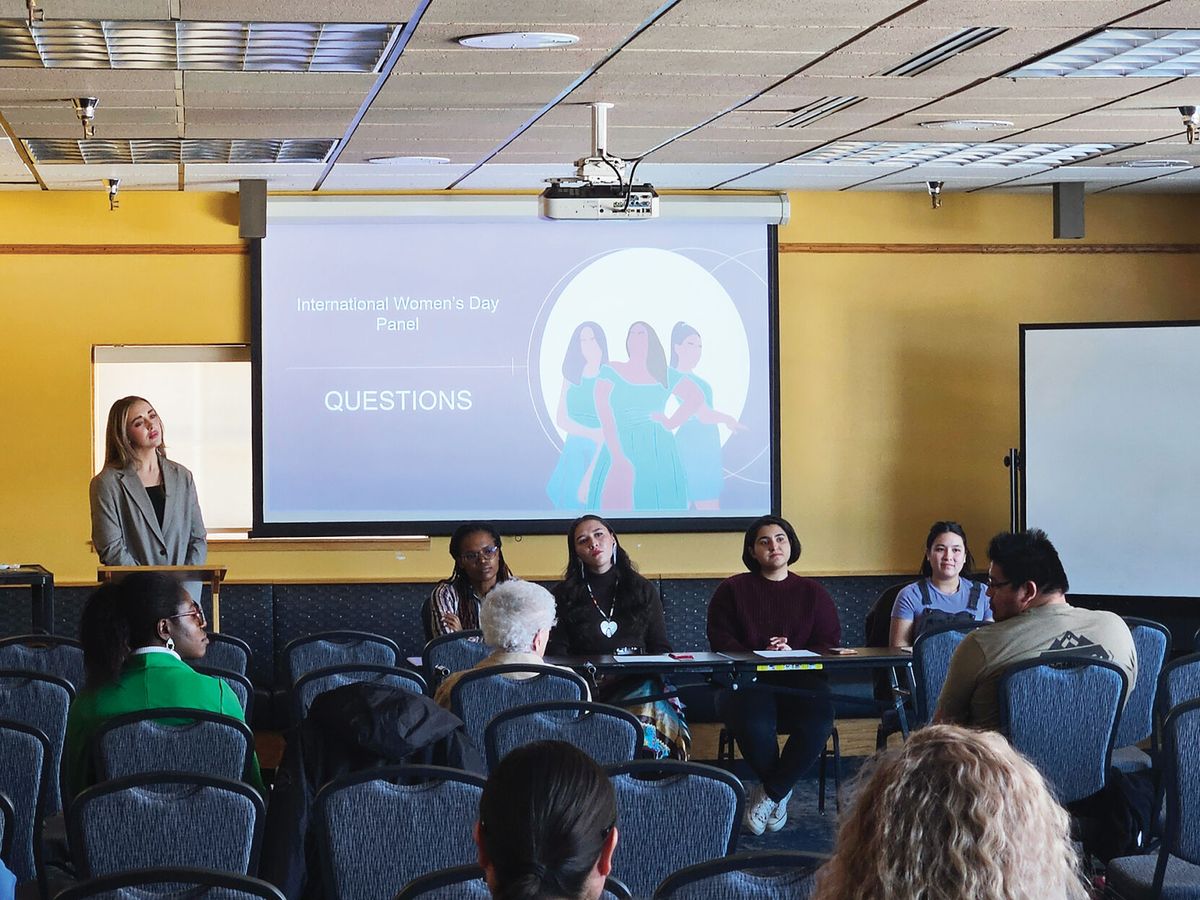
International Women’s Day, which occurs on March 8, first began in the early 1900s as women workers in needle trades banded against child labor and sweatshop conditions. Today, the holiday recognizes women for their achievements and gives focus to the adversities women around the world face. Each year, a theme is chosen to draw attention to different subjects. This year's theme was “Inspire Inclusion.”
With this theme in mind, the Office of International Programs, the Women’s Center and the UNA-USA student club held a discussion panel on March 6, spotlighting several international students. The panelists — Maleeya Knows His Gun, Redempta Manzi Muneza, Fatemeh Aflatounian and Célia Koh — gathered in the Alumni Legacy Lounge to examine the celebration of International Women’s Day in their respective nations, their personal aspirations and achievements and to discuss any challenges they've faced as women in their fields.
“[Seminars like these] give us a voice that is not often given,” Knows His Gun said. “It amplifies our voice when oftentimes, they are muffled. It is important that MSU represents these voices, so [students] can help make change. Women are the lifeways of these worlds.”
Knows His Gun is from the Northern Cheyenne Reservation in Ashland, Montana. She is active in the Missing and Murdered Indigenous Peoples Student Association on campus.
“A lot of women inspire me, especially in Native communities,” Knows His Gun said. “That’s who I look to the most. The leaders in our community, my mom, my grandmas. I take the most inspiration from them.”
In the audience, Knows His Gun’s mother, Joni Jo Bement Spottedwolf, shared her enthusiasm for her daughter's community work and their mutual passion for celebrating womanhood.
“Women are the nucleus of our people,” Bement Spottedwolf said. “They are the life givers, they are the strength — that is why I am here, to support my daughter. [My daughter] will be speaking to the women who have impacted her life, like my grandmother. I just know that as women we carry a lot, we are able to cope with a lot — we are responsible for a lot. I love that the college is supporting this.”
Panelist Koh also expressed how she participates in International Women's Day.
“I am a very passionate person when it comes to humanitarian topics,” Koh said. “I am French, and this year’s [celebration] is specifically important because [France] constitutionalized abortion rights this year. It makes me proud of my country. [For the U.S. ] overturning Roe v. Wade was one of the biggest stepbacks in women's rights and health.”
Koh further drew attention to contrasting attitudes towards reproductive rights in the U.S. and her home country.
“Sometimes, I wonder why I am so in love with this country,” Koh said. “Everyone has the right to think the way they do, but I still get really unnerved about it. I have the safety of saying I can go back to my home country — if I need an abortion, if I need specific [reproductive healthcare], I can go to my country and have them safely. I am sad for women who do not have that right and opportunity. We've seen it in history. When abortion was [illegal], we still had abortions.”
Koh elaborated on how her home country honors women throughout history who have advocated for the rights of others.
“Simone Veil survived the Holocaust in two different internment camps,” Koh said. “She was a really strong woman. She became the first woman [to serve as] the President of the European Parliament. In 1974, she fought for abortion rights. She died in 2017, and in France, we have this thing called the Panthéon, which is a [cemetery] for very influential people. She is one of the only seven women there, and there are 82 people total. It shows how important of a woman she was.”
Panelist Aflatounian identified the woman who served as her greatest inspiration and empowered her to pursue a Ph.D. in mechanical engineering.
“Maryam Mirzakhani is an Iranian mathematician,” Aflatounian said. “She came to the U.S. to receive her graduate degree and worked as a professor. She was one of the first women to [win] one of the biggest mathematics [awards]. When I was in high school, I saw she won that prize, and I was like, I would love to be a woman like her and follow my dreams.”
It is crucial to acknowledge the importance of representation in fields that have been historically male-dominated — not just on the week of March 8. Roger Fischer, a professor in the math department, actively incorporates recognition of women in mathematics at the beginning of his classes.
“We almost never talk about women mathematicians,” Fischer said. “Ask ten people on the street — name a mathematician, and none of them will name a woman. Women do not get enough credit for their contributions.”

Comments ()