
14 years after DOJ investigation into Missoula rape cases, officials tout changes made
Around 2012, Missoula took the national stage after a spate of high-profile sexual assault cases against various members of the Griz football team led to scrutiny over how the University of Montana, the Missoula Police Department and the county attorney’s office handle such reports.
A four-month stretch started it all.
In December of 2011, UM hired an outside investigator to review allegations of a sexual assault on campus involving two female students, multiple male students and a date-rape drug. Then, in January of 2012, a Griz football player named Beau Donaldson was charged with rape. He later pleaded guilty and was sentenced to 30 years in prison with 20 suspended.
In February of that year, an international student from Saudi Arabia left the country after being informed that he was being accused of sexual assault under UM’s Student Code of Conduct. The Missoula Police Department was never informed of the accusation.
Then, in March, a female UM student was granted a temporary restraining order after she said UM starting quarterback Jordan Johnson sexually assaulted her. Johnson was formally charged a few months later and was later acquitted after a sensational trial.
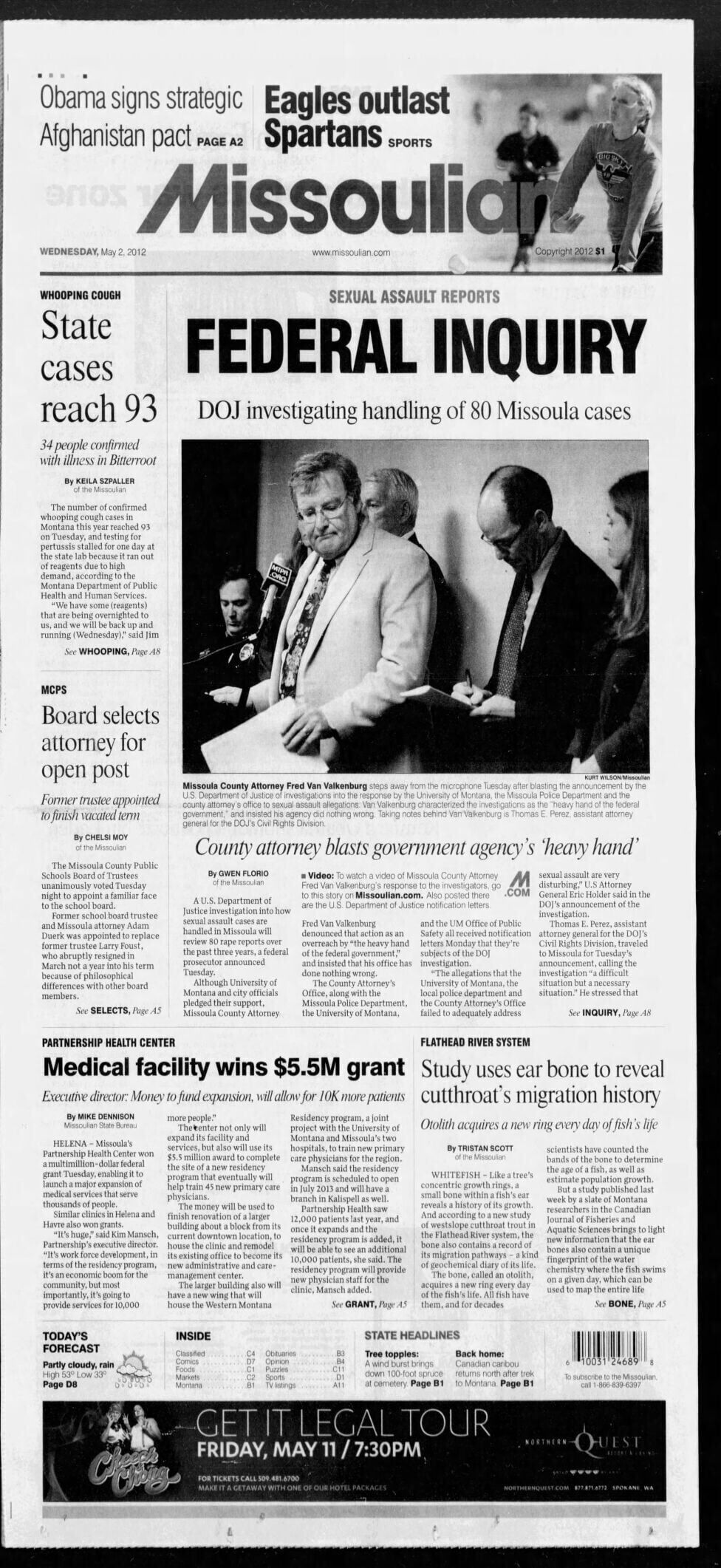
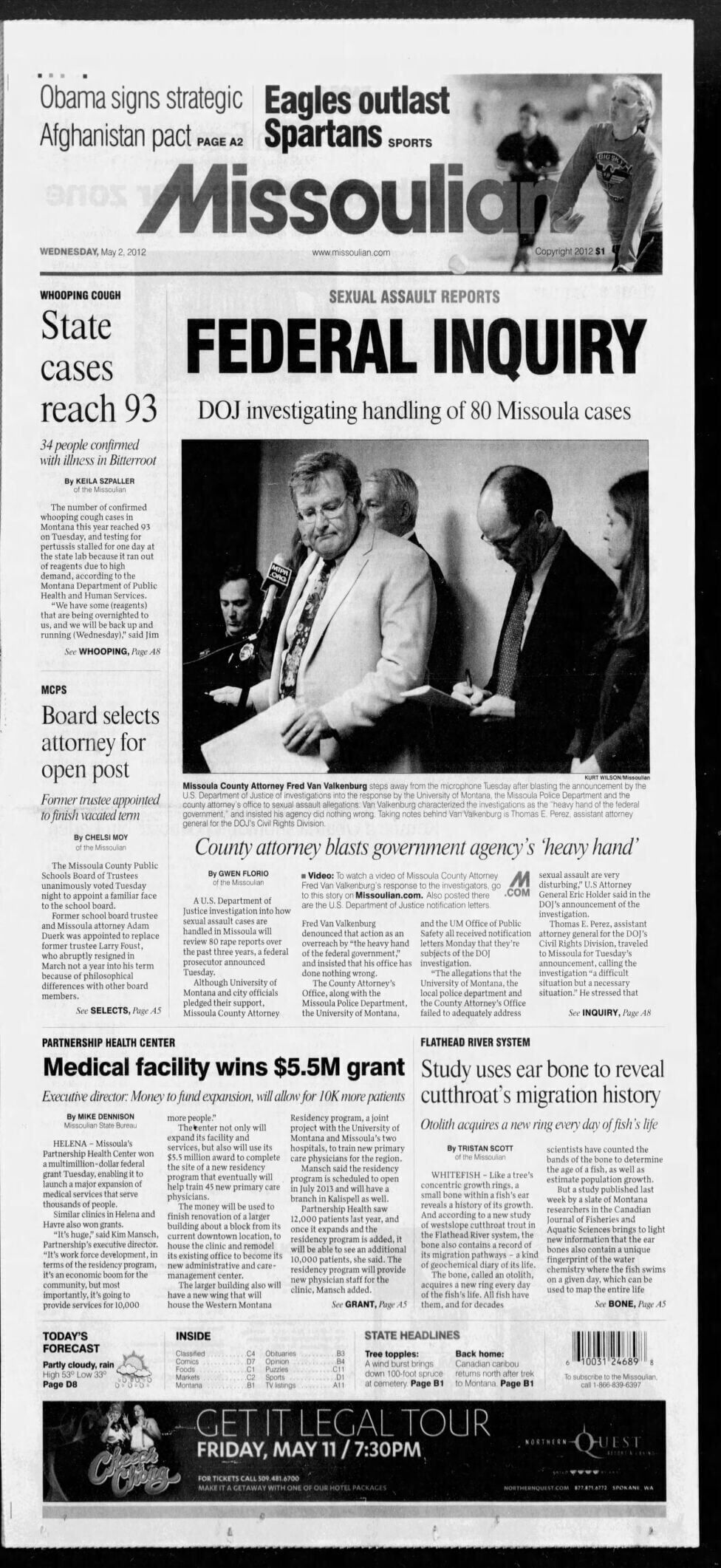
On May 1, 2012, the U.S. Department of Justice announced that “in light of at least 80 reported rapes in Missoula in the past three years” they were investigating the handling of sexual assault allegations by the University of Montana, the Missoula Police Department and the Missoula County Attorney’s Office. It was a tumultuous time in Missoula. A headline in Jezebel screamed “My Weekend in America's So-Called 'Rape Capital.'” (That article has since been taken down.)
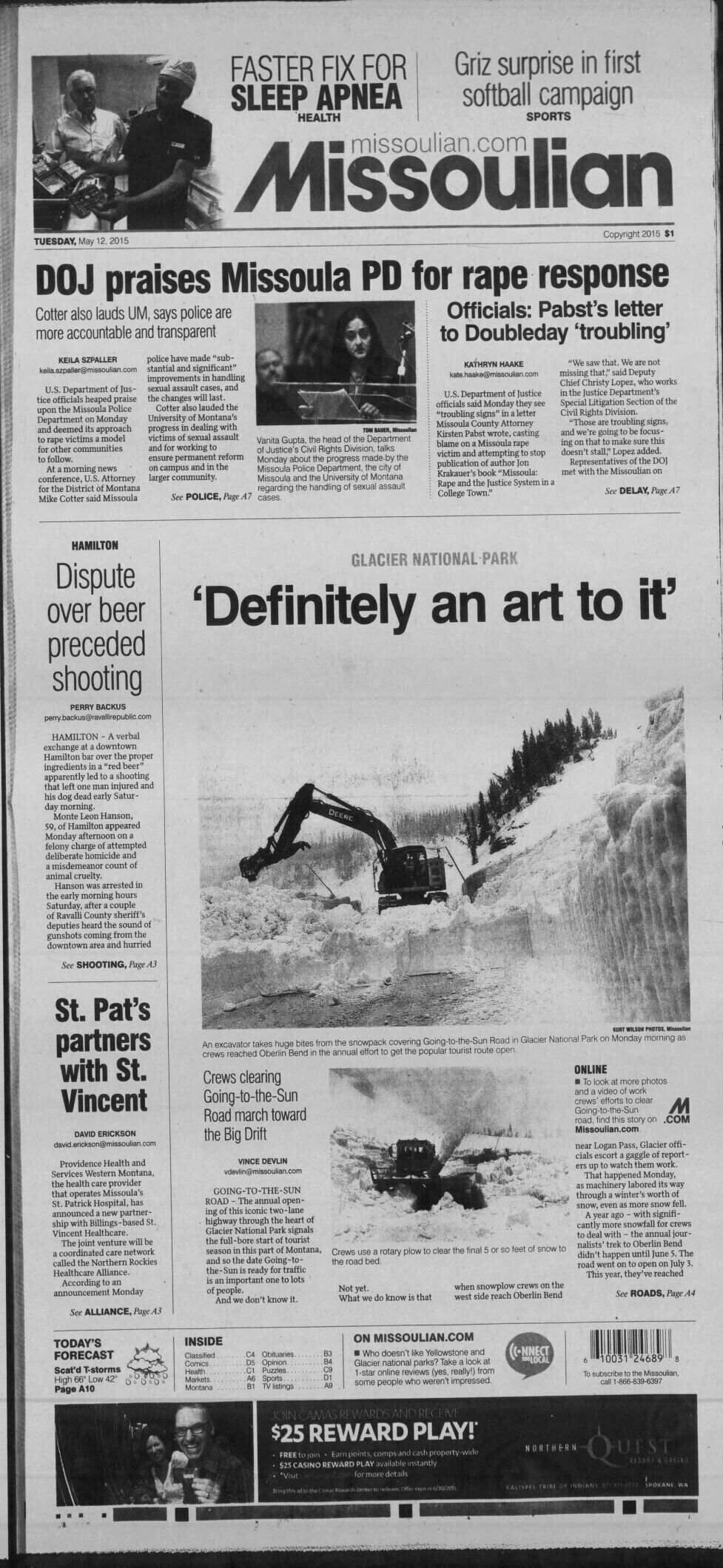
The DOJ investigation later found evidence of gender bias in a string of rape investigations that unfolded in Missoula between 2008 and 2012. It was all highlighted in a 2015 bestselling book, “Missoula: Rape and the Justice System in a College Town,” by Jon Krakauer, that thrust the issues under a nationwide spotlight.
After a monthslong investigation, in 2013 the DOJ found evidence that all three organizations had showed gender bias in how they treated adult female survivors of sexual assault, resulting in survivors being less likely to come forward.
The DOJ tasked various Missoula agencies and organizations with making several changes.
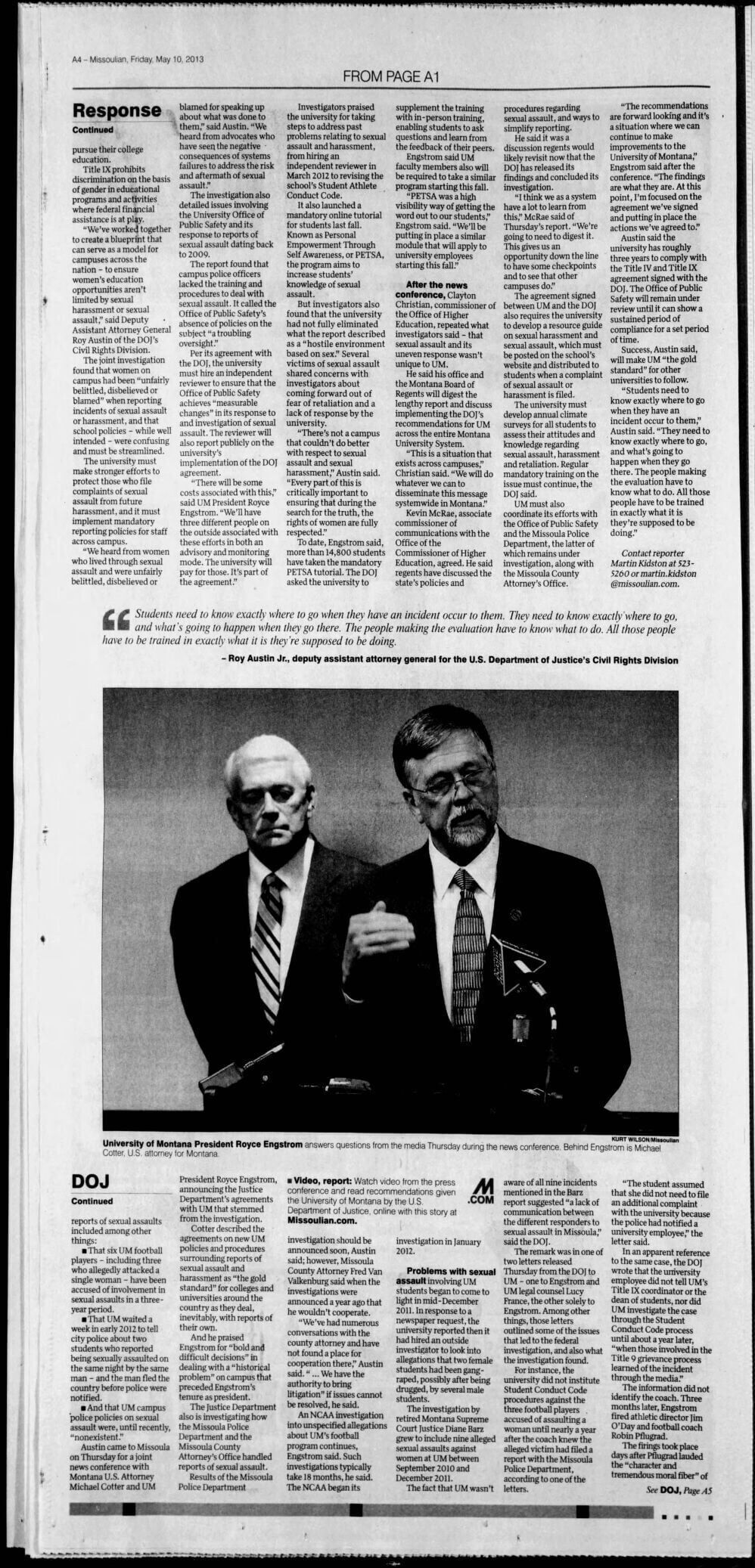
The federal agency entered into agreements with UM, the county attorney’s office and MPD that mandated they improve their policies and practices surrounding sexual assault allegations, cases and reports. These agreements gave the three organizations a to-do list to address the deficiencies found in the DOJ investigation.
It’s been 14 years since, and the three Missoula entities involved in the string of events say they have fulfilled the initial requirements set by the DOJ, which included trainings, new policies and structural changes, among others.
A number of people involved in sexual assault response told the Missoulian in recent interviews the landscape is far different in Missoula than it was back then due to the changes made.
Missoula County prosecutors
In 2012, the Missoula County Attorney’s Office didn't immediately cooperate with the DOJ's investigation. Then-County Attorney Fred Van Valkenburg argued that the federal government didn’t have any authority over his office, and denied any gender bias against sexual assault victims in how cases were prosecuted. It took some negotiation before the attorney’s office reached an agreement with the federal government, which they fully implemented a decade ago.
Since 2012, there’s been a complete turnover of personnel at the attorney’s office, according to Missoula County Attorney Matt Jennings, who said he’s proud of the work the office has put in to better handle sexual assault cases since the DOJ investigation.
The office has doubled the number of prosecutors since the time of the incidents, Jennings said, seven of whom make up a Special Victims Unit (SVU) exclusively tasked with looking into sexual assault and domestic violence cases in the county. Cases are now assigned differently too, with fewer given to each attorney so they can devote more time and resources to investigating them.
Every time a sexual assault allegation is reported to the police, that report is sent to the county attorney’s office for review, regardless of whether there is enough evidence to charge the person the allegations were brought against, Jennings said. Prior to the DOJ investigation, prosecutors only heard about the cases that the police chose to refer, he added.
“Once in a while we see something that was missed or a victim shows up in another case and we are able to re-engage with them,” Jennings said. “That work is not always going to result in many more convictions, but it does make sure cases don’t fall through the cracks and there’s always another set of eyes.”
Between 2010 and 2025, the Missoula County Attorney’s Office has seen a somewhat consistent rise in yearly convictions for sex crimes.
Jennings said the changes Missoula has made seemed to make people more likely to come forward about their experiences.
“A lot of victims feel more comfortable reporting than they used to,” Jennings said.
That’s a complication with sexual assault statistics, Jennings said — if more people trust prosecutors and police to handle sexual assault reports well, that leads to more reports of sexual assault.
Jennings said there are some external factors reflected in the data as well.
Aside from prosecutors taking on more cases, a case may resolve years after the investigation begins. In other words, an investigation that launched in 2015 may not have been resolved until 2017. The pandemic also caused some court delays.
Attorneys also now receive trauma-informed training, which Jennings said can help make survivors feel more comfortable offering testimonies — something he says is important in sexual assault cases. Trauma-informed training entails lessons on the impact traumatic events have on survivors and how to avoid retraumatizing survivors during the investigation process.
Jennings also credits statewide legislation surrounding sexual assault and domestic violence with improving the landscape of the court system for survivors, such as a 2019 bill that lifted the statute of limitations for prosecuting child sexual abuse and a 2017 bill establishing strangulation as its own crime.
Many of the reforms in the Missoula County Attorney’s Office were led by Suzy Boylan. She served as a prosecutor in the county attorney’s office from 1999 to 2023, and was the first lead prosecutor of the Special Victims Unit that was established as a result of the DOJ investigation.
Boylan remembers the DOJ investigation as a chaotic period.
“There was a lot going on. We all felt like we’d been hit by a truck,” Boylan said.
The office settled with the DOJ in June of 2013. By the end of July, it had a Special Victims Unit. By that December, Boylan had written a sexual assault manual with the help of the Montana Attorney General’s Office.
It helped that Missoula wasn’t starting from ground zero, Boylan said.
The county attorney’s office already had good relationships with other community agencies, like police and victim services, she said, adding some reforms were already underway.
“We had a really good foundation in a lot of things,” Boylan said. “By the time we settled, we could really hit the ground running.”
Something the community didn't always recognize, Boylan said, was that Missoula's sexual assault response wasn't just about the systems.
“It’s impossible to separate how a system responds to these crimes from how a community responds to these crimes,” Boylan said.
Myths around rape culture could make it hard to get a guilty verdict, Boylan added.
When she first joined the office, she says there was a lack of community understanding around how survivors respond to trauma. So prosecutors were trained on how to present expert testimony to a jury about how trauma impacts how survivors process events.
“The community-level knowledge is different than it was 10, 15 years ago,” said Shantelle Gaynor, director of the Missoula County Community Justice Department. “There’s far more sensitivity to these issues writ large.”
In 2017, Boylan was tasked with writing a new definition of sexual assault that the Montana Legislature passed into law the same year. Under the new legislation, a lack of consent is enough for a rape to be considered as such. Previously, Montana prosecutors had to prove the survivor was attacked or threatened to show a rape occurred.
Boylan recalled that, early in her career, she came in eager to take on sexual assault and domestic violence cases, but once went nine months without a single cooperative survivor in a domestic violence case. She remembered an officer commenting, "Well, I guess if she wants to get hit," and was once called a "little girl" by law enforcement. But since then, she's seen sexual assault response shift from a simplistic "get the bad guys" approach to a more survivor-centered outlook.
“I think Missoula has come a long way, as a whole,” Boylan said. “I think it was really gratifying to be part of that change, though it was also very difficult.”
The University of Montana
The University of Montana entered into its own agreement with the DOJ in 2013 to improve its response to sexual assault, data collection and collaboration with local police.
Since then, the UM office responsible for dealing with Title IX — the federal law governing gender equality in education — has more than doubled in size, according to University spokesperson Dave Kuntz.
UM's nondiscrimination and harassment office has gone through a few iterations, and is now called the Office of Conflict, Resolution and Policy.
Neither Alicia Arant, the associate vice president of Conflict, Resolution and Policy, nor Pamela Altmaier, UM's Title IX coordinator, were at UM at the time of the DOJ investigation. But they said the agreement still informs a lot of what the office does.
“The longer I’ve been at UM, the further away in time that experience feels,” Arant said.
The way the university does things now is very different from what she read about in Krakauer's book and the DOJ report, Arant said.
“Everyone has such higher expectations, as they should, and I feel like we consistently meet those,” Arant said. “It’s kind of hard to imagine what it was like back then.”
According to Kuntz, sexual assault response roles are more clearly delineated now at the university.
Before the investigation, UM offered mandatory reporter training, but it was optional. Now, sexual assault training is mandatory for both students and staff. This summer, they’re launching a new in-depth online asynchronous training for staff, along with in-person training focused on skills and scenarios.
Arant and Altmaier emphasized the importance of their relationships with other Missoula agencies and offices, working regularly with UM's campus police to make sure that both offices understand one another's policies.
Arant said UM wasn’t the only school in Missoula driving change. She credits a lot of Missoula’s changing culture around sexual assault response to education work being done at the K-12 level to teach about consent and interpersonal skills.
“When we think about a cultural shift, it’s not about a revised policy or procedure,” Arant said. “Culture change is slow and takes a lot of effort from a lot of people.”
Arant and Altmaier said they've done a lot of outreach work to make sure survivors of sexual assault or harassment know they can come seek help at their office.
“They know that they can come here even if they don’t want an investigation,” Altmaier said. “Anecdotally, we’ve heard from a few individuals on how much better this has been.”
Missoula Police Department
When Eddie McLean joined the Missoula Police Department (MPD) in 1996, one of his priorities was preventing violence against women and children, he said. When the DOJ came in and told the department it wasn’t doing a good enough job, he said he was offended at first.
“I initially felt it was unfair,” McLean said.
McLean knew how other departments conducted investigations at the time, and said MPD wasn’t unique in the deficiencies the DOJ pointed out.
In recent years, Missoula County has had more reported rape cases than the national average, but less than the state's average as a whole.
In 2023, Montana had 54.4 rapes reported per 100,000 people, according to the Montana Board of Crime Control. The national average was 37.5 rapes per 100,000 people. Missoula County, meanwhile, reported 44.8 rapes per 100,000 people in that same year, according to the Montana Board of Crime Control.
McLean said other police departments in Montana have since learned from the changes Missoula made in the wake of the investigation and implemented similar changes.
Now McLean is MPD's detective captain, and said the DOJ investigation and changes that followed continue to guide the agency’s response to sexual assault.
“What initially was unwelcome from the DOJ has actually triggered some good practices,” McLean said. “I implement the suggestions they make when instructing our new officers on policy.”
Gaynor, with the Missoula County Community Justice Department, said she saw MPD implement the DOJ’s recommendations well, especially its current chief, Michael Colyer, who was a captain at the time and led MPD's cooperation with other agencies to address sexual assault response.
She said when she worked at UM’s Student Advocacy Resource Center in 2002, there were some MPD detectives who wouldn’t even let victim advocates into interviews, and was told that one detective had said that 90% of rape reports are fake.
Like the county attorney’s office, MPD now has sexual assault specialists. Instead of all sex crimes getting thrown into the “crimes against persons” pile, there are two investigators who specialize in them.
An external review board also came out of the DOJ investigation requirements, which McLean now oversees. It’s a group of people with experience advocating for victims that take random cases and assess the police response, offering advice on how investigators could have done better.
“It gives a really good perspective on what is important regarding how we’re perceived by victims,” McLean said.
There’s also a crime victim advocate integrated into the department, with an office two doors down from McLean’s.
Like Boylan, McLean believes Missoula’s existing interagency cooperation made it easier to implement the DOJ’s recommendations.
“From where I sit, my priority is that our investigators are doing the best job possible to do a thorough investigation,” McLean said.



Comments ()