
'70 going on 45': Rick Ladzinski reflects on five decades of 'flying around' on cold smoke
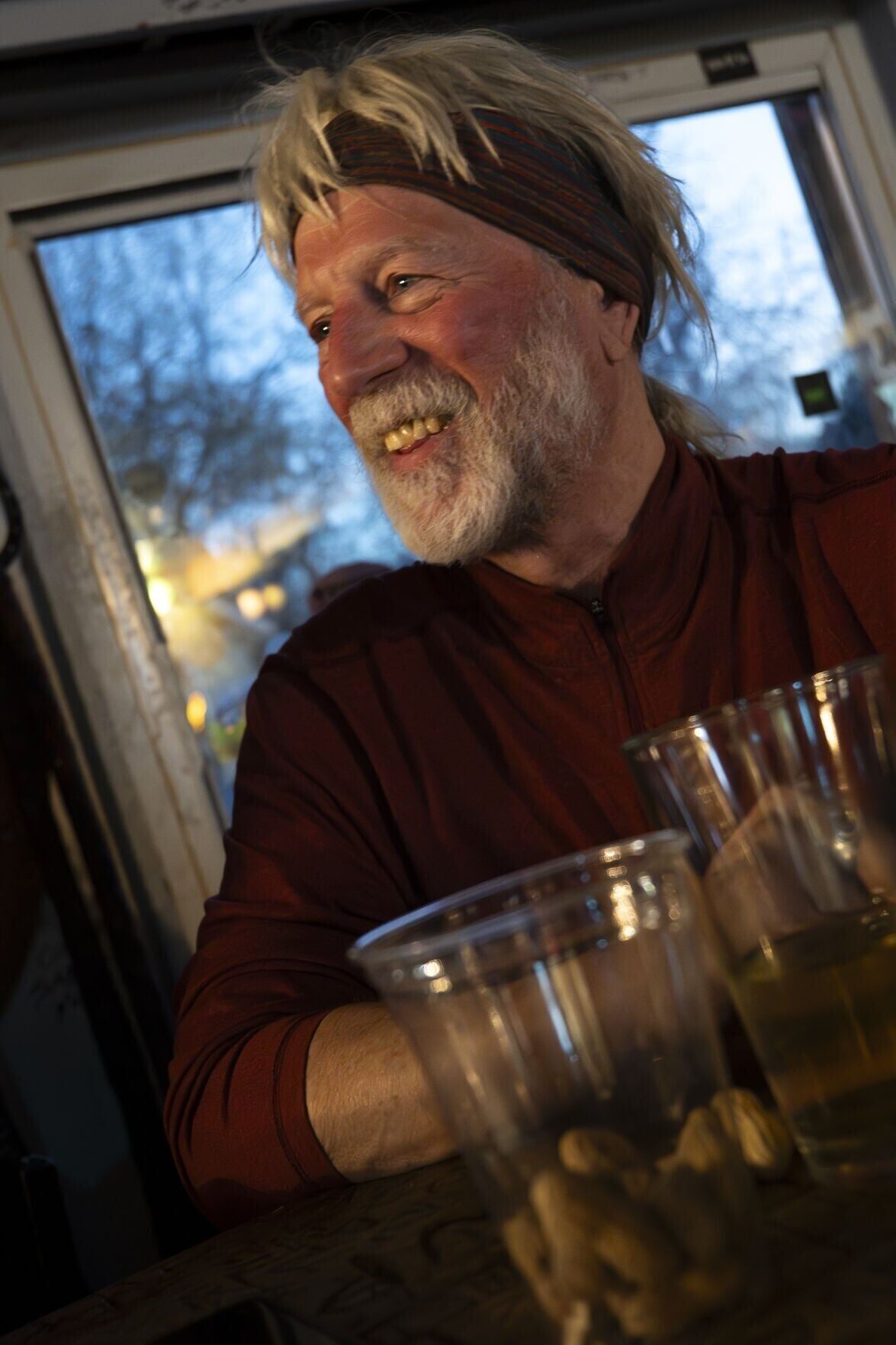
The late evening sun peeked through the small windows of the Haufbrau, mingling with the pink and green glow of neon beer signs to cast a soft glow on sticker-covered walls and the wooden bar.
Rick Ladzinski stepped out of his Subaru and walked quietly through the bar door, gray hair pulled back in a disheveled ponytail, eyes scanning as he appraised his old post-skiing haunt.
“I made it to the casual part of my day,” Ladzinski said as he pulled up a stool. “We ski at a pretty high level. Steep stuff, difficult, challenging stuff. And we probably go faster than we should at my age.”
At “70 going on 45,” Ladzinski estimates he has skied 115–120 days this season. For him and his posse, numbers like these are nothing to bat an eye at.
After ordering a Lockhorn Cider and pulling a half-full cup of peanuts to his side of the table, Ladzinski settled onto a stool, taking a load off after a full day skiing Big Sky.
“I don’t think I’ve ever really had a ‘real job,’ (or) career path,” he said as he cracked a peanut. “Just because I wanted to ski, and a real job just doesn’t really go with being a ski bum.”
Ladzinski, who moved to Livingston five years ago after about 40 in Bozeman, has held a Bridger pass for five decades, including a two-year stint in eastern Washington for grad school. As for Big Sky, he estimates he’s held a pass for 12 or 14 seasons.
Between the two ski areas, Ladzinski said he doesn’t really have a preference.
“I like them both,” Ladzinski said. “A lot of people don’t like really hard or rugged conditions, because you have to be really precise and accurate, or you’ll kill yourself. But I like it because it forces you to be really good.”
Each season, Ladzinski focuses on becoming the best skier he can be, choosing where to ski based on the skills he wants to sharpen.
“Bridger, because of the terrain, the trees, the steepness, is very technical and it will force you to be a very technical, precise skier,” Ladzinski said, waving his hand through the air, emulating a skier’s line.
“Big Sky is entirely different. I call it ‘fly around skiing.’ You have all the room in the world, so you can fly around wherever you want,” he added, opening his arms as if he were going in for a hug and pivoted, a bird in mid-flight.
“I love flying around, going fast.”
Ladzinski first strapped on a pair of skis in high school during the 1970–71 season. Back then, snowboarding was still in its infancy. Save for one week at Big Sky in the early 2000s, he’s been loyal to the toothpicks.
“It was a good powder week, but I hit the ground more than I wanted,” he said.
Raised in “Corn Town” — his term for his Midwest hometown — Ladzinski learned to ski on mountains in Wisconsin and Michigan.
At 18, he moved to Bozeman to attend Montana State University and study social research, marketing research, and English.
“Good excuse, huh?” he mused, brushing a pile of peanut shells onto the Hauf floor.
After nine years at MSU, Ladzinski went to Washington State University, where he received a master’s degree in environmental sociology.
“I’m a weird guy, I have a lot of interconnected experiences in education, farming, writing, and sustainable land use,” he said, raising a finger for each venture he listed.
As the sun set, the Thursday evening crowd shuffled into the Hauf. As the ambient noise rose, the peanuts in Ladzinski’s plastic cup dwindled.
“A lot of people think I’m a total ski bum, trust fund ski bum, and I’m way more than that,” he said.
To support his lifestyle, Ladzinski sells real estate. He said he’s “mostly at war with the mainstream real estate crowd.”
Starkly opposed to subdivision sprawl, Ladzinski applied his conservation and agriculture backgrounds to encourage the establishment of what he calls “agri-hoods.”
“I’ve been working on it for quite a while. It started with this property south of town. Everybody loves it, it’s perfect for looking at the Bridgers, the Spanish Peaks, and it’s got this great farmland,” he said.
When a developer wanted to subdivide the parcel, Ladzinski said the landowners came to him asking for an alternative idea.
His proposal would use only 15 out of 100 acres for housing, reserving the remainder for farmland. Anyone who owned a townhouse on the land would automatically own a piece of the farm, “kind of like a commune.” At the end of the year, Ladzinski said homeowners would receive a dividend check.
He hopes to spread the concept internationally and set up a “national real estate investment club firm” for “normal people” interested in organic farming, community living, and sustainable land use.
Ladzinski draws inspiration from “Design With Nature,” by Ian L. McHarg, a 1969 book advocating for landscape design practices that “fit society into nature without destroying it.”
“And so how does this all tie into skiing? Skiing drives me to do this. It makes me stronger, healthier, happier,” Ladzinski said.
In his seven decades on Earth and five decades on the slopes, Ladzinski has accumulated a posse of skiing and life buddies, including local legend Turk Comstock and Jerry Hance, a Bozeman local and founder of a heli-skiing company in Alaska.
While he shreds with some of the most prominent figures in the local skiing scene, Ladzinski said he has no interest in fame. He skis because, to him, it feels like flying — aging in reverse.
“I’m a child. Me and my group of friends, we’re a bunch of children on the mountain,” Ladzinski smiled.
These days, Ladzinski isn’t catching as much air as he used to, and tricks are out of the question. But it doesn’t matter — he said he was never one for the park.
“I’m afraid to hit the ground,” he said. “I don’t like crashing.”
Ladzinski believes “peak male performance” on the mountain happens somewhere around 45 years old. He said it’s a combination of experience, skill and survival.
“You gotta end the day and end the year in one piece.”
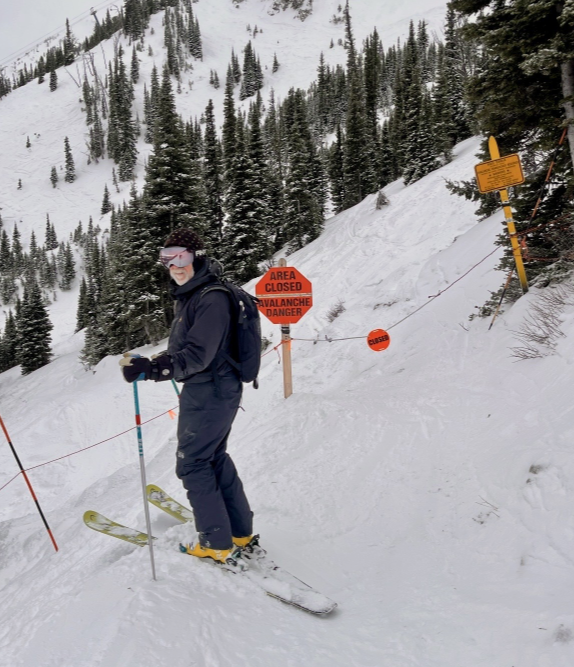
Ladzinski, who opts not to wear a helmet on the slopes to keep his hearing sharp, said he has been caught in at least one avalanche.
It was December 18, 2018.
Ladzinski and Comstock were skiing Saddle Peak, “a very dangerous place to be on the wrong day.” Although they knew there was a high avalanche risk, Ladzinski said the duo had to follow their “you have to know to go” ideology: Scope the conditions and then make a decision.
“In a split second, I saw what the snow looked like. I made a turn, and as soon as I touched the snow, I knew it was all sugar and that it was going to move,” Ladzinski said.
Ladzinski called a warning out to Comstock, who was close enough to hear but not far enough to get out of the way.
“I touched it, and it exploded like a bomb,” Ladzinski pulled his hands apart, emulating an explosion. “I went from zero miles to 50 in a split second.”
With Volkswagen-sized pieces of snow and ice crashing down around him, and minimal control of his trajectory, a small tree in his path was like seeing a buoy in turbid waters.
“I grabbed it, wrapped my arms around it, and it saved my life,” he said. “The next summer, I went out and put prayer flags on it.”
Despite several close calls, Ladzinski has never considered giving up the sport.
“I’m a lucky guy, I’m lucky to be alive. I have great genetics, but I work really hard at being good at what I do, and I work really hard to be healthy and strong,” he said. “I’ll ski until I physically can’t anymore.”
In the off-season, Ladzinski can be found biking, running and elk hunting.
“You get dense protein, muscle building, and (when you’re) elk hunting, running around the mountains with a pack and a rifle will make you as strong as you want to be. The stronger you are for skiing or boarding, the better you are.”
From power days to slush, and first chair to slogging in the backcountry, as long as the snow is falling somewhere, Ladzinski is almost guaranteed to find a way to tear down it.
“Every day on skis is a good day,” Ladzinski brushed his final pile of peanut shells to the ground and glanced at the empty cup. “It makes me happy.”



Comments ()