
Ann Bertagnolli: 28 years of leadership and mentorship at MSU
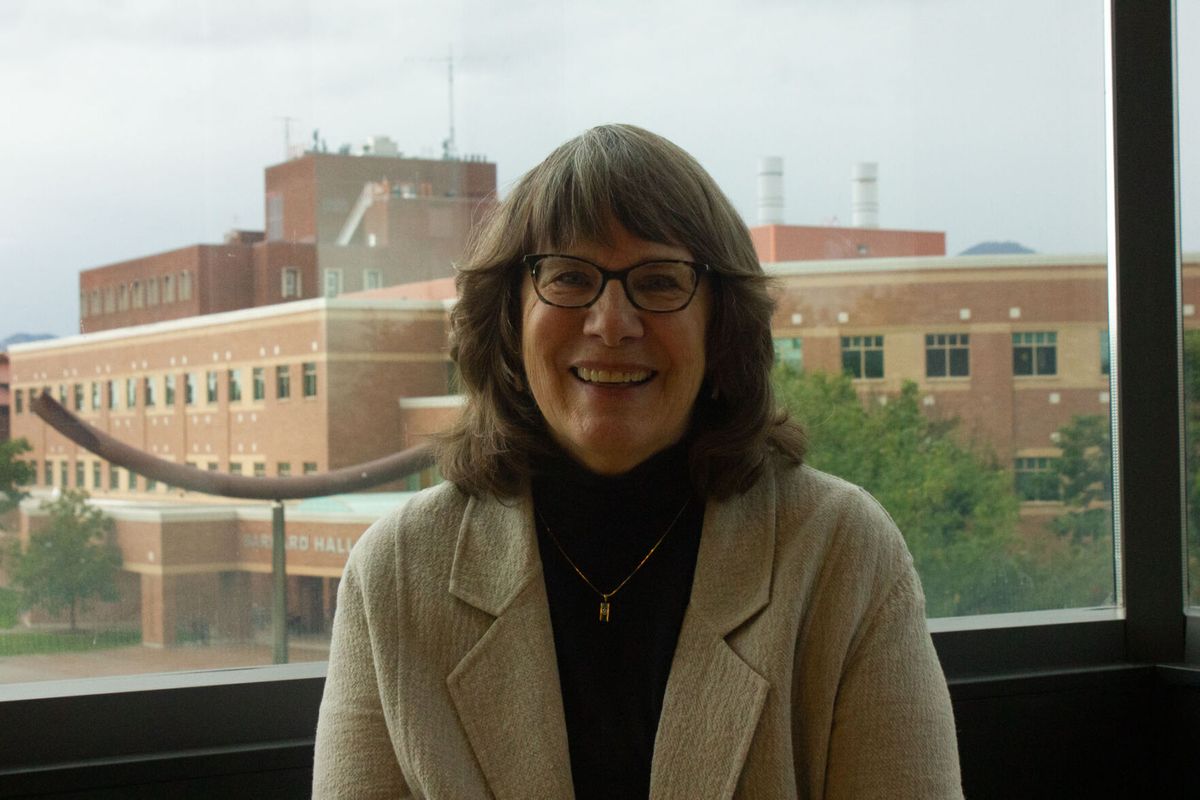
A room of voices, new and old, filled Norm Asbjornson’s Inspiration Hall on Tuesday, Sept. 17 as attendees celebrated the career of a truly beloved woman. Within the room, images of retiring faculty member Ann Bertagnolli rotated on the screen, curating a mixture of emotion among the guests as they exchanged stories, laughs and heartfelt words.
Bertagnolli’s journey began in the small town of Three Forks, Montana. Growing up surrounded by the expansive landscape of the Treasure State, she felt a persistent pull to discover what lay beyond. “Always in my mind, I just kind of knew that I would keep going to school. When I was in high school, I used to think I had to get over that. Literally — I’d look at the mountains and I’d think I need to find out what’s out there,” she recalled.
And find out she did. Her curiosity and academic determination led her to Carroll College in Helena, Montana, where she earned her Bachelor’s in English and studied abroad in Florence, Italy. From there, she continued her studies at the University of Nevada, Las Vegas, where she completed her Master’s in English while working as a teaching assistant. However, her journey didn’t stop there, as Bertagnolli went on to earn a Ph.D. in English from The Ohio State University.
Although Bertagnolli and her husband Dennis didn’t originally have plans to return to Montana, they ended up doing so in 1989. According to her, the move was a symbolic act, marking a new chapter for their lives. Once back in Montana, they adopted their daughters, Hannah and Leah. To accommodate the demands of motherhood, Bertagnolli joined MSU as an adjunct faculty member in 1996 in the Honors Program, where she taught night classes.
Her career quickly expanded beyond teaching. In 2001, she took on the role of associate director for the preliminarily BRIN program — now called the IDeA Network of Biomedical Research Excellence (INBRE) — which aimed to build biomedical research infrastructure in states that historically received less federal research funding.
“In those first three years, what we were supposed to do was build a statewide research network,” Bertagnolli said. “That meant going to all the undergraduate tribal and community colleges and asking [if] their faculty and students [wanted] to be involved in research.”
Her leadership and vision helped transform INBRE into a congressionally mandated program, thus ensuring stable funding for biomedical research across Montana. Bertagnolli said her approach to leadership was rooted in openness.
“You don’t go with anything. You go with your ears open,” she said about her work with communities across the state, especially Montana’s tribal colleges and underserved populations.
Bertagnolli’s role as program coordinator at INBRE was more than just administrative. She worked tirelessly to establish trust and build meaningful relationships with 16 partner institutions, including tribal colleges.
“We’re looked at as kind of experts in community engagement, but we don’t perceive ourselves that way. No one's ever an expert in anybody else's culture,” she said. At the retirement celebration, Director of INBRE and MSU Professor Brian Bothner was moved to tears as he painted the picture of this impact.
“There are 16 INBREs across the state of Montana and I know everyone is taking their hats off today and saying that’s a job well done,” Bothner said.
One by one, each speaker went up to share their testimony of Bertagnolli and the threads of her life began to be sewn together for the crowd — a life of complex designs, vibrancy and certain beauty.
An example of that beauty was reflected by the blankets bestowed on her by faculty of the Blackfeet Community College (BFCC). In Indigenous culture, a profound way to communicate love and gratitude for another is by wrapping them in a blanket. Brad Hall, president of the BFCC, alongside his fellow colleagues, wrapped Bertagnolli in three blankets.
“It's a symbol of love, honor and warmth. She is never going to go cold or leave our hearts,” Hall said.
As Bertagnolli reflected on her career, she shared that it’s moments like these and the enduring relationships she has built over the years that are the most meaningful aspects of her work. Looking forward, Bertagnolli said that she plans to continue to educate people on how to approach cultures and communities outside of their own. Though her formal career at MSU may be coming to an end, her influence will continue to be felt across Montana and beyond.
As she steps into retirement, her philosophy of empathy, respect and lifelong learning serves as a reminder that true success lies in how we treat each other. “All people truly matter,” she said. Through her work, Bertagnolli has shown that those words are not just a belief but a way of life.
Dean of the Honors College Ilse Marie Lee encapsulated the impacts of her career, stating; “it was Annie in 301 that changed lives.”
Comments ()