
BLM upholds decision to revoke American Prairie's bison grazing leases
Some bison can be grazed on federal lands, but not American Prairie’s conservation herd, the Bureau of Land Management has ruled again.
In a 23-page final decision issued on May 8, the agency’s acting director has upheld the Secretary of the Interior’s overturning of the Montana field office’s ruling which had approved American Prairie’s request to graze bison on seven federal leases in northeastern Montana.
Although American Prairie appealed the proposed decision issued in January, the BLM upheld its actions saying it was “not persuaded” by the group’s 200 protest points, nor the 34 other letters submitted on the group’s behalf.
The BLM and state of Montana had previously authorized the group’s leases when the agencies were under Democratic control, allowing American Prairie to graze bison elsewhere for the past 20 years.
American Prairie condemned the decision in an email “calling the move a politically motivated reversal that threatens decades of established public land management practice and jeopardizes bison restoration efforts nationwide.”
Gov. Greg Gianforte hailed the judgment as a "victory for the rule of law."
"For far too long, the Biden administration ignored the clear language of the Taylor Grazing Act in favor of an ideological experiment," the governor said in a statement. "I’m proud of our administration for leading the fight to reach this decision and I thank Secretary of the Interior Doug Burgum and BLM for putting Montanans first.”
Attorney General Austin Knudsen praised the permit cancellation in a news release.
"The decision by the Trump Administration to cancel the American Prairie Reserve’s bison grazing permit is a huge victory for Montana farmers and ranchers," he said. "For more than four years, my office has been working tirelessly to cancel APR’s permit, and it’s great to see that hard work pay off."
The decision can be appealed to an administrative law judge.
Defining a 1934 law
The BLM used a definition of the Taylor Grazing Act to argue that the conservation group’s bison are managed “as wildlife used primarily for conservation and ecological restoration,” not “production livestock” as required under the 1934 law, and therefore should be banned from the federal allotments.
The decision ignored that Montana statute classifies bison as domestic livestock.
“Notwithstanding claims that American Prairie treats bison ‘like cattle,’ including because it tags, vaccinates, and donates meat from its bison, American Prairie has consistently been clear that its primary management focus is conservation and an effort to restore wild populations and reestablish natural ecological processes,” the agency wrote in its press release.
American Prairie’s attorney, Mary Cochenour, said the “agency’s reversal required a novel interpretation of the Taylor Grazing Act and introducing new anti-bison and anti-conservation provisions in order to justify rescinding the permits.”
“This decision is not grounded in resource damage, permit violations or failed stewardship,” Cochenour added. “It reflects a political effort to target bison conservation despite overwhelming evidence that American Prairie has responsibly managed these lands for years.”
Alison Fox, CEO of American Prairie, said in a statement that the BLM’s “decision abandons decades of consistent federal policy and extends far beyond American Prairie. By reversing decades of precedence, BLM is creating uncertainty for tribal buffalo restoration, conservation partnerships, and public lands grazing management nationwide. The agency’s action is arbitrary, shortsighted, and contrary to its own longstanding interpretation of federal grazing law.”
Gianforte said the BLM's decision protects rural economies, ranchers and farmers. Knudsen called American Prairie a group of "elitists" whose goal is to destroy rural America's livelihood.
Only American Prairie is targeted
The BLM was keen to note the decision “applies only to these seven allotments and does not affect other permit holders, treaty rights, tribal grazing authorizations or tribal bison herds.”
Hundreds of bison will not be evicted from Montana, the BLM added, just American Prairie is affected because their bison aren’t “kept for sale or trade.”
“The issue before the BLM is not whether bison can, under certain circumstances, be considered livestock, but whether the specific animals at issue here are managed as domestic livestock within the meaning and purpose of the BLM’s governing statutes,” wrote Bill Groffy, the agency’s acting director.
“The BLM’s determination in this decision, therefore, focuses on the manner in which the animals are managed and the primary purpose of that management, rather than their species classification.”
Groffy also wrote that the Taylor Grazing Act refers to “domestic livestock,” and American Prairie’s bison are “presently treated as wild” despite “claims that American Prairie treats bison ‘like cattle,’ including because it tags, vaccinates, and donates meat from its bison.
American Prairie had argued that it uses bison for “meat consumption, commercial purposes, breeding stock for existing bison operations,” contributed animals to tribal food banks, allowed public harvest of 370 bison and shipped 645 to other producers.
Yet the BLM said although some of these actions may be considered production oriented, the organization had to be judged on its “full factual record,” including its public communications and management plans. Those documents and statements, the agency said, reflect that the primary purpose of the herd is conservation with a broader goal to “restore wild populations and reestablish natural ecological processes.”
Conservation groups, including the Montana Chapter of Backcountry Hunters & Anglers, had spoke out in opposition to the BLM's decision.
"The ruling highlights a double standard," said Thomas Baumeister, vice-chair of the group. "While cattle ranchers are rightfully celebrated as stewards for running fewer head on public land than permitted, American Prairie is penalized for doing the same. It remains unclear why a neighbor grazing bison is treated differently than one grazing cattle."
Reversing a 2023 decision
The decision reverses the Montana field office’s 2023 authorization which was challenged by Gov. Greg Gianforte’s administration and the Montana Stockgrowers Association. Gianforte is also using the BLM’s definition of domestic livestock to rewrite state leases in an attempt to deny American Prairie’s use of school trust lands.
Groffy, the BLM’s acting director, previously worked for the Colorado Oil and Gas Association. In his BLM role Groffy has touted reducing “unnecessary regulatory burdens” for the energy industry on federal lands.
He also is working to reverse a Biden administration BLM rule that was intended to put conservation on an equal footing with grazing, energy development and recreation.
“This final decision by the BLM makes it clear that this is an all-out attack on conservation," Cochenour said. “It is a textbook example of the government moving the goal posts and changing the rules in the middle of the game to reach a predetermined outcome. There have been no grazing violations, and the administrative record contains objective evidence showing that rangeland conditions have improved over the last two decades with bison on the landscape.”
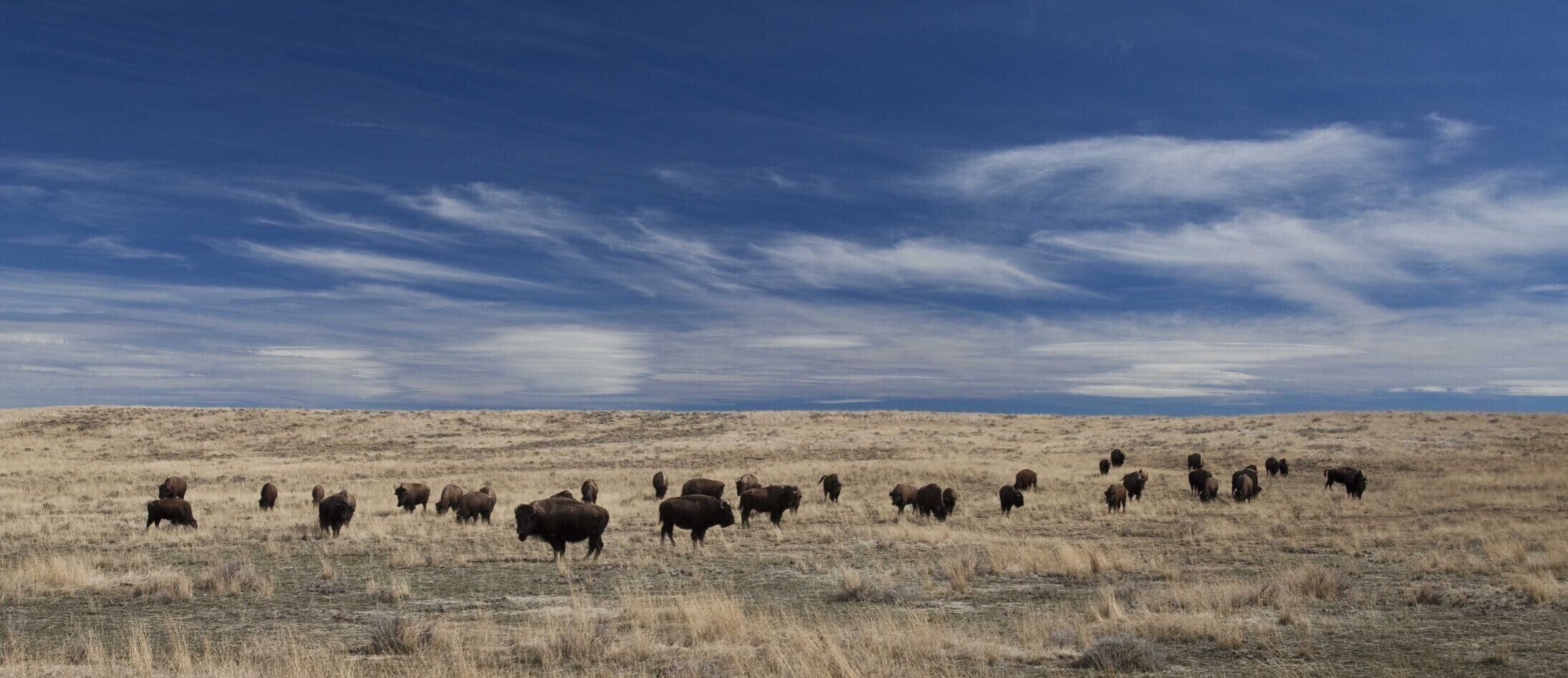
American Prairie currently has a herd of about 940 bison but leases more than 500,000 acres of its land to 25 ranching families that run 8,000 head of cattle.
Last week, the Department of the Interior, which also oversees the National Park Service, issued a notice that Yellowstone National Park’s bison management plan, released in 2024, will be re-examined under the Trump administration. Gianforte’s administration had sued the federal agency regarding the plan, seeking greater involvement with an eye to reducing the park’s total bison numbers.



Comments ()