
Bozeman’s “No Kings” protest draws thousands of community members
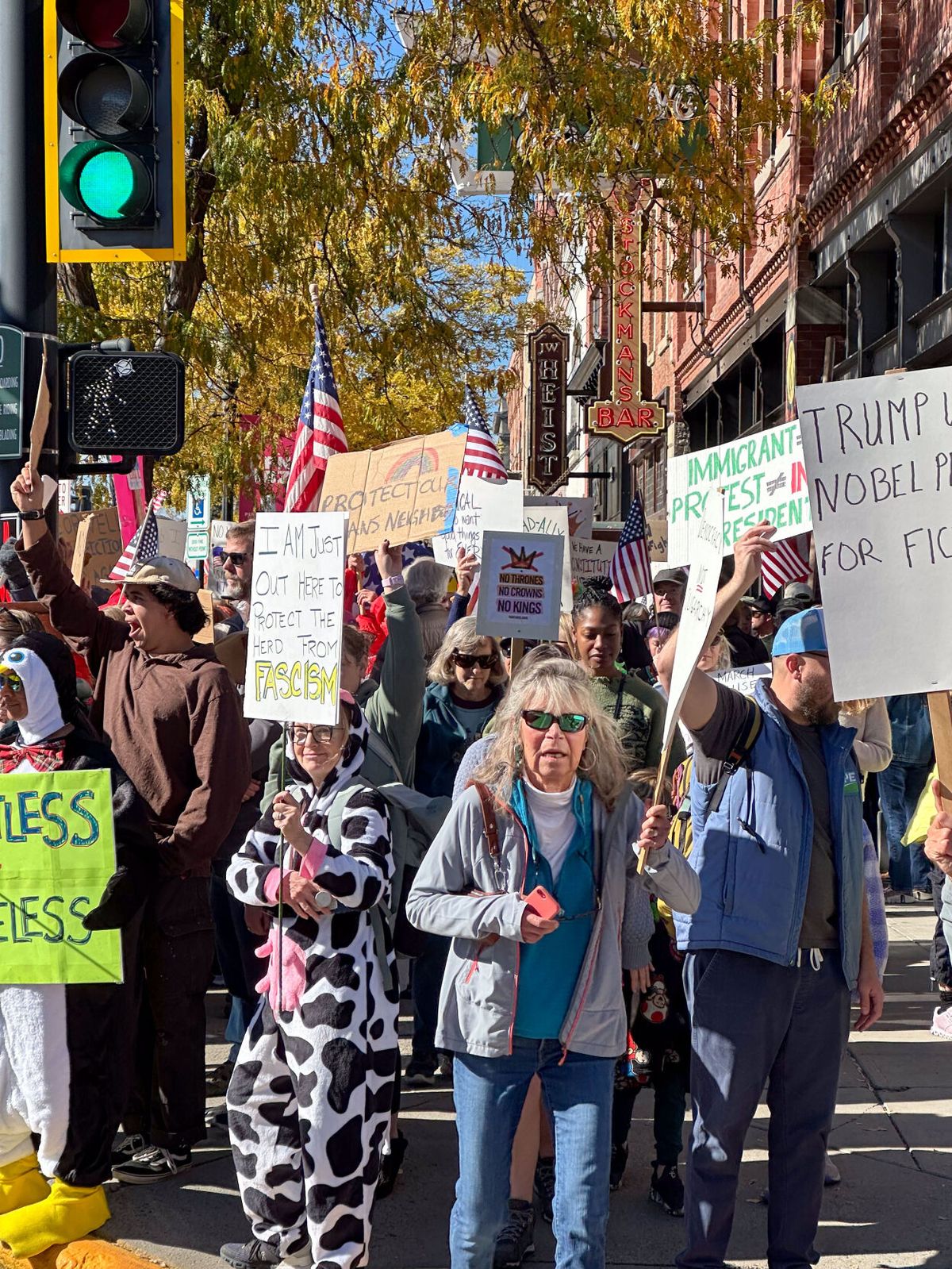
Several thousand people took to Main Street last weekend brandishing signs, wearing costumes and shouting into bullhorns in participation with the second, nationwide “No Kings” protest.
Bozeman’s event — put on by Indivisible Bozeman — was one of over 2,700 protests that took place across the country and abroad on Oct. 18. According to the No Kings website, more than seven million participants marched down streets, filled public parks and lined the sidewalks of towns, all to convey the same message: America has no kings, and power belongs to the people.
“People are so dissatisfied that they’re willing to come out in the street and exercise their First Amendment rights to protest,” said Beth Kampschror, Indivisible Bozeman’s media liaison. Indivisible is a national movement of grassroots organizations working to protect democracy, according to its website.
Former MSU professor Margaret Bortko was standing on a corner dressed as the Statue of Liberty and hoisting a sign that read, “Give me your tired poor, your huddled masses yearning to be free.” These words are part of “The New Colossus,” a poem by Emma Lazarus that is inscribed at the base of Lady Liberty as a message of welcome to immigrants, according to her.
“We’re treating our immigrants rather poorly, violently and very disrespectfully of any humanity,” Bortko said. Her costume was designed to represent democracy and advocate for better treatment of immigrants, according to her.
Many protesters said the recent arrests by ICE were their main reason for attending. “[They are] sending masked goons to kidnap people off the street,” Kampschror said.
In an executive order titled “Protecting the American People Against Invasion,” signed on Jan. 20, President Donald Trump ordered federal agencies to prioritize curbing illegal immigration and deporting undocumented people.
“I think due process is a big area that’s being violated right now,” said Missey Dore, a recently retired teacher. “ICE is masked — and not providing any identification — and going into places that we usually consider private, like schools and churches, and just taking people,” she said.
Dore said that understanding the U.S.’s history and system of government — specifically the checks and balances in the Constitution — is key to protecting American democracy. “Knowing your history is very important, you know? We say that so we don’t repeat it,” she said.
According to Dore, hopelessness and anger are how democracies fail and people should have more faith. “Let the system work out as it should. It’s slow, it’s messy, it’s not necessarily efficient, but it’s the best and it’s the most fair,” she said.
Another primary issue for many protesters was cuts to federal programs. Elizabeth Marum was advocating for Medicare and Social Security — two programs she said are critical for many people, and are under threat by the current administration.
“It’s the largest anti-poverty measure in America today,” she said. “I can’t even stress the significance. [Social Security] saves 40 percent of people from poverty.”
According to the Center on Budget and Policy Priorities, 40 percent of Americans over 65 are lifted from poverty in nearly a third of states due to Social Security. In Montana, 64,000 seniors rely on Social Security to keep them from falling below the poverty line.
Marum said she was upset that the administration was cutting domestic programs while sending billions of dollars to other countries. “Trump is an authoritarian fascist and he wants to drive us all to the margins,” she said.
The event also drew MSU students, including Lucia Jackson, a junior English major. She said that she wants more college students to voice their opinions at protests. “A lot of kids say sh--t online but not a lot of them show up,” she said.
Jackson emphasized the importance of education for the future of the country. “Read a book, read some theory,” she said. Jackson said she hopes protests like “No Kings” shed light on the American people’s frustration with the government. “Visibility and change are two main things that need to come from this,” she said.
The Bozeman Police Department had teams of two officers on most corners of downtown Bozeman throughout the event. They also deployed kits to detect threats such as bombs and chemical weapons.
While there was a police presence in the area, Captain Hal Richardson said he was not worried about anything happening. “We just want to be prepared,” he said. “We want to make sure that everyone’s safe down here and that they can carry out their constitutionally protected activities.”
To learn more about the “No Kings” protests, visit https://www.nokings.org/.
To learn more about Indivisible, visit https://indivisible.org/.

Comments ()