
City council to consider adoption of land use plan, subdivision regs
Population could double in 2040s, according to city
Belgrade councilmembers will consider adopting a land use plan and updating the city’s future land use map and subdivision regulations at their meeting next Monday.
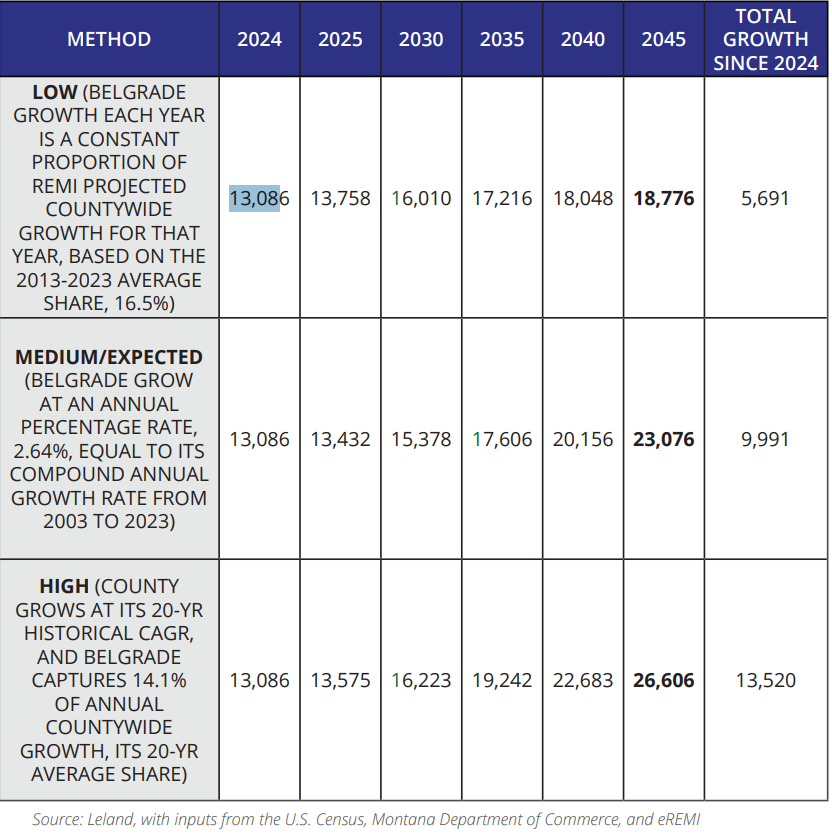
The draft land use plan assumes the city’s population will grow from the current 13,086 to 23,076 by 2045. This constitutes a growth of 4,145 households needing an additional 4,394 housing units. Another projection, which the city doesn't expect to come to fruition, puts the city’s estimated population at 26,606 by 2045. All this information is in the proposed land use plan and in a presentation that’s on the council’s May 4 agenda.
Officials have been preparing those new documents to comply with the Montana Land Use Planning Act. The act, enacted in 2023, was a response to housing shortages, according to the recitals of a proposed ordinance establishing new subdivision regulations. The act also requires updates to land use regulations and Subdivision Regulations that support and encourage more density and mixed-use development. The act “introduced a new statewide planning framework designed to streamline land-use decision-making, prioritize public participation, and align local land-use goals with future population and housing needs,” according to the ordinance’s recitals.
The proposed regulations revise the subdivision review process and approval criteria, standardize submission requirements across all subdivision types, clarify procedures for amending subdivision regulations and other planning documents through the Planning Commission, and formally establish appropriate processes for administrative decisions and appeals, according to the presentation on the council’s May 4 agenda.
The presentation is at https://tinyurl.com/58hvc4n3.
The proposed subdivision regulations are available at https://tinyurl.com/bddkdxdw.
Land use plan, future land use map
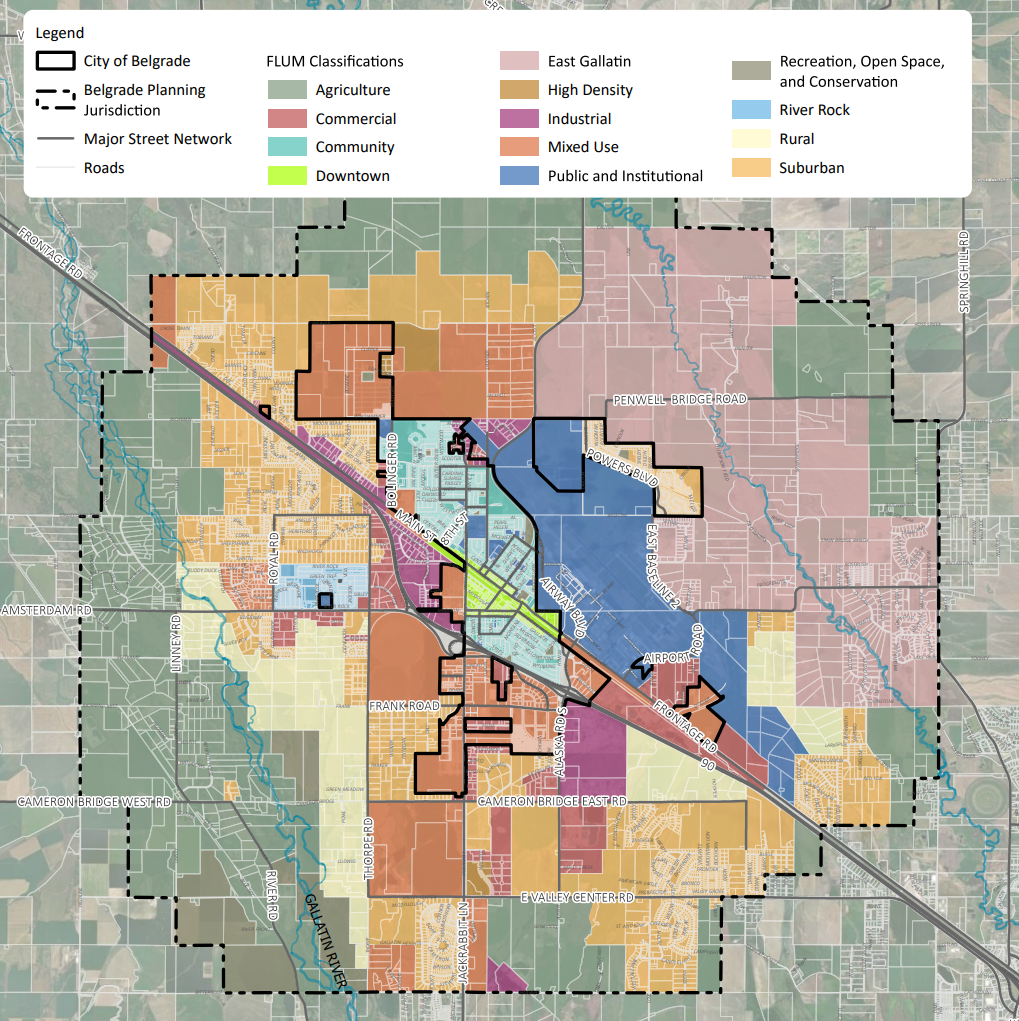
The proposed land use plan and future land use map include the city limits and The Belgrade planning area, also known as the planning jurisdiction, which was established in 1975 and encompasses an area of about 4.5 miles surrounding the city totaling 66.42 square miles.
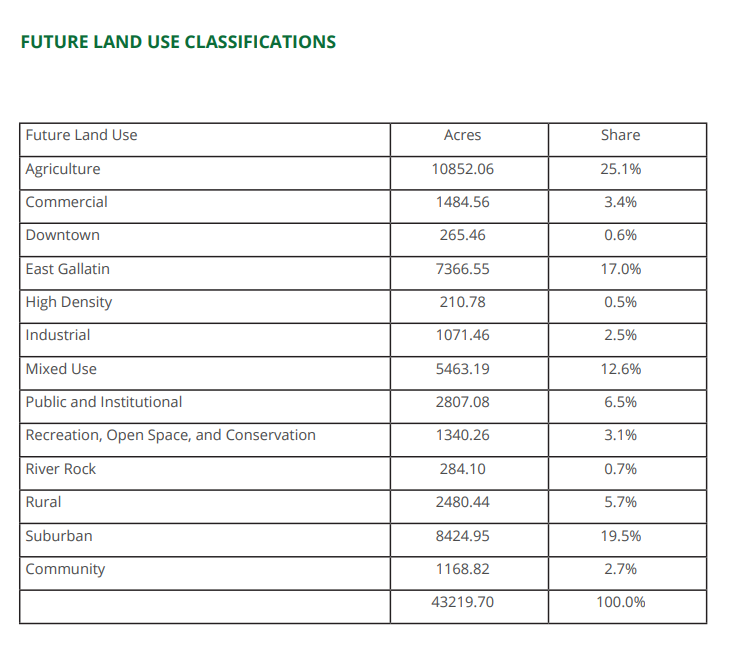
Land use classifications in the documents include agriculture; commercial; downtown; East Gallatin; high density; industrial; mixed use; public and institutional; recreation, open space, and conservation; River Rock; rural; suburban; and community.
The land use plan and future land use map were drafted to substantially be in compliance with the Montana Land Use Planning Act to guide future growth in and around the City of Belgrade, according to a city staff report to the council. A draft of these documents is available at https://tinyurl.com/2npuwk28.
‘Transformational change’ while ‘uniquely and clearly Belgrade’
The draft land use plan acknowledges the importance of heritage while accepting that drastic change has happened, and more is on the way.
“The city has seen transformational change over the course on a single generation,” with the municipality’s population having more than tripled from 1990 to 2023, according to the draft land use plan.
Before the late 1980s and early 90s, “Belgrade remained smaller and quieter than Bozeman, yet residents took pride in the town’s independence, agricultural heritage, and close knit character,” the document states. By the late 80s and early 90s, “the city entered a period of significant residential and commercial expansion.”
“Although recent indicators suggest that growth rates are beginning to settle, the community continues to respond to the impacts of this recent surge,” reads the plan. “As a result, the city has largely been forced into a reactive position, addressing pressing demand on services while crafting broader, strategic measures to manage escalating costs across multiple systems. Compounded by similar trends in neighboring jurisdictions and Gallatin County, the need to balance routine maintenance, targeted capital improvements, and long‑term investments that support proactive, coordinated planning remains a priority.”
The rapid pace of change “is shaping the population, housing, local economy, environmental conditions, culture, and, perhaps most significantly, community identity,” the document states.
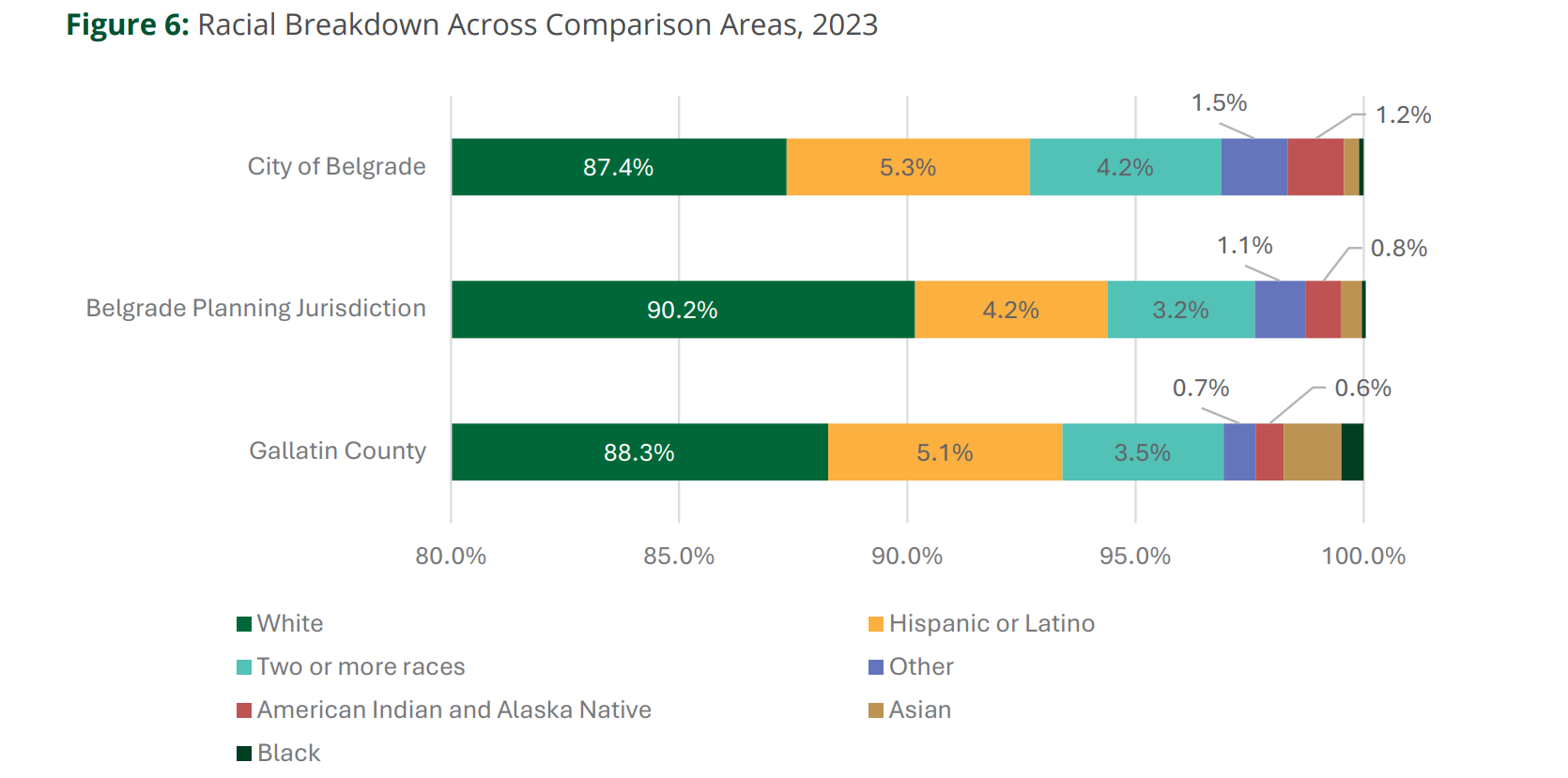
There has been “increasing racial, ethnic, and linguistic diversity” in Belgrade, which calls for "more intentional, targeted community engagement strategies to ensure that public participation processes are inclusive and representative, and that new cultures and languages are integrated into the community,” according to the plan.
“The considerations of language accessibility, particularly for Spanish‑speaking residents, will be important to support equitable access to information, services, and civic decision‑making,” reads the plan. “These trends challenges [sic] more traditional assumptions of cultural homogeneity in Belgrade and highlights the importance of broader cultural and linguistic awareness within the community.”
Still, the presentation on the council’s agenda characterizes Belgrade as “a destination with a distinct identity.”
“Belgrade has moved well beyond its origins as a quiet bedroom community within Gallatin County and is continuing to emerge as a vibrant city with a distinct and evolving identity of its own,” read the draft land use plan. “While comparisons to surrounding communities will always remain, they reflect the real and shared experience of a city undergoing rapid change that is shaping the population, housing, local economy, environmental conditions, culture, and, perhaps most significantly, community identity.”
The city’s public engagement process reportedly showed residents value Belgrade’s small-town character, agricultural heritage, independence, and sense of place.
Public engagement
The city undertook a community engagement process to inform the land use plan, including kickoff events, open houses, focus groups, district-level outreach, transportation-specific engagement, and community-wide surveys. The process was intended to include different age groups, longtime residents, new families, rural landowners, business owners, educators, recreation leaders, and youth and senior advocates. There reportedly was strong agreement that Belgrade is at a pivotal moment.
“Land use and growth emerged as a central theme throughout engagement,” reads the plan. “Participants repeatedly voiced the importance of protecting agricultural land, open space, and the rural character that defines Belgrade’s identity. There was concern that unchecked sprawl, low‑quality commercial development, and overly car‑centric design threaten both quality of life and long‑term affordability. At the same time, many residents expressed support for growth when it is intentional, favoring mixed‑use areas, walkable neighborhoods, higher‑quality design, and reinvestment in the downtown core. The dominant message was not opposition to change, but a call for managed growth that reflects community values.”
This is a developing story and more will be reported.
Monday’s meeting will begin at 7 p.m. at 205 E. Main St., and will include the opportunity for public comment on any matter under the council’s purview. The meeting can be watched live over the internet at https://www.belgrademt.gov/357/Watch-Live-Meetings.



Comments ()