
Democratic and Republican appetite for ticket splitting in Montana elections is low, poll indicates
Montanans often tout being independent-minded, and have historically elected statewide and federal candidates of both major political parties in the same general election. But a new Montana Free Press-Eagleton poll indicates voters’ appetite for ticket splitting is continuing to wane.
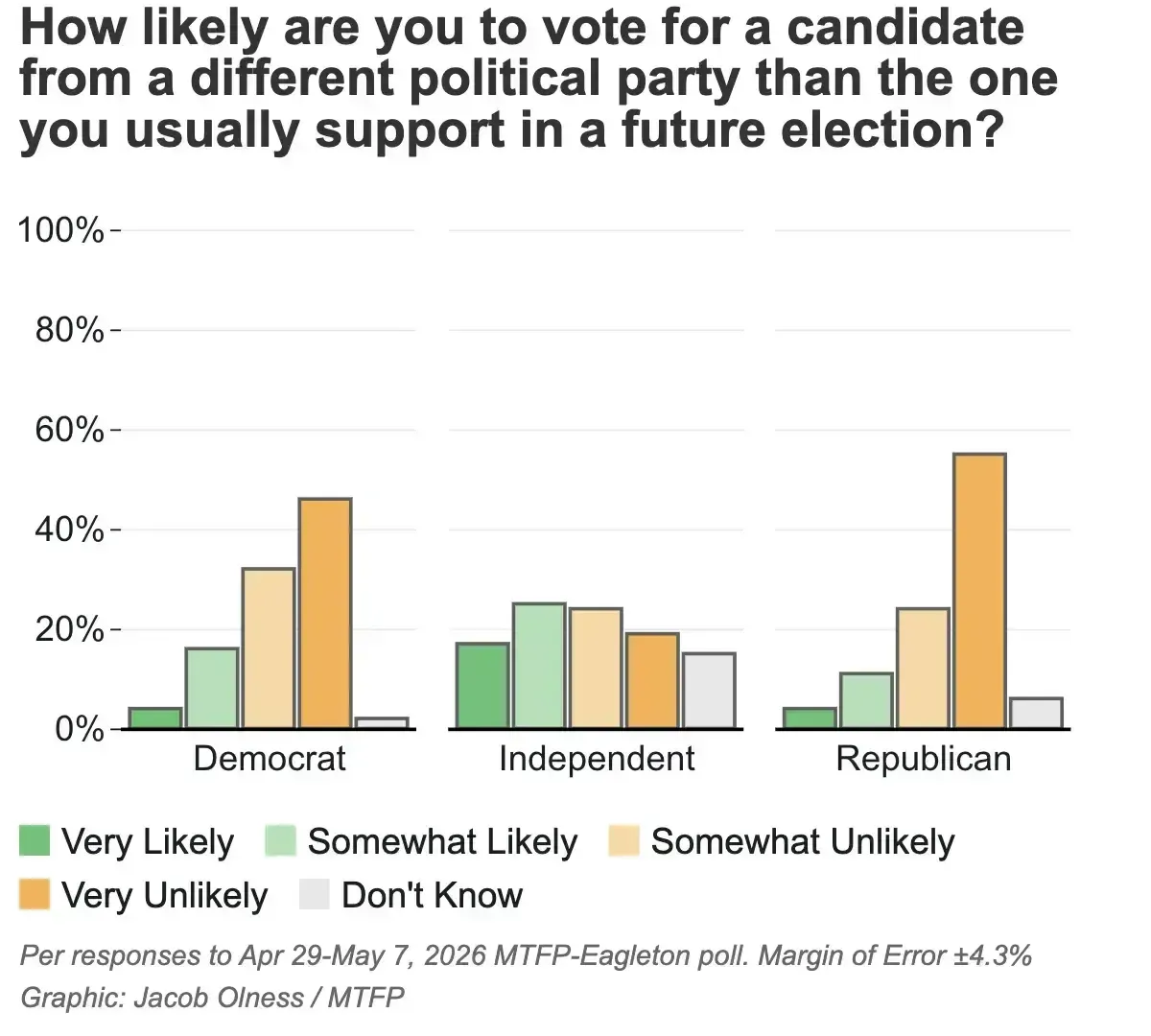
Roughly two-thirds of respondents said they have voted for candidates of multiple political parties on the same ballot in the past, but nearly the same proportion — 63% — said they are unlikely to vote for a candidate from a different political party than the one they usually support.
In 2016, Donald Trump won the state by 20 points. That same year, voters chose a Democratic governor. In 2018, voters elected a Democrat to the U.S. Senate and a Republican to what was then the state’s lone congressional district. Those outcomes are only possible with the help of ticket splitters, but there is some evidence that the number of ticket splitters has started to decrease as Montana voters have increasingly voted by party line in recent years. Following the 2024 elections, Republicans took over every statewide and federal office, the first time that happened in more than 100 years.
“Some of your longer term Montanans like to emphasize this spirit of being independent,” said Montana State University political science professor Eric Raile. “A lot of people who have moved into the state in the last five to 10 years do not share that sentiment and do not share that culture.”
But heading into the 2026 general elections, where notable independent and Democratic candidates are hoping to win big as voters sour on Republican leadership, ticket splitters could be a key voting bloc. “They are going to need to have Republicans split their ticket,” said Montana State University political science professor Jessi Bennion. “It’s getting harder and harder to do that.”
Roughly 73% of voters who most or all of the time vote for candidates from the Democratic Party said they were unlikely to vote for a candidate from the opposite party in a future election. Among voters who most or all of the time vote for candidates from the Republican Party, that number was 71%.
“People are so hyper-attached to that partisan label. It used to be that people really voted on the candidate,” Bennion said. “But partisanship seems to just reign supreme.”
Notably, 4 in 10 independents said they are not at all likely or not very likely to vote for a candidate of a different political party than the one they typically support.
“When we dig down, people are not independent,” Raile said. “They are going to vote one way or the other.”
There is also some indication that the number of people who are willing to vote for multiple political parties is even lower than the survey reflects, multiple political analysts told MTFP.
Bennion and others explained that respondents can be motivated to tell pollsters that they will vote for multiple political parties on the same ballot when in reality they might vote a straight Republican or straight Democrat ticket. Auburn University political science professor Kal Munis called it a “social desirability bias.”
“Most people are reluctant to come full out and say, ‘No, I would never think about voting for the other party,’” Munis said.
In Montana, it is not infrequent for certain political offices to not have a Democratic candidate running in that race, leaving voters without an option but to ticket split.
In that scenario, Raile explained, “You can be very partisan and split your ticket.”


Comments ()