
Democratic primary candidates for House seats, Senate, take questions in capital debate
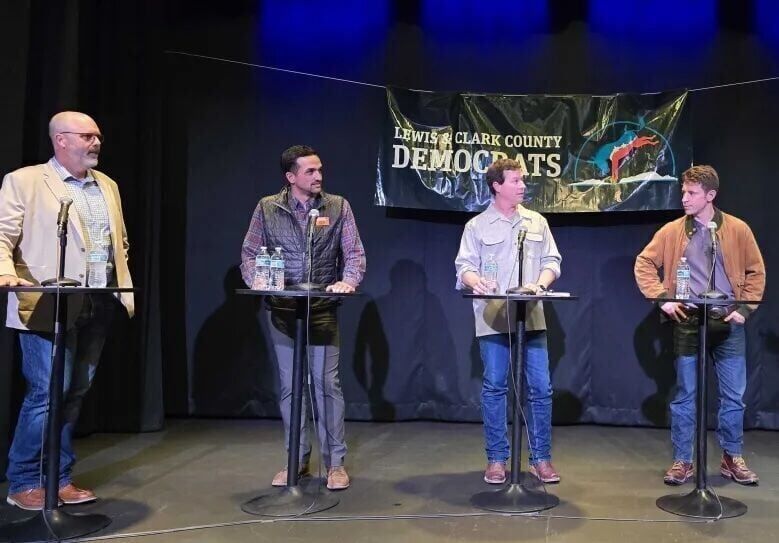
The Montana Democratic Party held three forums for its federal office candidates Sunday, April 12, at the Helena Avenue Theater in the state capital. Retired journalist (and Montana Free Press board member) Mike Dennison moderated the events, which involved Democratic candidates for the state’s two U.S. House districts and one U.S. Senate seat up for election in 2026.
What follows are candidate responses to three questions from each debate.
Eastern Montana House District
Western U.S. House District
Question: “What’s your opinion on outside spending on the Western District primary?” The question was asked after Ryan Busse accused Sam Forstag of soliciting dark money donations.
Sam Forstag: “I’m not accepting a dime of corporate PAC money. I am not accepting a dime of dark money. And I think it is a damn shame that we have Democrats on this stage trying to villainize labor and the AFL-CIO, because I’m proud to have the endorsement of the AFL-CIO, SEIU, home care workers across the state, firefighters unions, my own union of federal employees, that is the kind of coalition we need.”
Matt Rains: “I left my job at Montana Farmers Union to win this thing in November, and that’s going to take a crap-load of money. It’s going to take $5-$6 million, and as much as I love to know that the grassroots movement is there, and split four ways, it’s not going to get us across the finish line.”
Russell Cleveland: “I’m individual contributions only, and I will continue to run a clean campaign that’s for Montanans by Montanans.”
Ryan Busse: “You can’t say you’re for the Montana plan and then put a literal instruction booklet on your website about how to pour dark money into this race. It says for the primary. I just looked at it. This is not a general election thing. This is the instruction for big DC dark money to pour as much money into this race to usurp the work that Russ is doing, or Matt’s doing, or I’m doing. Why are we okay with saying one thing and doing another?”
Question: “Do you support President Trump’s decision to attack Iran or not? What’s the next step to resolve the conflict, and what role should Congress play?”
Matt Rains: “Article One, Section Eight of the Constitution says the right to declare war is reserved for Congress to prevent an autocratic president that just wants to take and use the military like a play toy. They kicked the hornet’s nest, and then are trying to run away, and those hornets are pissed. We are talking about a military of 600,000. There is no easy solution. They are going to keep the pedal to the metal. And if we do pull out, there are terrorist organizations salivating to backfill that government. We have put the Middle East in a very, very dangerous situation.”
Russell Cleveland: “We should not even be in Iran. That’s why we should not allow one man to decide the fate of thousands of Americans and put the economy in this country at risk. We’ve seen a higher increase in the last month in the price of fuel than we have in the last 59 years in this country. That’s Trumpism. And everyone who supports him supports that.”
Ryan Busse: “Congress is supposed to be a coequal branch of government. Right now, it’s a sycophancy for one man. It’s gotten us in a lot of problems, and it’s going to get us in a lot more. We gotta win this seat back in November.”
Sam Forstag: “Too many of the folks representing us do not have skin in the game when it comes to big decisions like whether you’re going to ask people to risk their lives, whether that is risking your life overseas or risking your life at home.”
Question: “Does Congress have a role in bridging the child care affordability gap?”
Russell Cleveland: “We’ve seen a dissolution of our Department of Education over the last year, and my plan includes changing that to a Department of Youth Development, which connects birth to workforce. It shows that childcare does help the economy. Every dollar invested in childcare is a $4 to $9 return in the local economy. Universal pre-K raises those learning outcomes, not just in first, second and third grade, but all the way into junior high and high school.”
Ryan Busse: “We’re spending $33 million a day on this debacle in Venezuela. We’re spending $1.6 billion a day on this thing we’re doing in Iran, we have just approved a budget for $191 billion for ICE. That’s more than all but 14 militaries on the face of the earth. It’s more than the U.S. Marine Corps here at home. And yet we tell young parents trying to make a living, trying to pay the rent, paying for exploding grocery prices, that we can’t help with child care. We’re making the wrong decisions in this country.”
Sam Forstag: “Absolutely we should have universal child care and pre-K in this country. We can afford to do all of that. We can have universal pre-K by expanding programs like Head Start and Best Beginnings. I was one of those kids who had somewhere to go, thanks to Head Start.”
Matt Rains: “We want to get out there. We want to make a living for ourselves. Child care should not be a limiting factor that it doesn’t make sense to go out and work. We need to make sure that our wages make it available to where you can go and make a better life for your family. We need to make sure that federally, we support the state with funding, that they can help minimize the cost and the drain on child care for our individual families.”
U.S. Senate
Question: “We have a huge, growing economic disparity in this country between the haves and have-nots, massive wealth gap? What, if anything, can Congress do about it?”
Alani Bankhead: “Everybody should pay their fair share of taxes, and we should be bringing a lot of that economy down to Main Street. So the simple impetus of this campaign is to bring more resources to Main Street. Because when we do that, when our economy is doing better, everybody does better overall. We all create better results together.”
Michael Hummert: “When we spend more money than we take in as a nation, who does that benefit? It doesn’t benefit anybody in this room. It benefits billionaires, it benefits corporations, it benefits other countries. So by getting a balanced budget, we can greatly restrict how much money is being spent on war and other countries. And I think that’s probably the best defense we have against our billionaires and millionaires.”
Reilly Neill: “We need to raise Montana’s minimum wage to the federal level. And when I’m in D.C., we need to raise the federal minimum wage. We need industry in Montana, but we need to invite industry that’s going to pay workers fairly so that they can keep up with the cost of living and the cost of housing, which right now is the highest in the nation.”
Michael Black Wolf: “Support our unions. We need to ensure that our made-in-Montana gets pushed forward. We need to really step up and really start looking at what we need to do here, raising the minimum wage, balancing budgets, and making sure this common sense is used when it comes to our nation’s dollars.”
Michael Hummert: “I think that it’s a state’s problem, and the state has the solution, and so does the city. Cutting these draconian requirements for building houses could be the first step.”
Question: “As a member of Congress, what can or will you do to attack the [affordable housing] problem?”Democratic U.S. Senate candidate Reilly Neill. Credit: Tom Lutey / MTFP
Reilly Neill: “We need federal infrastructure dollars to go to housing incentives for our veterans, for low-income families, for renters, and we need these incentives to work for people on the ground now. We’re already in a housing crisis. We need to help every Montanan compete in this market, and the Montana Legislature needs to provide some property tax relief for our seniors.”
Michael Black Wolf: “As your senator, I will fight to limit large-scale investor purchases and to support community investment into our own state, our own backyards. And it’s true, it’s a state issue. However, because it’s such a large housing crisis, any help from anywhere, including the federal government, I think would be greatly welcome.”
Alani Bankhead: “Number one, we have this amazing law and capital gains, and currently the limit’s $250,000, if we raise that limit to 500,000 we know that people are going to start selling houses, and that’s going to open up additional inventory, which is going to lower the cost of housing … I’m offering tax breaks to companies that are in construction and other tangential businesses to get tax breaks if 30% or more of their portfolio consists of affordable housing, which I define as $350,000 or below.”
Question: “What would your priority be as a U.S. senator to improve the lives of Montana’s Native Americans?”
Reilly Neill: “I will uphold all treaties with our Native neighbors, and I will respect our sovereign nations in this climate. I will protect the 14th Amendment, which gives our tribal neighbors the right to citizenship and to participate in our democracy.”
Michael Black Wolf: “We cannot forget and overlook the gross underfunding of Indian Health Services, just direct funding to tribes. And we also need to realize and understand that there is a unique trust responsibility between the federal government and tribal nations, and that trust responsibility needs to be honored.”
Alani Bankhead: “I’ve been working with Native American, Native Hawaiian tribes for almost two decades and protecting them from child exploitation and sex trafficking, and I will continue to do that. I know that for many of them, especially as a retired federal agent, or federal agencies, have done a piss poor job of protecting them from the most basic crimes, and I intend to do something about that at the federal level, with the relationships I have with survivors myself.”
Michael Hummert: “So it’s not about the money, it’s about actually some oversight, I think, and that’s what Congress’s job is supposed to be. Is oversight when you spend your money.”



Comments ()