
Discussion on data centers draws crowd to Inspiration Hall
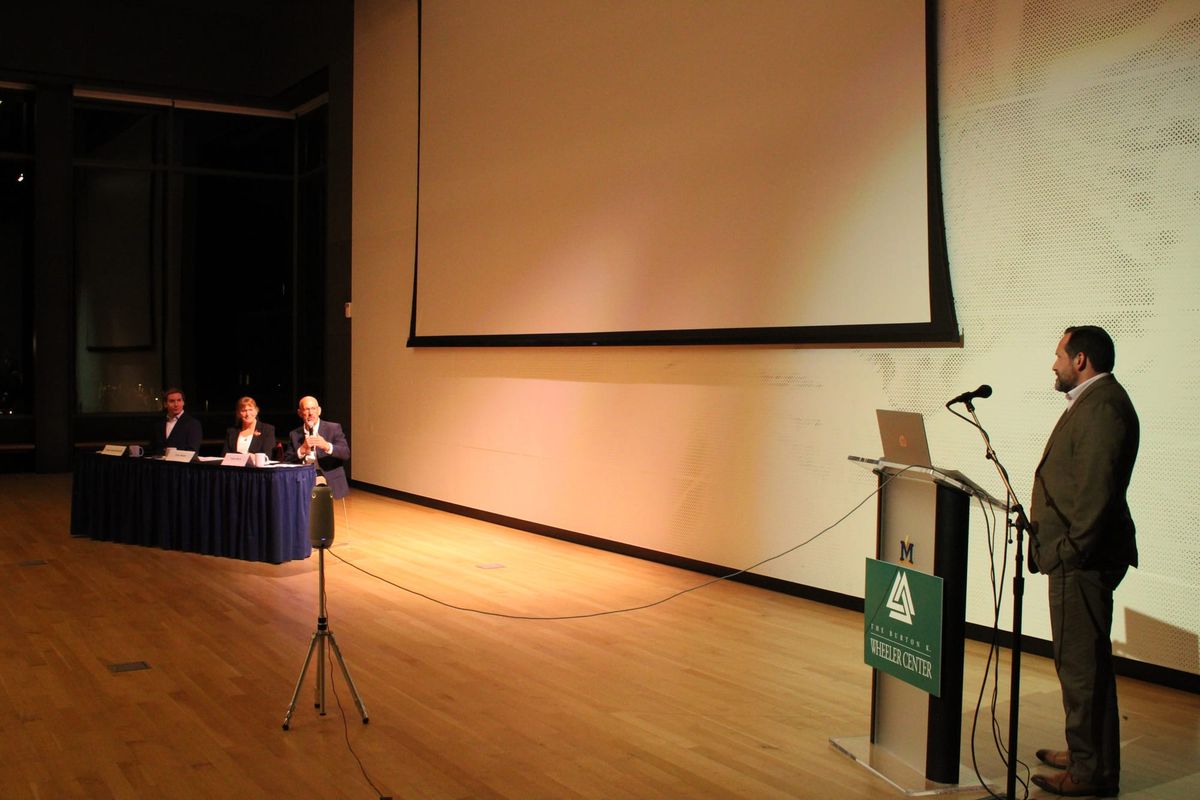
On Oct. 27 The Burton K. Wheeler Center held an event in Inspiration Hall, discussing Montana data centers. The event featured experts in electrical power systems, environmental law and AI and data systems. The moderator, Eric Raile — an MSU professor in the Department of Political Science — supplied questions to the panel to facilitate a civil, informative debate and discussion.
“Data centers are not a new thing. We've been building data centers for about 50 years,” said Coltran Hophan-Nichols, director of Systems and Research Computing at MSU, who oversees computational artificial intelligence and data systems management. “In Gallatin Valley right here, we have a number of data centers that have been here for decades,” he said.
According to Nichols, data centers are critical for everyday activities such as using a credit card, accessing a website or texting. The reason that data centers are a more prevalent concern as of late, is due to the drastic acceleration of large-scale data centers.
“Unlike the smaller data centers that have been around for a long time, these larger data centers have a much greater impact,” Nichols said. One such impact he discussed is the consumption of water and electricity.
“At a national level, data centers today consume about 0.4 percent of the nation's water. That's about one-fourth what the oil and gas industry does by comparison. That's not insignificant, but it's not a massive impact at a national scale,” Nichols said. “However, on the electricity side, data centers today consume almost six percent of the nation's power.”
According to Nichols, construction of a hyper-scale data center is planned for north of Billings and is expected to consume almost as much electricity as the entire state does today.
Robert Morris, Montana Technological University’s Lance Energy Chair, who specializes in electrical systems and infrastructure, pointed to the positive effects of data centers on a community. “Quincy, Washington was a town of 5,000 people 20 years ago, and then data centers came to town,” Morris said. “The town grew from 5,000 people to 8,200. They doubled the number of single-family homes in the town.”
According to Morris, when the new data center came to town, tax revenue went up and the community spent it on new infrastructure. “So they had a new fire station, a new police station, a new EMS station, a new aquatic center, a new town hall, a new high school and a new hospital,” he said.
Anne Hedges, executive director of the Montana Environmental Information Center (MEIC) and expert in environmental policy, had a less optimistic stance on the subject. “If we let data centers come here without setting up the regulatory structure, we will get taken advantage of,” she said.
Hedges pointed to some of the risks of AI. “AI will empower people to do more harm. Even criminals with very limited skills will be able to target victims at every scale,” she said.
Hedges also urged people to research retired Billings pulmonologist Robert Merchant, who said in a public speech to the Yellowstone County Commissioners that air pollution from the proposed Quantica data center would lead to one to three additional deaths per year in the area, according to EPA models.
According to Hedges, in most instances of data center construction, jobs are imported with the construction company. They do not provide local jobs as projections would suggest.
“The thing about this, though, is when they say there's 1,000 jobs in building these things, it's not 1,000 jobs in that town. These guys usually come in with their own group of people who are very good at building these facilities. So they're not usually local,” Hedges said.
After the moderated discussion, the floor was opened to audience questions. In response to a question about data center energy usage regarding climate goals, Hedges said: “It’s a disaster, we cannot go down this path.”
Josh Seckinger, representative for Montana House District 62, attended the event and said he generally agreed with Hedges’s stance. “I'm very cautiously optimistic that we will see strong regulations around data centers here in the state of Montana,” Seckinger said. “I would love for a moratorium to pass or a ban, but it's my understanding that the governor would veto either.”
Peter Strand, representative for Montana House District 63 said, he found the presentation fascinating. “I learned a lot and it actually opened a lot of, I mean, I walked away with a lot of questions and I want to learn more,” he said.
“My thoughts are that the potential to destroy our state is real and we need to be deeply thoughtful and careful about what we do.”
Comments ()