
Gardiner conservation group worried about proposed logging near Yellowstone
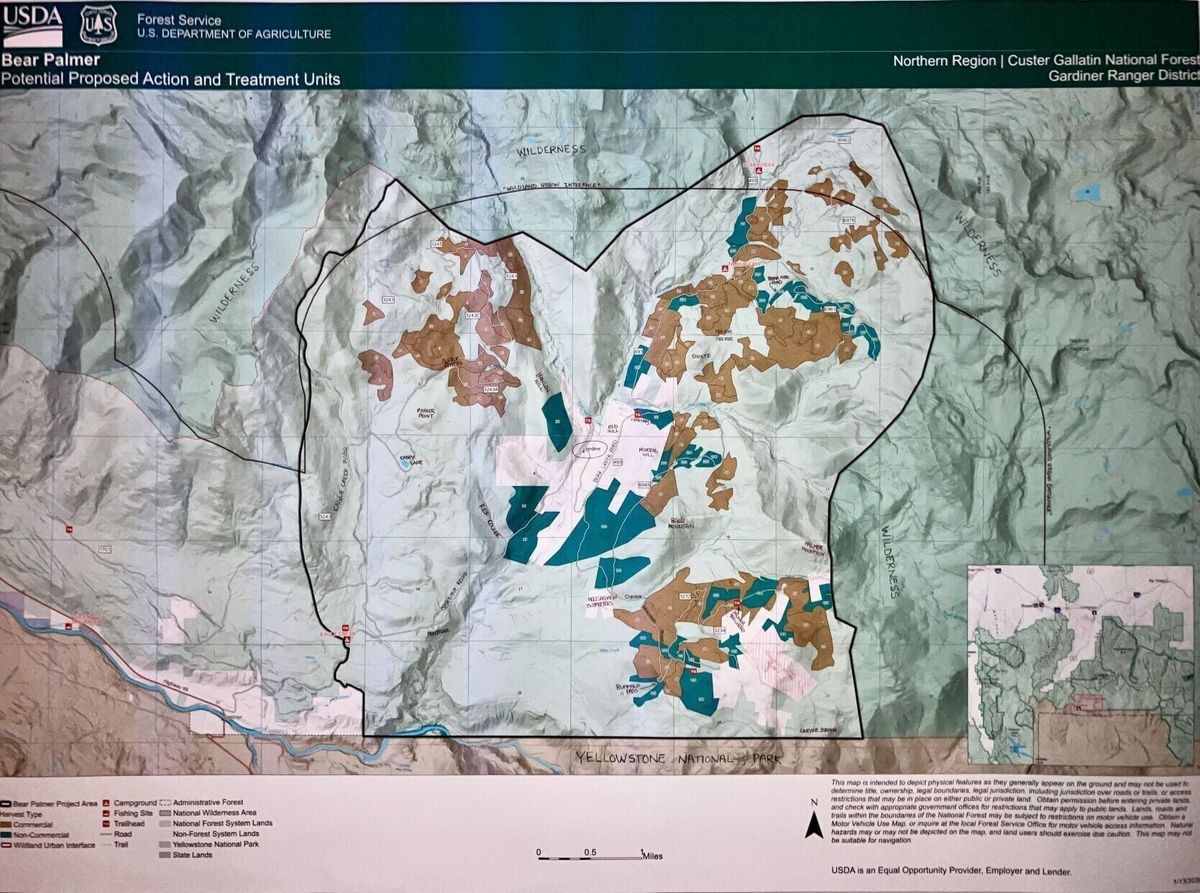
A Gardiner-based conservation group is expressing concern over a U.S. Forest Service proposed treatment area near Yellowstone National Park on the Gardiner District of the Custer Gallatin National Forest.
The proposed 3,000-acre Bear-Palmer project aims to reduce fire risk and “increase resilience to insect and disease infestation, and to reduce hazardous fuels”, according to the Forest Service.
The project is still in its preliminary phases, and the USFS has not released official scoping documents. The Forest Service had not responded to Chronicle requests for comment as of press time Tuesday.
According to a document distributed by the USFS during a January public meeting, proposed treatments include non-commercial forest thinning and commercial logging on dozens of units abutting the Absaroka-Beartooth Wilderness and Yellowstone. Some treatment areas fall less than a mile from the park boundary.
“The message of wildfire risk reduction and healthy forest restoration is a pretty easy sell,” Becky Johnson, the Bear Creek Council chairperson, said. “But it’s misleading; it’s a disguise for industrial-type logging.”
The Bear Creek Council, a Gardiner-based conservation organization, stated in a press release that the project could alter the visual character and wildlife habitat value for decades.
Jardine is an unincorporated village east of Gardiner. From 1866 to 1996, Jardine was intermittently mined for gold and tungsten.
“Every time Jardine gets a breather and starts to heal, it gets hammered, and hammered again,” Johnson said.
In the early 2000s, Bear Creek Council and other conservation organizations fought the Darroch Eagle Sale, which resulted in the removal of 2.9 million board feet from 195 acres in the Jardine area. The Forest Service sale cleared after years of litigation.
“All told, the (Darroch Eagle Sale) was a few hundred acres; this proposal has a footprint of 3,000 acres. From what we’ve been shown, and what’s been presented, we feel safe in saying a lot of it will be commercially logged,” Johnson said.
The Bear Palmer treatment plan is still in the preliminary phases, which is a large part of the reason the Forest Service has not released specific details.
Bear Creek Council is anticipating that the USFS will release the official scoping document in April. Once the document is released, a 30-day public comment period will follow.
While the official Environmental Assessment process has not commenced, Bear Creek Council and the Gardiner Ranger District have each held community meetings about the project.
In November 2025, after months of witnessing Forest Service crews surveying Jardine, the Bear Creek Council held a community meeting. With limited information regarding the project details, Johnson said the meeting was designed to spread awareness that the project would be coming.
Due to the federal government shutdown and a hiring gap between Gardiner district rangers, Johnson said communication with the Forest Service was limited during the latter half of the year.
On Jan. 14, the Forest Service held an official public meeting and presented the preliminary scope and rationale behind the proposal. The presentation chronicled the condition of the forest cover, species compositions, and threats to forest health, including bark beetles, parasitic vegetation, and fuel loading.
To combat the demonstrated threats to the forest health, the presentation suggests regeneration treatments including commercial thinning and group selection.
“I think the project came on the table due to executive orders and directives coming down from Washington,” Johnson said.
In March 2025, President Donald Trump called for the “Immediate expansion of American production”, mandating that the chief of the United States Forest Service “issue new or updated guidance regarding tools to facilitate increased timber production and sound forest management, reduce time to deliver timber, and decrease timber supply uncertainty.”
One month later, U.S. Secretary of Agriculture Brooke Rollins established an “Emergency Situation Determination” on 112,646,000 acres of national forest land to help “expand American timber production by 25%” and "expedite work on the ground and carry out authorized emergency actions to reduce wildfire risk and save American lives and communities".
Johnson said she worries the emergency declaration will lead to an expedited EA process with limited opportunities for public comment.
Once the scoping document is released, members of the public will be able to express their support or opposition to the project. Up to nine months after the public comment closes, USFS will release their final decision and EA either revising, greenlighting, or stalling the project.



Comments ()