
'In a pinch right now': Ex-DNRC director highlights growing pressures on Montana water rights
As water temperatures rise and volumes fall, groundwater rights in the Gallatin Valley are becoming increasingly turbulent.
For some homeowners, this realization came last winter in the form of paper letters, issued by the Department of Natural Resources and Conservation, notifying them that the water rights they believed were guaranteed with their property were obsolete.
“There are dozens of people who have properties that have no legal use of water. They’re caught in no-man’s land, and there needs to be a legislative fix,” Guy Alsentzer, executive director and founder of Upper Missouri Waterkeeper, said.
Nearly 10,000 wells are exempt from routine permitting procedures that draw from the Gallatin Valley aquifer alone, according to DNRC.
This proliferation can be traced to a section of the 1973 Montana Water Use Act, also known as Title 85, that provides exemptions for wells and groundwater from standard water-permit requirements.
John Tubbs, former director of Montana DNRC, calls it the “exempt well loophole.”
Montana Code Annotated § 85-2-306 stipulates that “a permit is not required before appropriating groundwater by means of a well or developed spring” when the appropriation is outside a stream depletion zone, is 35 gallons per minute or less, and does not exceed 10 acre feet per year.
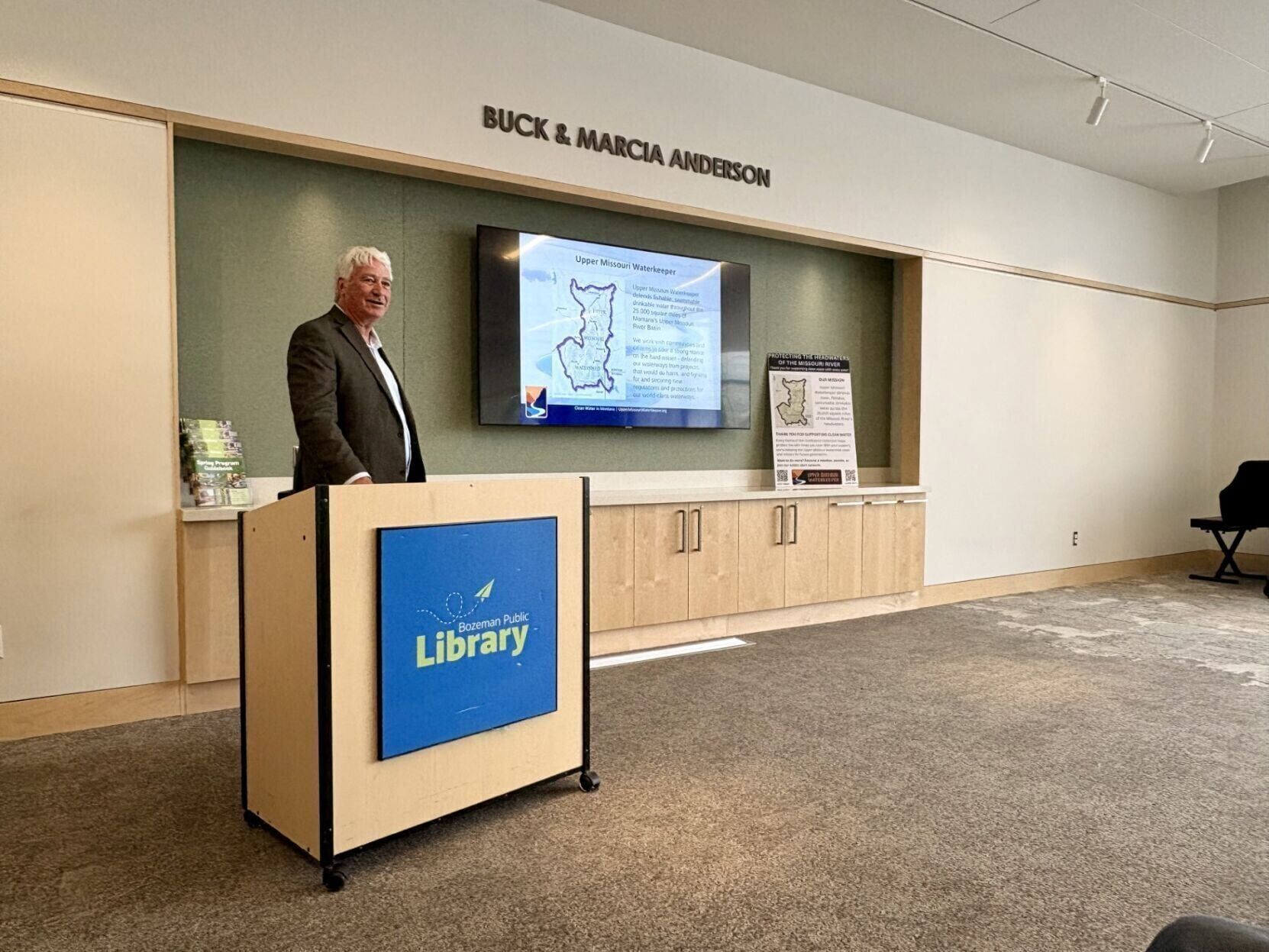
The Montana DNRC is responsible for processing water-use permits in the state. Tubbs, who served as DNRC director from 2013 to 2021, addressed a room of about 30 in the Bozeman Public Library to discuss the history and implications of the Montana Water Use Act and § 85-2-306.
When the exception was written, Tubbs said applications that satisfied the conditions of § 85-2-306 were “considered so small that we didn’t need to put them in the water-rights process.”
While groundwater uses for domestic, agricultural or livestock purposes under 100 gallons per minute are technically exempt from the permit process, Tubbs said most municipal and agricultural operations draw more water than the exemption allows.
“But, if you subdivide your land and put it in residential houses, then you can use that exception,” Tubbs said. “It’s generated tens of thousands of lots in Montana with certified water rights that never went through any public or agency review to determine where that water is coming from.”
If an operation does not qualify for an exemption under § 85-2-306, the Montana Water Use Act establishes a permitting framework that provides the public with notice and an opportunity to comment on the application.
To apply for a water-use permit, the applicant must drill a well, conduct a pump test, and perform a hydrologic analysis to identify the water source.
Once that information is secured, the applicant must notify the public and senior water-rights holders, who have the opportunity to object.
“It’s not only due process for a senior water-rights holder who could be affected, but it’s also a meaningful public comment opportunity, which is a constitutional right in Montana,” Alsentzer said.
Article II, Section 8 of the Montana Constitution requires state agencies and local governments to provide opportunities for public participation in government decisions before the final call is made.
For senior water-rights holders, especially, this opportunity is critical, Alsentzer said.
Under the prior appropriation doctrine of the Water Use Act, senior water rights holders have first claim to water, reserving the ability to stop junior users from accessing water during shortages.
Before to the establishment of the Water Use Act in 1973, there was no formal process for adjudicating water rights.
“All you had to do was prove you owned property, used a certain quantity of water, and file a claim with the county,” Tubbs said.
By 1910, water rights claims to the Gallatin River were 5.6 times the annual flow of the river, according to “Diversions, Ditches, and District Courts: Montana’s Struggle to Allocate Water”, a 2005 article by Brian Shover.
Starting in 1981 with the Milk River, Montana began closing its basins to surface water permitting. This left many seeking water rights permits to either purchase existing rights from senior holders or apply for groundwater permits.
As the demand for groundwater rights increased, controversy surrounding the “exempt well loophole” mounted, resulting in over a decade of litigation between conservation groups and government organizations. Namely, cases focused on DNRC’s definition of the phrase “combined appropriation” to mean only wells physically connected to the same system.
Under this definition, each unit in a subdivision could have an unconnected well, under 10 acre feet and 35 gallons per minute, drawing from the same aquifer. Because individual units in a subdivision were not considered a “combined appropriation”, they were exempt from the permitting process, putting significant strain on the groundwater basin.
In the 2016 Montana Supreme Court case Clark Fork Coalition v. Tubbs, the court affirmed a lower court ruling that invalidated the DNRC’s narrow definition of “combined appropriation.”
The court held that multiple wells drawing from the same source can constitute a single “combined appropriation” even if they are not physically connected, thereby requiring a permit when their total use exceeds statutory limits.
Clark Fork Coalition v. Tubbs tightened the reins on the Montana DNRC’s ability to permit groundwater rights through § 85-2-306 and strengthened protections for senior water rights against exempt well permitting.
“This was the first time in Montana’s history that you actually had a limitation on the use of exempt wells,” Alsentzer said.
Then, the tides shifted again.
In 2019, the Montana DNRC Water Rights Bureau adopted a phased approach for subdivision review, modeled after the Department of Environmental Quality system.
The DNRC’s approach allowed developers to seek approval for groundwater use one subdivision phase at a time, rather than evaluating the total water demand of the entire project upfront.
This meant projects could potentially stay under exempt well limits in each phase, reducing regulatory scrutiny and increasing the risk of cumulative impacts on aquifers and senior water rights.
In 2024, Upper Missouri Waterkeeper et al. v. DNRC, a District Court judge ruled against DNRC’s phased approach. The court held “that DNRC could not allow a developer to appropriate up to 10 acre feet of water under the permit exception for each phase of a four-phased subdivision.”
Rather, all phases were to be assessed as part of the same appropriation, effectively limiting groundwater extraction.
While the tightening of the “exempt well loophole” appears to be a win for conservation groups and a step back for developers, a lot of the burden is passed on to homeowners, Tubbs said.
“Every home in a development can have a septic system and a well, and none of them has had a review,” Tubbs said. “When a developer is building a development, there’s not a single permit. They don’t deal with the permitting — they push it onto the landowner.”
Once someone purchases the home, Tubbs said the property owner is responsible for filing a Form 602, which provides notice of completion of groundwater development to DNRC. The form documents groundwater use and grants rights to the groundwater as stipulated under § 85-2-306.
“The developer never sees it. The contractor never sees it. The well driller never sees it. The homeowner, who has bought the property, paid the well driller, and filed the 602, is responsible — and that’s why some people are in a pinch right now,” Tubbs said.



Comments ()