
‘Leaning into the future’: Changes to the Career Fair reflect broader shifts coming to Career Services
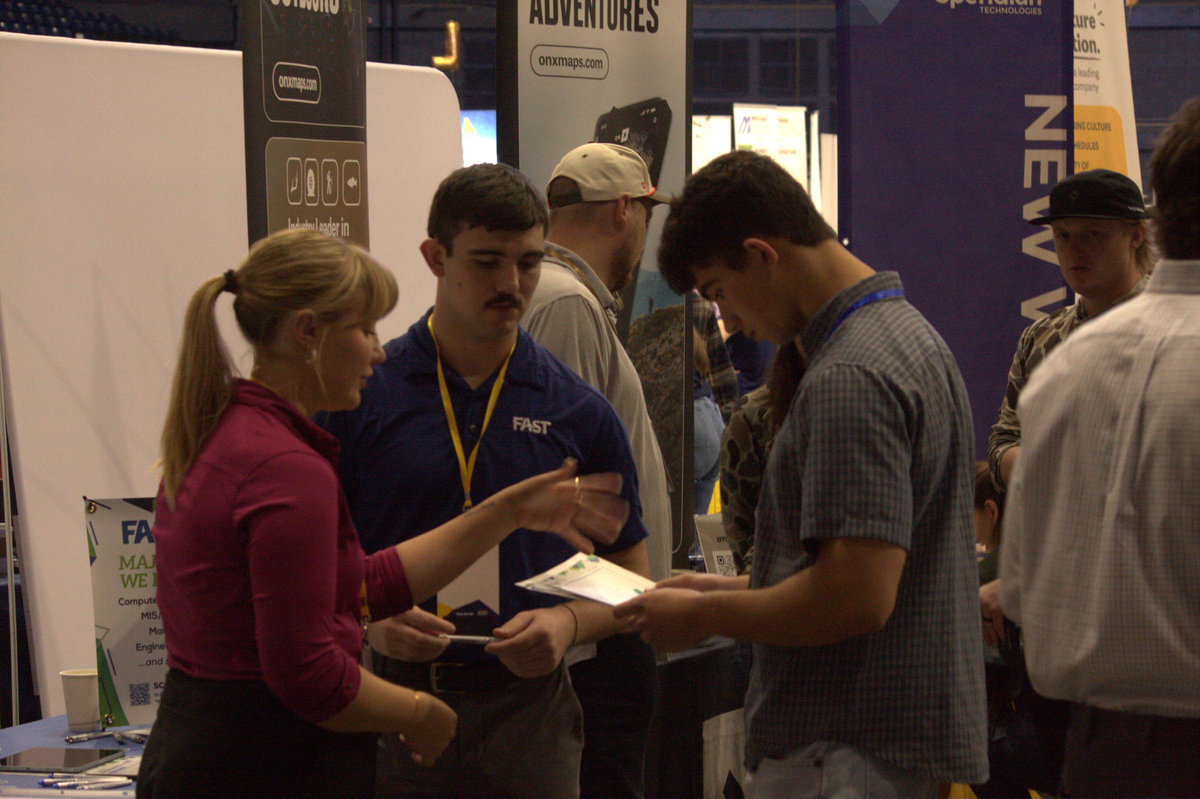
For many students, a career fair is a familiar rite of passage. It features a room full of recruiters and nervous students holding freshly printed resumes, who are about to engage in exciting conversations about future careers. These experiences were still present at the 2026 Fall Career Fair, but featured several changes to its structure and energy. Career Services revamped the event, altering everything from event logistics to employer-student interactions in an effort to increase engagement and accessibility.
Held on Wednesday, Sept. 30 in the Brick Breeden Fieldhouse, the 2026 Fall Career Fair featured over 150 employers and saw over 2,000 students, according to Elizabeth Feary, the director of Career Services.
“We took the fall one-day fair in the Brick Breeden to the next level — and you can do that in the Brick Breeden because of the facility itself,” she said. “It was really exciting what we did this year.”
Feary said the office brought on Riveter Creative, a Bozeman-based marketing and branding agency, to change the structure of the event. This year, employers were organized into industry-specific sections throughout the Fieldhouse, making it easier for students to connect with organizations that matched their interests, according to Feary. Additionally, a central stage conversation hosted live employer panels that were recorded for Career Service’s podcast: Industry Insights.
According to Feary, one of the most successful additions was the introduction of seating areas and lounges in the center of the venue, which was designed to encourage networking between students and employers.
“I really loved how much the students were the ones throughout the day using those couch spaces to take a moment," she said. “You could see they were sort of prepping, they were gathering themselves — sometimes in a huddle with some friends, sometimes just by themselves.
“The fact that the students were taking advantage of the whole space meant that we created a space that was comfortable, where students felt like — we say this a lot — felt safe, but they felt that, ‘Yeah, I can stop here for a minute and it's professional. It's okay.’ That means we have arrived from the perspective of what students are looking for.”
Feary acknowledged that Career Services has heard feedback from students outside of engineering who are unsure whether the Career Fair is relevant to their career goals. Feary said she had heard this perception from students when she first started in her role as director. According to her, part of this stems from engineering firms having strong marketing materials. Further, she said that the College of Engineering places an emphasis on students attending the fair, with many classes creating assignments that are based on attendance.
“It is so important to us that our students see themselves at the fair,” she said.
She pointed to O*Net OnLine as a resource that students can use to explore how their skill could transfer to different fields. According to her, the office aims to further push these tools to students of all majors as a way for them to visualize careers that align with their majors and skills, but in fields that they may not have previously thought they could be in.
“What does that look like for a student? They can start seeing themselves in a different way,” Feary said. “[An English major] could apply to an engineering company that has writing they need to do. They need someone who can write between technical and lay person, and then they will use that writing in their marketing and promotions — it’s not always a marketing person that will do that.
“That is a lucrative business. AI is a tool but I’m not sure that [it is] replacing those jobs because of its accuracy and that's a problem. That's where the human comes back in,” she said.
Feary said the changes at the career fair reflect a broader shift in the office.
“MSU has a 70-year history of career services, and so it has gone through many iterations,” she said. “What we're doing now is really leaning into the future. We had a wonderful, strong foundation, a great benchmark from which to spring forward into the future.”
Feary said the office has focused on making career coaching tools more accessible and easier for students to utilize. Some of its new programs, including the Career Readiness Journey in NavMSU, among others, are expected to pilot in the spring.
“Students today are different from the students who graduated even four years ago,” she said. “And that's not a negative, that's not a plus — it's neutral. It's just students taking and absorbing information differently. We are trying to meet students where they're at — to give them tools that are accessible regardless of where they're at in their own process. How do we help them to best express themselves and present themselves and to be ready for those pivotal moments at the career fair?”
Comments ()