
Making an impression: Absarokee blacksmith leaves his mark on the Museum of the Beartooths
COLUMBUS — Penny Redli had a moment in the newly remodeled Museum of the Beartooths Collections Room that she didn’t quite expect.
“This whole thing has kind of got me emotional,” the museum director admitted. “It’s definitely a dream come true. I work in a small museum and never thought we’d have something like this — never in a million years.”
The room that moved her to tears is the result of a high-density shelving project — the last major renovation needed in the museum’s facility and years in the making.
When the community gathers for the Open House and ribbon cutting on Monday, May 4, they’ll see what that investment looks like: A customized shelving system that increases storage capacity by more than 80 percent, with configurations tailored to artifacts of every size and type — hanging storage for textiles, trays, space for artwork, and archival boxes for fragile and small items funded through a separate Columbus Community Foundation grant.
Before the project, the museum’s collections sat on volunteer-built open shelving that didn’t use space efficiently. Shelves were too tall, layouts were inflexible, and the museum was running out of room.
“The collections storage area is the last major space in the museum that needs significant improvement,” said Redli, who also serves as executive director of the Stillwater Historical Society. “This project ensures that the artifacts entrusted to us are preserved properly and remain accessible to staff, researchers and the public for generations to come.”
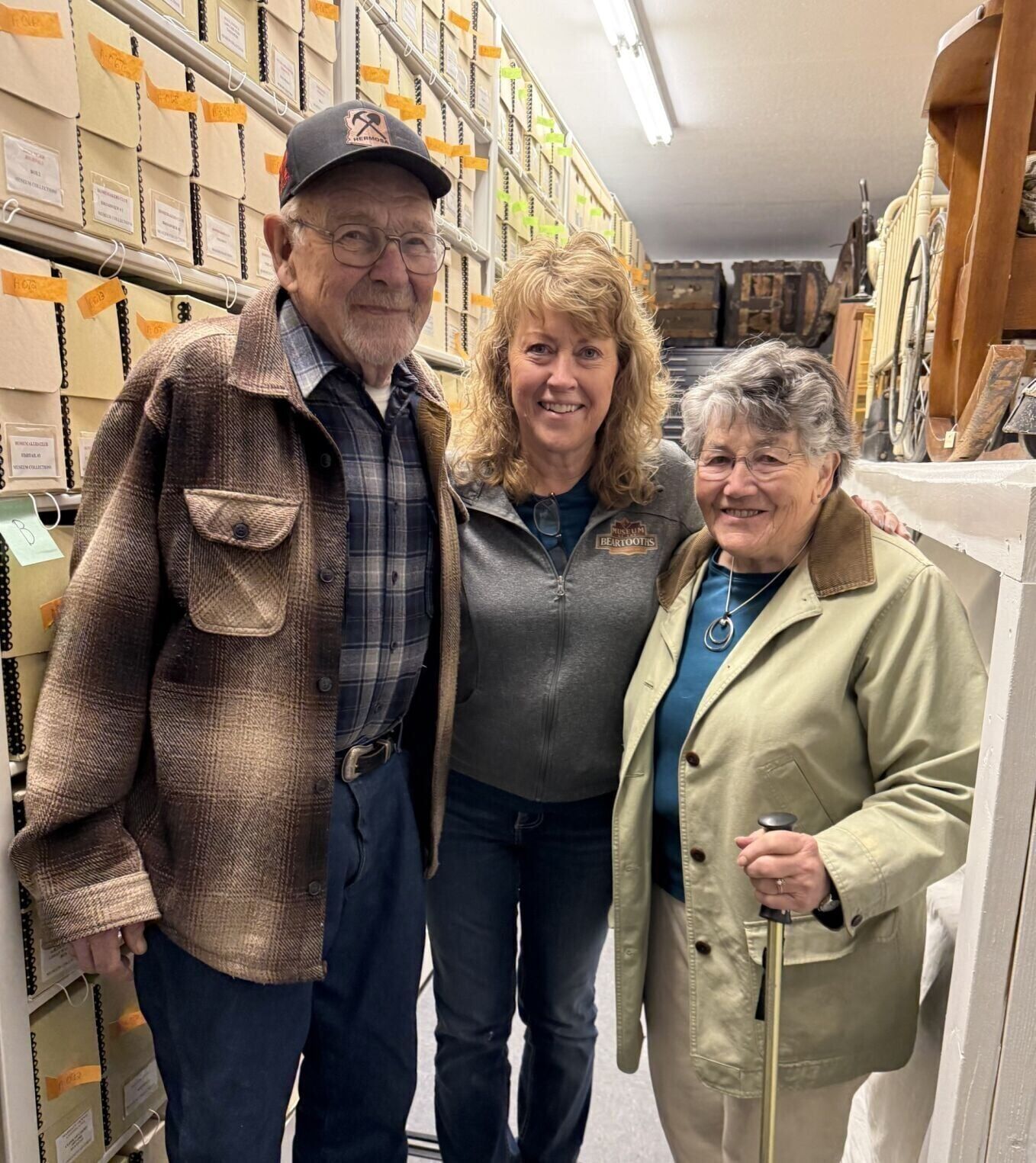
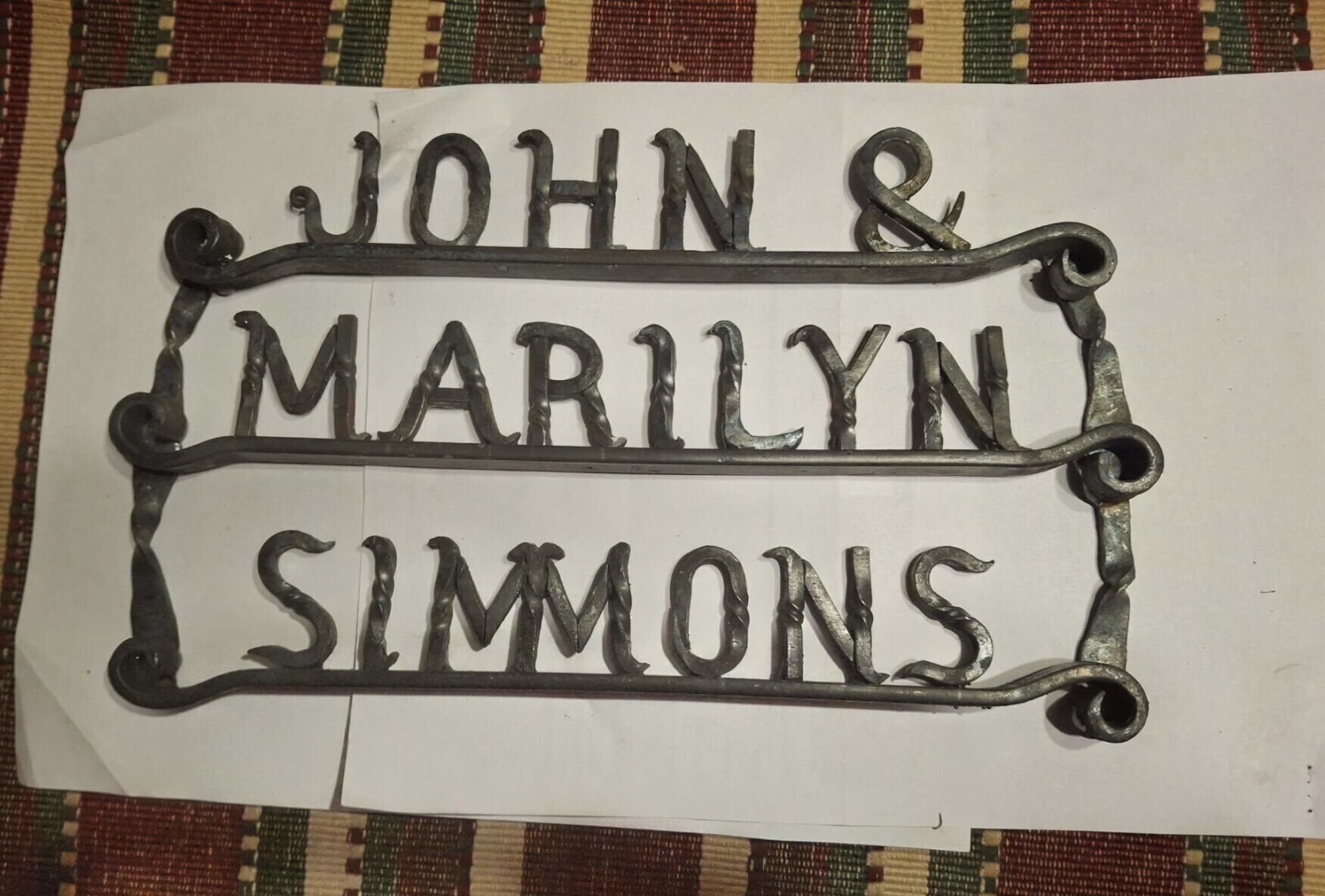
Among the project’s lead donors are John and Marilyn Simmons of Absarokee, who contributed $65,000 — and got an early look at the finished room on April 27, walking the aisles they helped build. They also donated one more thing: a hand-forged iron sign made by John himself, bearing the names of the project’s three major donors — the Simmons family, the Susan Scott Heyneman Foundation, and A.J. “Jim” Movius — that will hang in the room permanently.
“That sign is going to be here forever,” Redli said.
John Simmons has been making things that last for a long time.
He arrived in Absarokee in the early 1970s, a young welder and blacksmith who had grown up following his father through logging camps and highway construction jobs across the American West. His father was a gifted mechanic and an independent logger at heart who didn’t always find steady work — but he was unfailingly generous.When venison was scarce, the elder Simmons made sure the neighbors had meat. When the company bought two barrels of antifreeze, he talked them into giving one barrel’s worth to the hired help.
“Those things — that was the giving side,” John recalled. “We were really poor. But that kind of stuck with me.”
John was 29 when he planted roots in Stillwater County. He founded J.P. Simmons Iron Works — “The Absarokee Blacksmith,” as the letterhead read — and got to work. He built 101 land rollers that went out to ranches across Montana, fabricated steel sets and ladders for the mines, and eventually became one of the key suppliers to what would become the Stillwater Mine.
His most notable contribution to the mine came almost by accident. Engineers needed a bolt that could anchor work platforms to mine walls during ceiling drilling — a high-stakes operation 150 feet underground. The bolts being used kept failing. They brought the problem to John.
“You’ve got to make a bolt that doesn’t fall apart,” he was told. He designed one with a unique attachment ring — a safety feature that deformed slowly under extreme load rather than breaking suddenly, giving miners a visible warning before failure. Montana State University and Montana College of Mineral Science and Technology both tested it. It held up to 14,000 pounds of static stress before yielding, and could withstand thousands more before final failure.
He got a patent on it. Over the years, J.P. Simmons Iron Works produced more than 125,000 of the patented I-Bolts, and more than 200,000 J-Bolts alongside them. Marilyn worked the $22,000 bending machine herself.
“I bet I bent 10,000 of those bolts on that machine,” she said.
During a recent walk-through of the collection, Redli pointed out a set of eyebolts inside the new Collections room — bolts John had made for the mine decades ago.
“There you are,” she told him.
The Simmonses have been giving to Stillwater County almost as long as they’ve lived here. John served on the school board for nearly eight years. He and Marilyn were involved with the Back Country Horsemen for 25 years, doing much of the trail work that reopened routes from Woodbine to Cooke City. He ran the BBQ at the Little Britches Rodeo for 16 years. Marilyn served as Chamber president and was active in 4-H from nearly the day they arrived.
John’s generosity has also taken artistic form. He has long donated artwork to the Quick Draw at Absarokee High School, and has contributed pieces to benefit fundraisers at Stillwater Billings Clinic. His work is also on permanent display in the clinic’s lobby, part of a collection honoring Drs. Kane and Klee.
{h3 style=”text-align: left {&&}”}Money from Stock Market{/h3}
When it came to the museum, John’s reasoning was straightforward.
“Why wait til I die to start giving?” he said. “We wanted to do something with education and the museum.”
The contribution came from the stock market — John began investing at 42, after building the shop, and has been buying and selling for more than four decades. He credits patience, and the steady work the mine and local ranchers provided through the lean years, for making it possible.
“Money came from the stock market,” he said. “But it did come from a start.”
That start was a lifetime of work with his hands, a father who gave away venison and antifreeze, and a community that gave back.
The Museum of the Beartooths Open House and ribbon cutting takes place May 4, from 4 to 6 p.m., with the ceremony at 4:30. The event also kicks off Columbus MTGives Week, the museum’s key annual fundraising campaign running May 4 through May 10 in partnership with the Columbus Community Foundation.
Additional project support came from the Susan Scott Heyneman Foundation and A.J. “Jim” Movius. The museum is located at 440 East 5th Avenue North in Columbus.



Comments ()