
Montana 4 Palestine interrogates resistance and the meaning of peace
Imagine a foreign country bombs your child’s school. Its justification? The building was being used as a human shield by an armed militia. Afterward, you’re asked to sit down and engage in dialogue with those responsible. What would a resolution look like under those circumstances?
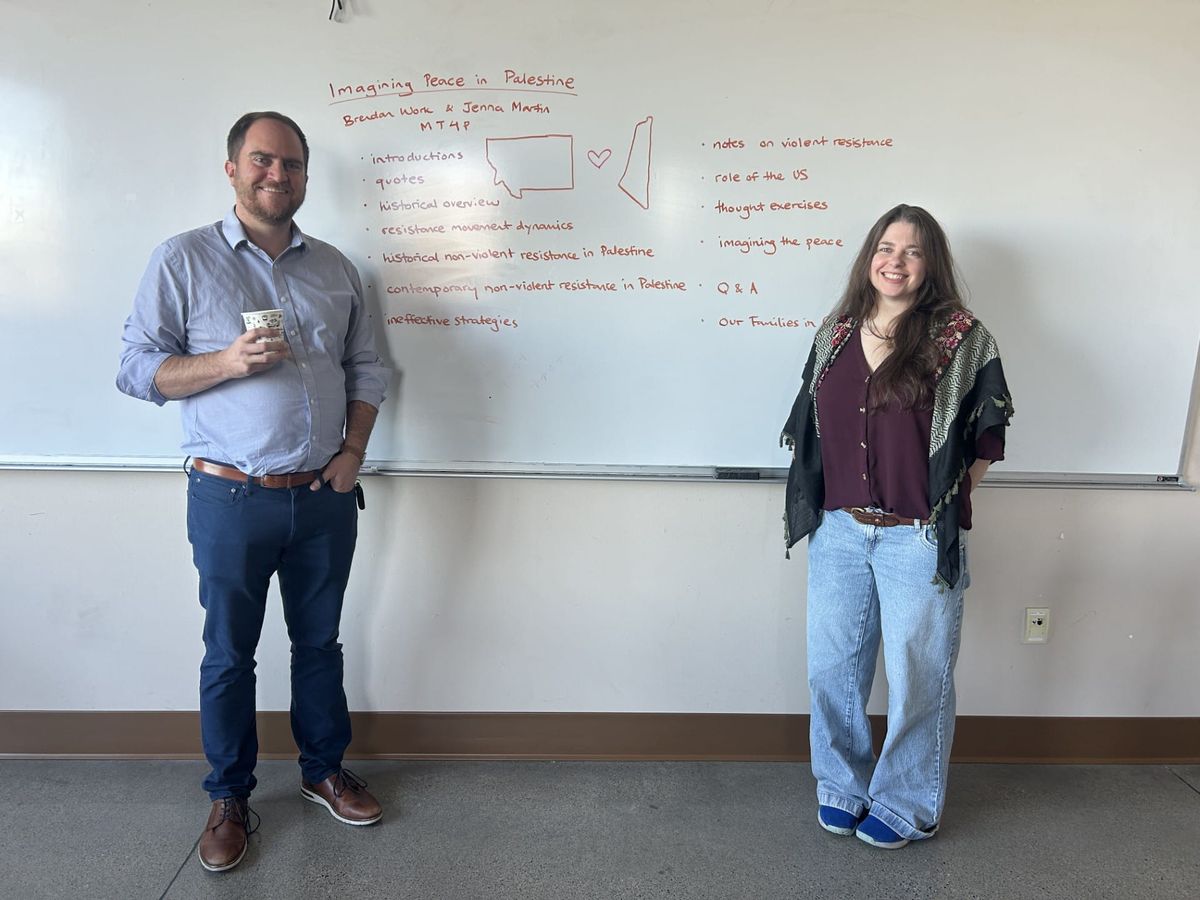
That was one of the hypothetical scenarios presented during Montana 4 Palestine’s (MT4P) “Imagining Peace in Palestine” event on Saturday, Nov. 14, at the Bozeman Fire Department Community Room.
The event was led by Brendan Work, an Arabic teacher and MT4P co-founder, and Jenna Martin, a journalist and filmmaker who currently splits her time between Montana and the West Bank.
Work was introduced to advocacy through his Palestinian, Arabic teacher. To him, language builds understanding across cultures.
“Learning a language is the most humanizing journey you can take. It is a way to fundamentally rewire your brain, but also to undermine existing prejudices and biases about the world that you grew up with,” he said. “Learning Arabic is, for me and for my students, a radicalizing and deepening journey. I'm still on it.”
Martin, an MSU Billings alum, discovered Work and MT4P through a Palestinian advocacy event. Her initial involvement in Palestine grew out of her coverage of Indigenous activism. She first encountered Palestinian resistance through the Standing Rock movement, when a Palestinian delegation visited the encampment.
“You can’t really learn about resistance and not eventually end up in Palestine,” Martin said.
Work and Martin opened their presentation with a Martin Luther King Jr. quote that captured its central theme: “True peace is not merely the absence of tension; it is the presence of justice.”
The presentation began by examining different forms of Palestinian resistance. Martin and Work challenged the distinction between peaceful protest and more disruptive forms of resistance, suggesting that different approaches can work alongside one another.
“We wanted to interrogate what peace meant. We wanted to examine the interplay of non-violence and armed resistance,” Work said, arguing that meaningful change does not solely come from peaceful demonstrations.
Through hypothetical scenarios, the presenters asked attendees to reconsider more conventional understandings of violence, resistance and peace. Work described the exercise as a way to speak out against what he called the “cynical use of dialogue,” questioning the expectation that people who have experienced violence or oppression should be expected to engage in dialogue with those responsible.
“We wanted our audience to think critically about the ways that they can envision peace and justice in their lives, and what sacrifices they would be willing to make to their reputation, to their sense of self, to engage in disruption,” Work said
The presentation also discussed forms of resistance they’ve found successful, referencing Montana’s role in challenging state-level economic ties with Israel as an example of what grassroots organizing can accomplish.
MT4P’s organizing efforts are connected to the broader Boycott, Divestment and Sanctions (BDS) movement — a Palestinian-led campaign launched in 2005 that advocates for economic and political pressure on Israel.
Montana lawmakers have introduced legislation in 2017, 2019, 2021 and 2023 that would restrict state contracts and investments involving companies participating in boycotts of Israel. None became law, leaving Montana one of the few states without a statute targeting anti-Israel boycotting currently in effect, according to Martin and Work.
“Montana is the only state that we know of — and that the national BDS campaign knows of too — to defeat investment in Israel at the state level,” Work said.
Martin attributed this to Montana’s smaller population and individualist political culture.
“Montana's not being told what to do at all. So when you tell us that we are not allowed to boycott someone or you're telling people how they want to spend their money or how our pensions are, Montanans do not respond well to that,” Martin said. “The idea that the government could tell us what we could and couldn't spend our money on is vastly unpopular here.”
When asked if they had any advice for those interested in getting involved, Martin emphasized that activism comes in a variety of forms.
“You can get involved one way and then you can change and adapt and grow and change with your skill sets,” Martin said. “I just want people to come to the movement with an optimism that this has been going on for a long time and there are a lot of people working on it.”
Work referenced campus organizing groups as an accessible way for students to get involved.
“The Students Against Genocide, the Students for Democratic Society and the MT4P chapters in Bozeman have concrete and very important ways to dismantle the architecture of genocide in Montana and on Montana State University campus,” Work said. “People interested in Palestine solidarity can start at home and there's a lot for them to do.”

Comments ()